Bitcoin continues to gain traction as a payment method. A study by Springer identifies more than 11,000 merchants accepting BTC worldwide, with strong community momentum in certain regions. The analysis is based on data from BTC Map, a collaborative map of merchant acceptance.
Slowly but surely: Bitcoin continues to gain traction as a payment method
A recent study conducted by Springer, one of the world’s largest scientific publishers specializing in science, technology, and medicine, recently revealed that Bitcoin’s adoption as a payment method continued to grow in 2025, regardless of BTC price movements.
The study relies primarily on data from BTC Map, a collaborative map listing brick-and-mortar businesses that accept Bitcoin. Researchers identified over 11,000 businesses worldwide.
However, the Lightning Network, a layer-2 solution enabling fast and low-cost BTC transactions, provides no information on the nature of purchases or their location. BTC Map thus becomes an essential tool for understanding the geography of Bitcoin adoption as a payment method.
Thus, only the number of merchants accepting Bitcoin can truly serve as an indicator of this adoption, acting as a market signal. If no one were willing to accept Bitcoin, then the number of these merchants would not be growing at such a rate.
One might think that these merchants could simply register and never actually accept Bitcoin. In fact, many businesses stop accepting these payments when they see low adoption, but BTC Map updates this data regularly; 64% of the listed establishments have been verified over the past 12 months.
Restaurants, bars, cafes, and supermarkets are the most common types of businesses accepting Bitcoin.
Places where Bitcoin is most widely adopted
The geographic distribution of businesses accepting Bitcoin remains highly uneven: Europe, North America, and Central America account for the majority of acceptance points.
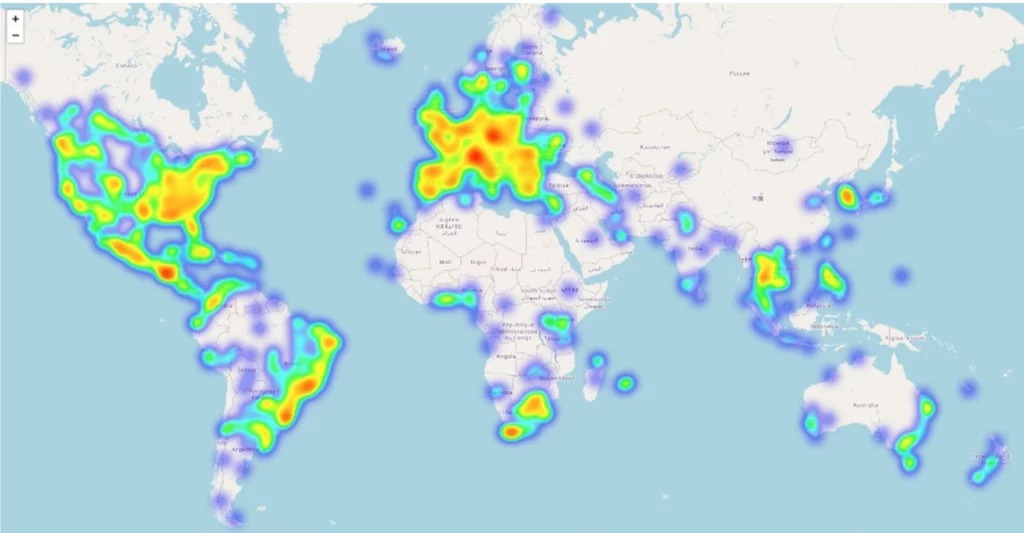
Heat map of businesses accepting Bitcoin
Two cities stand out in particular: Prague, in the Czech Republic, and San Salvador, in El Salvador.
In Prague, approximately 6% of restaurants and 2% of cafes accept BTC. The city is also a hub for the Bitcoin ecosystem in Europe, as it hosts the annual BTC Prague conference and is home to the headquarters of Trezor, a pioneer in hardware wallets.
In contrast, in El Salvador’s San Salvador, over 70% of businesses accept Bitcoin—a trend driven not by national legislation but by community dynamics.
During our reporting in El Salvador, we met Gerardo and Evelyn, founders of the Bitcoin Berlín association. Inspired by the success of Bitcoin Beach in El Zonte, they wanted to replicate the experience in their own city. Today, Berlín has become the city with the highest density of Bitcoin-accepting businesses in the world.