
The cryptocurrency market is crashing, driven by a wave of liquidations of rare intensity. In 24 hours, more than $2.7 billion has been liquidated, while Bitcoin has fallen to $60,000 and Ethereum to $1,750. Investors fear the freefall will continue.
The crypto market is bleeding and has lost $340 billion in market capitalization in 24 hours
The cryptocurrency market has just experienced one of its worst days, with Bitcoin down 13% over 24 hours, falling from $73,200 to $62,200.
The BTC correction is all the more striking when viewed in perspective: digital gold has lost 38% of its value in about twenty days and is now down 51% from its last all-time high of over $126,000, reached in October.
The same scenario is playing out for Ethereum. The price of ETH has fallen 15% over the past day and 64% since its August high of $4,955. It is now trading around $1,750.
Overall, the entire cryptocurrency market has lost more than $340 billion in market capitalization in just 24 hours.
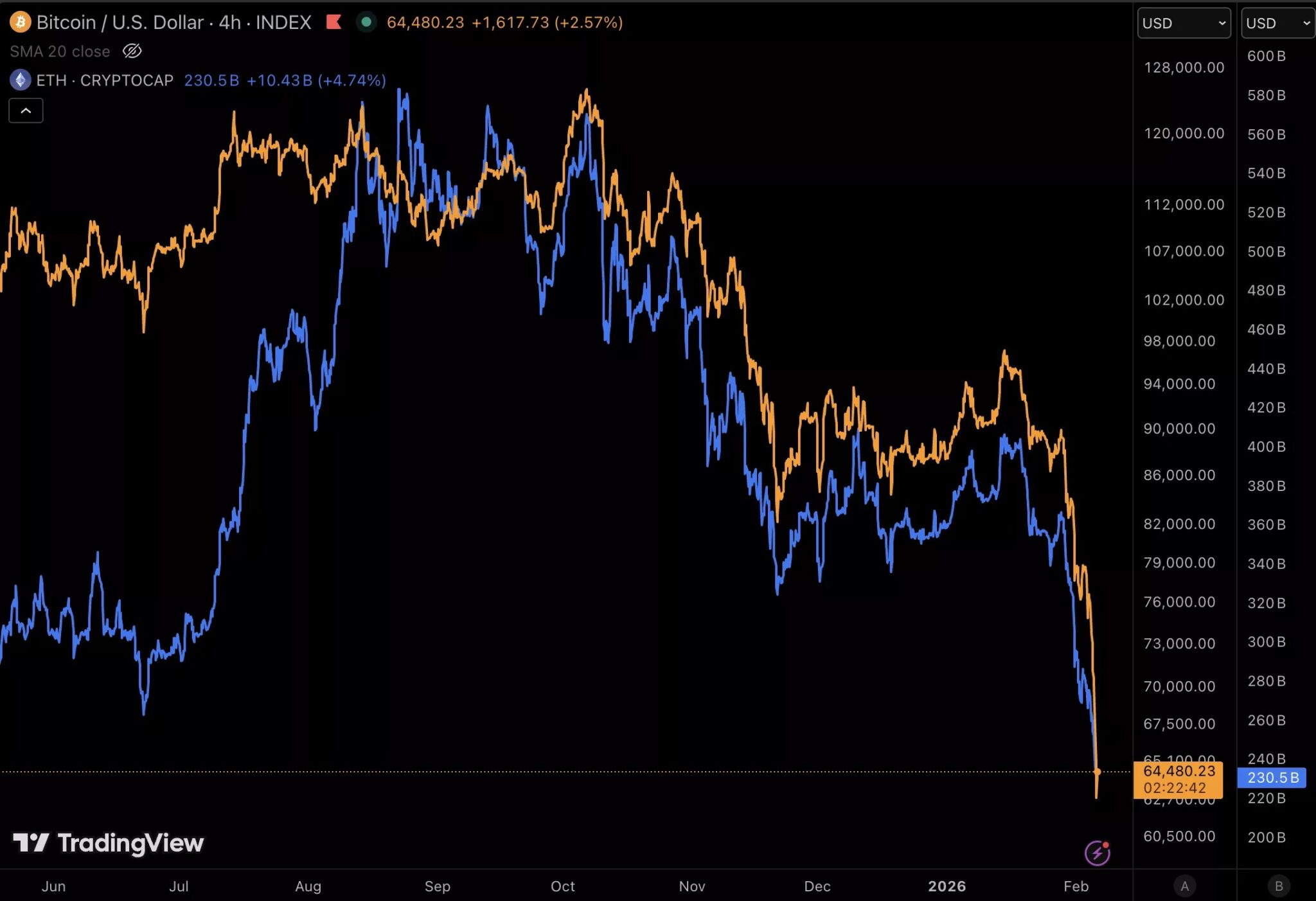
Bitcoin and Ether Prices
The crypto crash has been accompanied by massive liquidations in leveraged markets, with $2.7 billion in positions forced to sell within 24 hours, according to data from Coinglass.
This violent movement thus resembles a veritable “stop-hunt,” which swept away positions opened amid the euphoria of recent highs.
Already fragile, market sentiment has also continued its descent into the “extreme fear” zone, with the Crypto Fear & Greed Index at 9/100, its lowest level since the 2022 bear market.
How much further can cryptos fall?
The question everyone is now asking: is the worst over, or is there still more blood to be shed?
From a purely technical perspective, the market remains under pressure, with critical support levels under threat. For BTC, the $58,000 range appears to be an important level to defend. If it breaks, a return to $48,000 cannot be ruled out.
Ethereum, meanwhile, could slide toward $1,500, the range where the price hit its low during the previous bear market.
But what is most concerning is the speed of the decline and the lack of positive fundamentals for Bitcoin. Investors seem to be fleeing both risky and non-risky assets—as evidenced by gold, which has lost 15% from its peak—liquidations continue, and macroeconomic uncertainty remains as heavy as ever.
Paradoxically, it is also during these periods of capitulation that long-term buying opportunities emerge. The history of crypto cycles shows that phases of extreme fear often precede the most powerful rebounds.
Thus, even if a new bearish leg is possible, the market is entering price zones that are historically attractive for patient investors.