
In recent days, the price of Bitcoin has plummeted below $75,000, dragging the entire crypto market down with it. But does that mean we should avoid cryptocurrencies? Or, on the contrary, is it precisely during these moments of uncertainty that it might be wise to invest in Bitcoin, especially if you’re taking a long-term view?
A New Correction Phase for Cryptos
After several months of Bitcoin trading in a range around $90,000, the cryptocurrency market is currently experiencing a marked correction phase. Indeed, as of early February 2026, the price of Bitcoin is just above the $75,000 threshold.
As a result, over the past 7 days, Bitcoin’s price has fallen by nearly 12.6%, triggering even steeper declines in other cryptocurrencies over the same period
- Ethereum (ETH): -22.6%;
- BNB: -13.2%;
- XRP: -15.1%;
- Solana (SOL): -17%;
- Cardano (ADA): -17.4%.
In this climate of uncertainty, many are giving in to panic and selling their crypto. And yet, it is often in these moments of doubt that the most interesting opportunities arise.
Investing when everyone else is selling: an opportunity?
As the famous quote by investor Warren Buffett reminds us: “Be fearful when others are greedy. Be greedy when others are fearful.” This means that periods of significant decline, such as the one at the end of February 2026, should not be seen as times to flee, but as strategic periods to enter the market or strengthen one’s positions—provided, of course, that one has a clear strategy and a long-term vision.
For this is a common mistake: many buy Bitcoin when its price is soaring, lured by stories of quick profits spread by the media and influencers.
But at that point, most of the rally is often already behind us. Conversely, few investors dare to buy during phases when Bitcoin’s price is falling sharply, even though these moments often offer the best entry points.
To better understand Bitcoin’s current movements, it is essential to view this decline within a broader context: that of market cycles. Like all financial assets, Bitcoin evolves in successive phases that repeat over time.
Here are the main theoretical stages of a Bitcoin cycle:
- S1 – Accumulation: the market is calm, prices are low. A few investors begin buying BTC in anticipation of a recovery
- S2 – Uptrend: the trend turns bullish, enthusiasm gradually rises, and the price of Bitcoin climbs
- S3 – Overheating: Euphoria dominates, Bitcoin skyrockets, and many buy… at the peak
- S4 – Correction / Consolidation: The market reverses, some investors take profits. This is often when opportunities reappear for those with a long-term vision
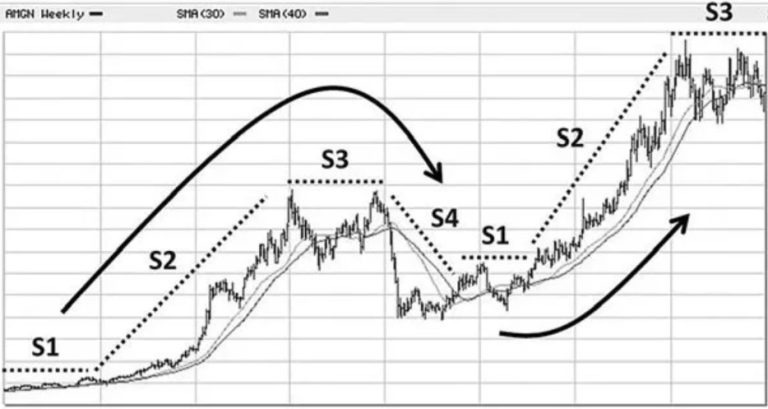
Graph theoretically representing the life cycle of a financial asset
Currently, Bitcoin appears to be in the midst of a correction phase. The price decline observed in recent days, while significant, is therefore not unusual. It follows a recurring pattern, where temporary dips in BTC can offer attractive opportunities to those who maintain a long-term perspective.
The decline may continue…
While this article highlights the potential of correction phases, that doesn’t mean you should invest in Bitcoin without careful consideration. The cryptocurrency market remains inherently volatile, and no one can guarantee Bitcoin’s future performance. This is not a signal to “buy now,” but rather a call to observe the market with a step back.
That said, for those who wish to take advantage of this pullback phase in a methodical way, a few principles may prove useful:
- Place orders at strategic levels: during periods of high volatility, flash crashes can briefly cause crypto prices to plummet following a cascade of liquidations. Orders placed in advance, well below current prices, can thus trigger automatically if the opportunity arises
- Focus on fundamentals: during a correction, it’s better to prioritize Bitcoin, which is more robust, rather than altcoins, which can be more fragile. Unless you have strong conviction in a crypto you believe is undervalued, caution remains the order of the day
- Think long-term and focus on sustainable narratives: beyond short-term volatility, try to identify the major trends likely to drive the market in the coming years and their flagship cryptos (AI, DeFi, RWA, etc.)
There’s no rush: the key is to build a coherent strategy tailored to your investor profile and goals, without giving in to panic or euphoria. The crypto market isn’t dead and will likely rebound—the only question is where you’ll stand when it does.