
Which projects generated the most revenue in 2025 within the cryptocurrency ecosystem? A look at the year’s top earners in key categories.
Which crypto players generated the most revenue in 2025?
All in all, 2025 was a mixed year in the cryptocurrency ecosystem. Indeed, we witnessed several all-time highs for Bitcoin (BTC), the rise of institutional adoption, the surge of stablecoins, but also the failure of most altcoins.
In a context where some players stood out and others did not, Sealaunch Intelligence analyzed the on-chain revenue of various protocols to identify leaders by category.
For example, Tether leads the stablecoin issuer category with $7 billion in revenue, while Hyperliquid (HYPE) stands out in the perpetuals market with $811 million, and Pump.fun tops the launchpad category with $634 million in revenue:
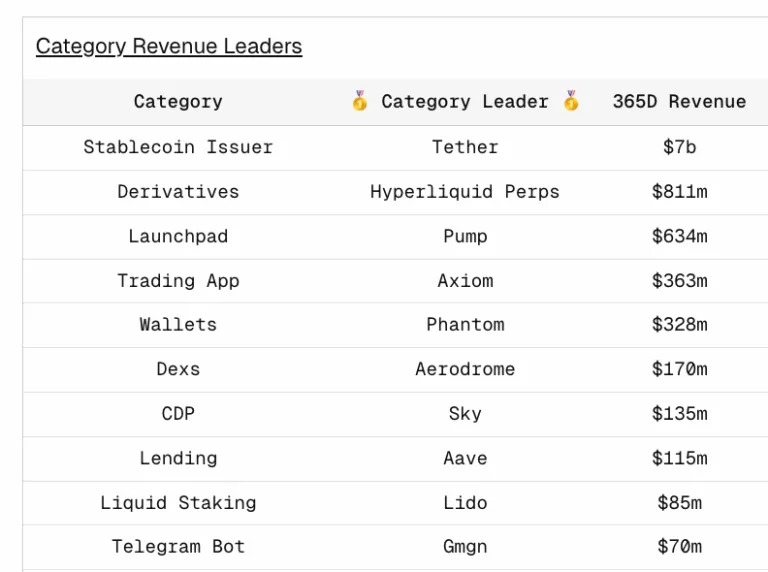
2025 revenue of leaders in each category
However, some caution is warranted when interpreting these figures. This is because on-chain data analysis, by definition, relies solely on data sources available on the blockchain. For example, it is possible to estimate the revenue of a decentralized exchange (DEX) by correlating its trading volumes with the fees collected; whereas for a collateralized stablecoin issuer, this same estimate can be made once the quantity of bonds held is known, by multiplying that amount by the yield over the period in question.
Depending on the subject under study, the results may therefore be more or less accurate, not to mention the fact that a company may also generate revenue that cannot be estimated via on-chain analysis. For example, in the first three quarters of 2025 alone, the Tether group already reported $10 billion in cumulative net profit (not revenue).
Nevertheless, this empirical analysis does allow us to identify the leaders in each category to form a general picture. In this context, Tether is estimated to generate three times more revenue than its competitor Circle, while in the lending sector, Aave is estimated to have generated more revenue than all its competitors combined:
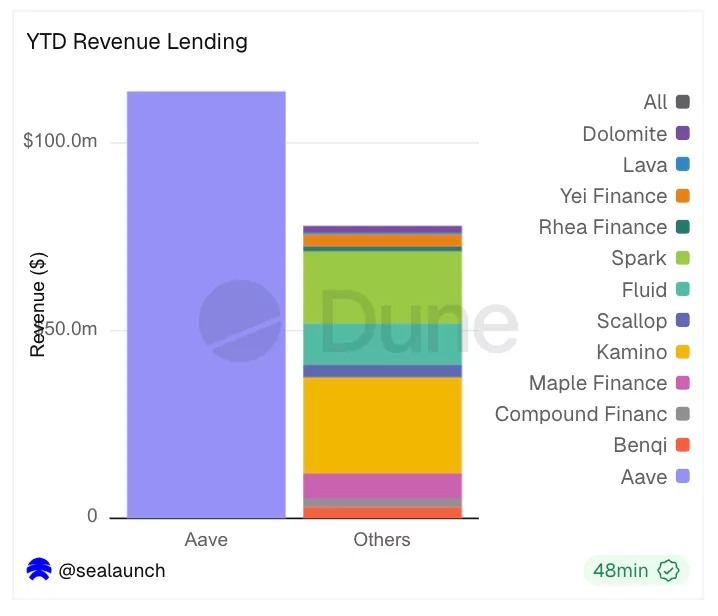
Revenue generated by lending protocols in 2025
Furthermore, a similar observation can be made regarding wallets, as Phantom reportedly generated approximately $320 million in revenue, while its competitors collectively earned $160 million.
Regardless of the accuracy of these figures, we can conclude that, to stand out in the blockchain ecosystem, it is advisable to at least partially decouple revenue from on-chain volumes—as Tether has done with its Treasury bonds—or to expand the range of services offered by one’s application to generate maximum activity, as Phantom has done with wallets.
If we are indeed in a bear market, we will be able to assess its impact on the various protocols in the ecosystem, as a decline in volumes could accompany the drop in prices.