Now that the Fed has ended its quantitative tightening program at the beginning of the month, will we see a return to quantitative easing? Let’s take a closer look.
After the Fed ends quantitative tightening, will we see a return to quantitative easing?
Depending on whether a central bank’s priority is to maintain monetary stability or to stimulate the economy, it has several tools at its disposal.
The best-known variable on the market is key interest rates, which can be lowered or raised depending on the economic situation. Two other opposing instruments can also be used:
- Quantitative tightening (QT);
- And quantitative easing (QE).
The first refers to a program during which a central bank sells debt from its balance sheet on the financial markets, which can reduce money supply in an attempt to slow inflation. In contrast, the QE program is characterized by money supply, and the central bank adds debt to its balance sheet to stimulate the economy.
On December 1, the US Federal Reserve (Fed) ended its quantitative tightening program, and since then, we may wonder whether quantitative easing will return soon. If so, this could stimulate the markets, including Bitcoin (BTC), but in return could lead to a further acceleration of inflation in the months following this decision.
For the time being, this return to QE does not yet seem to be on the agenda, although there are some signs pointing in this direction. While the Fed indicated last month that its reserve levels were “somewhat above the appropriate level,” John Carroll Williams, president of the New York Fed, explained that the next step was to determine when these levels would become “appropriate”:
It will then be time to begin the process of gradual asset purchases that will maintain an adequate level of reserves as the Fed’s other liabilities increase and underlying demand for reserves rises over time.
While past data show that periods of QT and QE have sometimes followed each other directly, the reverse is also true, particularly between 2014 and 2018, as shown by the Fed’s balance sheet assets expressed in millions of dollars:
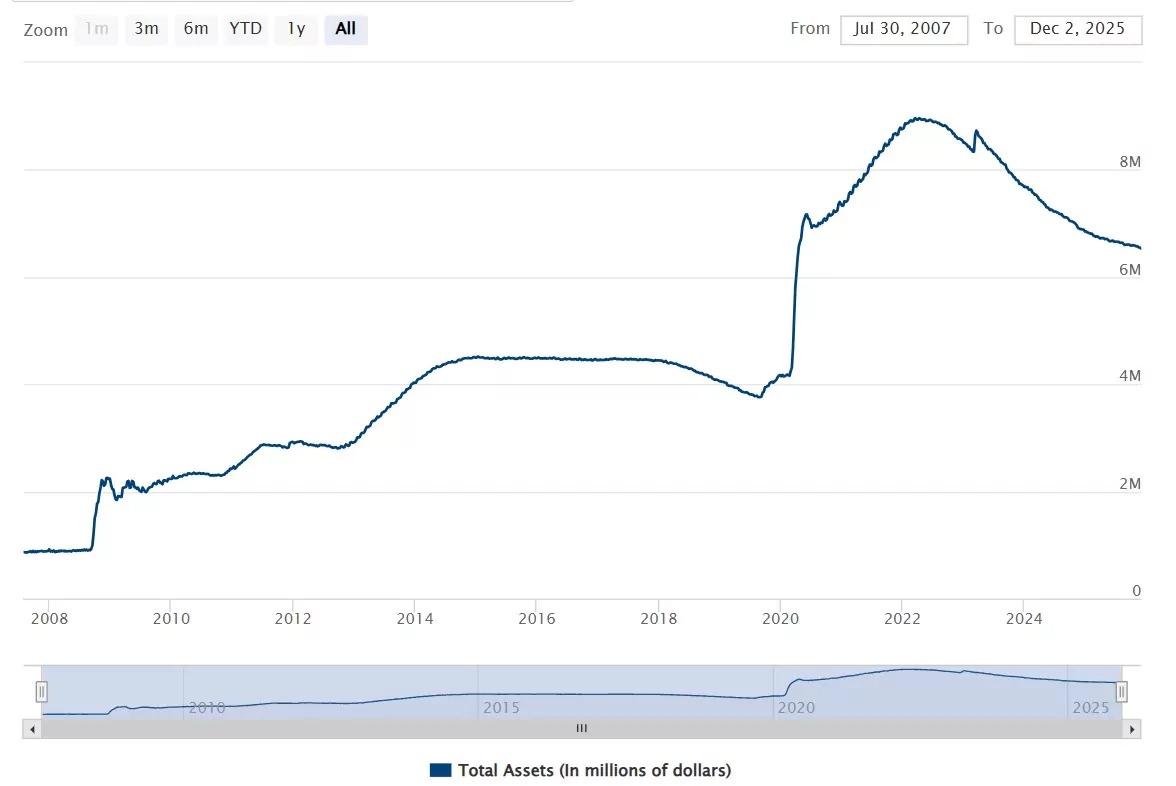
With a balance sheet of $6,535.78 billion, it should be noted that the Fed’s assets remain well above pre-COVID levels, even though the balance sheet has returned to its April 2020 level.
Over the coming weeks, we will learn more about the central bank’s future plans and see how the market reacts. In the meantime, projections for key interest rates suggest a nearly 90% chance of a 25-basis-point cut on December 10, bringing the range to 375-400 points.