
Four years after the speculative boom of 2021 led by Coinbase, a new generation of crypto companies has just gone public this year. Less dependent on Bitcoin, they want to prove that blockchain can now create value in the financial system.
A strong comeback
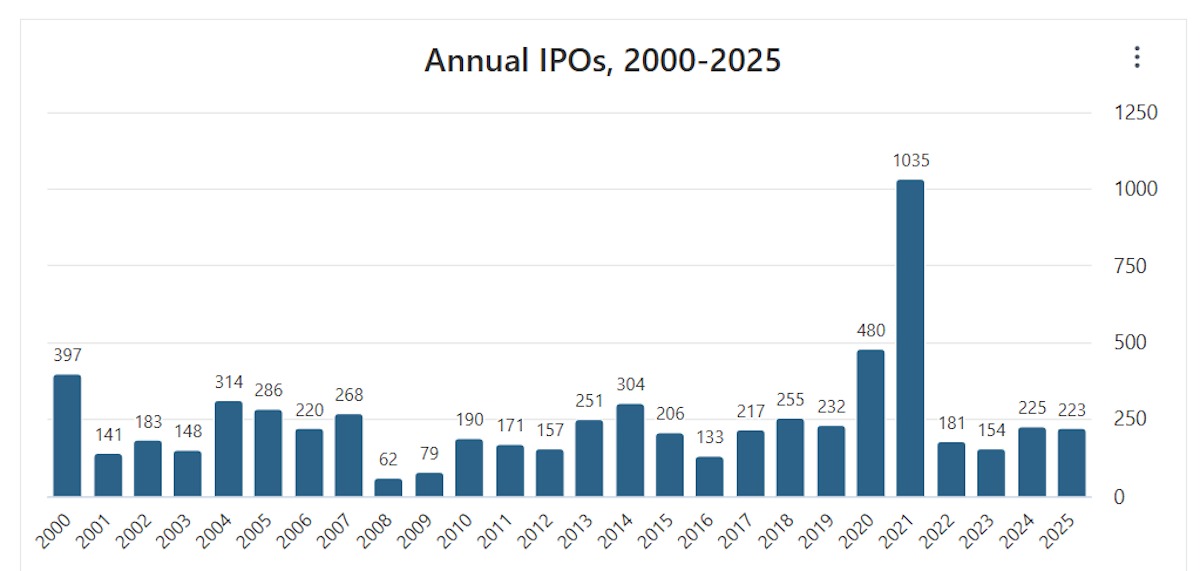
The dynamics of initial public offerings (IPOs) in the United States have experienced a spectacular “boom and bust” in recent years. After a historic record of 1,035 IPOs in 2021, driven by post-Covid euphoria and excess liquidity, the market shut down abruptly in 2022, with only 180 transactions, then 154 in 2023.
Since last year, the window has been opening again, supported by the gradual decline in key interest rates and high stock market valuations. However, this recovery remains selective and less euphoric. Among them, the return of blockchain-related players marks the emergence of a second wave of crypto IPOs.
The first wave, led by Coinbase in 2021, took place in a still speculative environment dominated by SPACs (special purpose acquisition companies created for the sole purpose of raising capital) and valuations closely correlated with the price of Bitcoin. The current wave, in 2025, is more mature. It now involves infrastructure companies such as Circle, Bullish, Gemini, and Figure Technology, all of which aim to modernize traditional finance. Here is an overview of these four newcomers to Wall Street.
Circle (NYSE:CRCL)
Opening price on June 5, 2025: $69.
Price on October 17, 2025: $125 (+81%)
This is probably the most emblematic player in this transformation. The issuer of USDC, the world’s second-largest stablecoin, has built a hybrid model. On the one hand, there is interest income from reserves invested in Treasury bills, and on the other, service income from the use of stablecoins in payments and financial applications. The first driver benefits from high interest rates, while the second, which is more sustainable, depends on the adoption of its dollar stablecoin in trading. The main risk for the company remains its sensitivity to the monetary cycle, as a rapid fall in interest rates would automatically reduce its interest margin and therefore its profitability. The stock is trading at a forward P/E (price-to-earnings) ratio of over 100, which leaves very little room for error. But Circle has a unique position with USDC, which has become a pillar of the regulated DeFi ecosystem, and the company is now seen as a trusted player by the US Treasury.
Bullish (NYSE:BLSH)
Opening price on August 13, 2025: $90.
Price on October 17, 2025: $56 (-38%)
The company follows a more traditional model, but one geared toward institutional flows. Founded by former NYSE executives, the company operates a hybrid exchange platform combining a centralized order book with liquidity automation. It has just obtained its BitLicense in New York and plans to expand its offering to derivatives, a higher-margin segment. The company faces a simple economic reality: exchanges thrive on volume, but volume is volatile. To reduce this dependency, Bullish is leveraging another asset: data. The integration of CoinDesk and CCData allows it to diversify its revenues and establish an image as a regulated and credible marketplace. The challenge will be to maintain profitability when spreads narrow.
Gemini (NASDAQ:GEMI)
Opening price on September 12, 2025: $37.01
Price on October 17, 2025: $19 (-49%)
A similar approach, but with a more defensive strategy. The New York-based company, founded by the Winklevoss brothers, has always positioned itself as the platform most compliant with the US regulatory framework. Nasdaq’s investment in its IPO illustrates this desire to bring crypto and traditional finance closer together.
However, the business model remains fragile. The business still depends heavily on transaction fees and trading volumes, two levers that are cyclical in nature. Gemini must now expand its scope, strengthen its custody activities, develop USD deposit yield products, and, ultimately, integrate regulated derivatives. Without this shift to recurring revenues, the company risks remaining stuck between two worlds: too cautious for the crypto market, not yet profitable enough for traditional investors.
Figure Technology (NASDAQ:FIGR)
Opening price on September 11: $36.01
Price on October 17, 2025: $38.60 (+7.22%)
The company stands out for its positioning. Where Circle, Bullish, and Gemini deal with financial flows, Figure focuses on the assets themselves. Its ambition is to tokenize credit and real estate loans via its proprietary blockchain (Provenance). The company’s idea is to enable a loan, once issued, to be financed and traded directly on an on-chain infrastructure.
The company, led by Mike Cagney, former CEO of SoFi, has already demonstrated a rare ability to be profitable in the sector. Its model, combining origination and financing platform, leverages two advantages: reduced operating costs and accelerated liquidity cycle. The risks are not insignificant, as a slowdown in the real estate market or a contraction in credit spreads could slow the company’s activity, but the potential is considerable. If the tokenization of real assets takes hold, Figure could become the backbone of a new digital capital market.
Conclusion
This new generation of publicly traded companies is shaping a more fluid and interconnected financial system, where the line between crypto and traditional finance is gradually blurring. Circle aims to circulate currency, Bullish to structure exchanges, Gemini to reassure regulators, and Figure to connect blockchain to credit. In a few years’ time, it may no longer be a question of distinguishing “crypto companies” from others, but simply of measuring the extent to which blockchain technology has finally improved the fluidity, competitiveness, and resilience of financial flows.