
The cryptocurrency sector is currently undergoing a major transformation, with the massive arrival of traditional finance players. This context seems to be benefiting DeFi, but also leading to a revival of NFTs in the third quarter. The situation is a little more complicated for decentralized applications (dApps).
DeFi sets a new TVL record
The fourth quarter is off to a flying start for the cryptocurrency sector, with Bitcoin already reaching a new all-time high of over $126,000. This provided an opportunity for the analysis firm DappRadar to take stock of the previous quarter in order to assess trends.
This exercise, carried out as part of its regular reports, highlights some major advances, such as the new high recorded by the total value locked (TVL) in decentralized finance (DeFi) – across all blockchains – which ended the period with an estimated value of $237 billion.
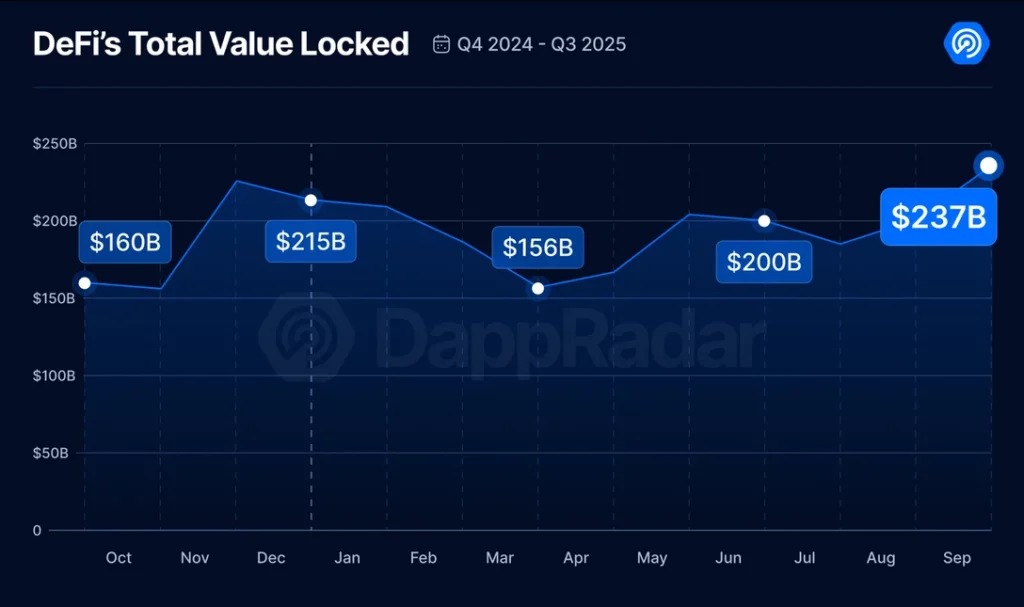
This momentum was largely supported by “flourishing lending protocols and inter-chain liquidity becoming a must-have, while the rise of memecoins and AI tokens brought a lot of liquidity to certain ecosystems.”
At the same time, the current boom in stablecoins “is putting DeFi in the spotlight of traditional finance,” while the tokenization of real-world assets (RWA) continues to gain momentum.
Ethereum remains the leader with $119 billion, but new challengers are emerging: Base (+48%), Arbitrum (+37%), and Bitcoin (+30%) are showing strong growth, while BNB Chain and Hyperliquid have also seen solid growth this quarter.
DappRadar
Towards a recovery in the NFT market?
According to DappRadar analysts, one of the data points to consider in the third quarter is the NFT market, which is clearly recovering with a total of 18.1 million sales—$1.6 billion in transaction volume—setting a record that had not been achieved since 2022.
Over this period, the OpenSea platform remains the undisputed market leader with $573 million in volume, an 88% increase largely driven by the announcement of the planned launch of its SEA token. However, few new investors seem to be responding to the call.
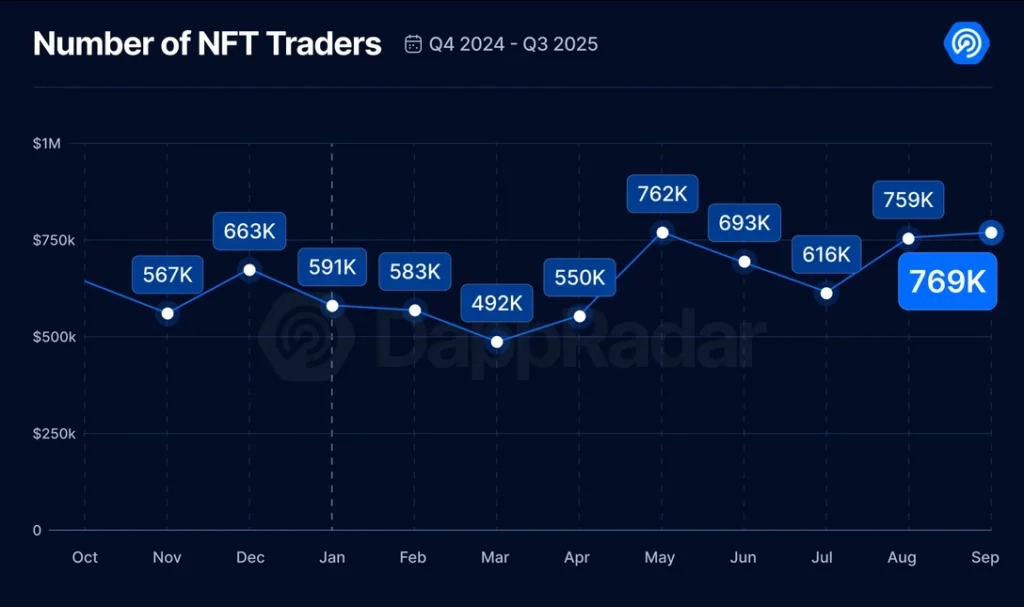
Between the second and third quarters, sales increased by 158%. However, the number of wallets only increased by 28.6%. This suggests conviction among established participants, rather than an influx of new users.
DappRadar
Analysts at DappRadar note significant activity on the Sorare fantasy soccer platform, “driven by the kickoff of new sports seasons.”
Dapps see a notable decline
However, the growing institutionalization of the cryptocurrency sector has been accompanied by a notable lack of momentum on the part of decentralized applications (dapps) capable of offering effective and sustainable consumer applications.
In fact, the number of unique active wallets (UAW) recorded a significant decline of 22.4% in the third quarter, reaching an average of 18.7 million. This trend affects all sectors without exception, but hits the social and AI sectors hardest.
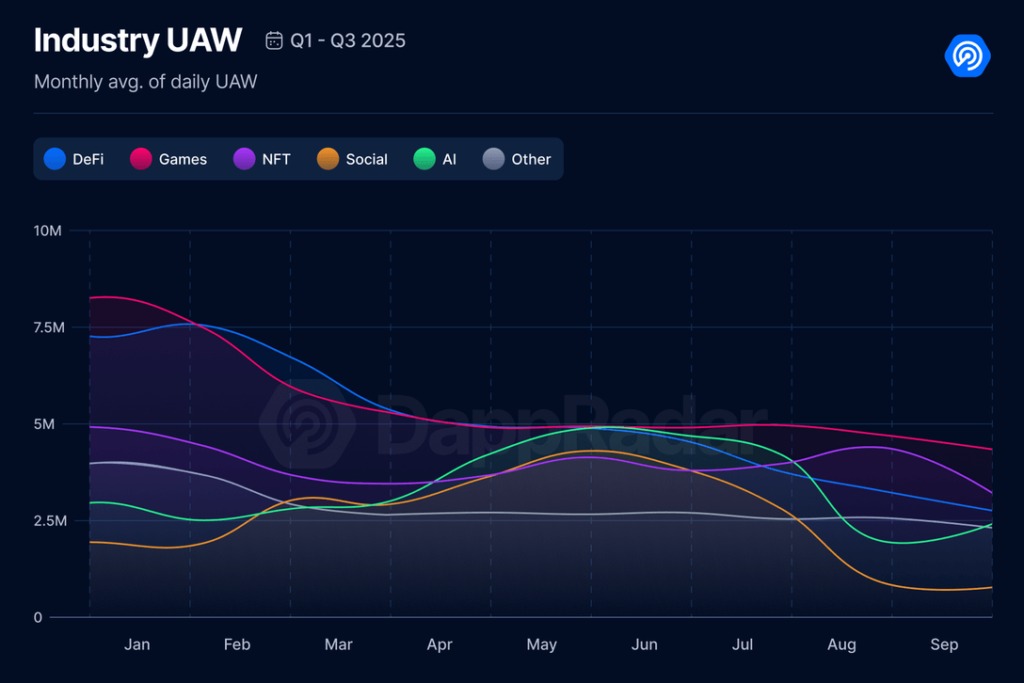
According to DappRadar analysts, the decline in the AI application sector can be linked to the Virtuals protocol losing its appeal in the third quarter compared to its record performance in the previous quarter. On the social applications side, the number of unique daily active wallets halved during the same period, particularly for The Arena, Layer3, and OnchainGM projects. In this field, gaming dApps dominate, particularly with the KAI-CHING project and its 177 million unique active users. Next come World of Dypians, HOT Protocol, Raydium, and KGeN, thanks to “engagement-focused mechanics.”
The DappRadar report makes no mention of prediction market platforms, which are clearly in the crosshairs of traditional finance. Indeed, the leader Polymarket has just raised a record $2 billion from the parent company of the New York Stock Exchange (NYSE), making its founder the youngest billionaire on the Bloomberg Billionaires Index. Could this be the next trend to follow?