In a sluggish NFT market, OpenSea continues to evolve. The platform is offering several new features this fall, including a treasury of non-fungible tokens and a new cryptocurrency, SEA. Will this be enough to rekindle the flame?
OpenSea offers new features, including an NFT reserve
OpenSea’s head of marketing, Adam Hollander, detailed the company’s new areas of development on X. First up is a new mobile app, redesigned to include artificial intelligence:
OpenSea Intelligence – the ability to trade smarter and faster with AI. We are building the first truly AI-native trading experience, capable of understanding your entire portfolio across multiple blockchains.
The other major development is the creation of an NFT reserve, featuring coins considered to be culturally significant. This “Flagship” collection will be a reserve of “timeless” non-fungible tokens, according to OpenSea:
We are launching the OpenSea Flagship collection with over $1 million committed to acquiring historic NFTs as well as works by emerging artists.
SEA cryptocurrency to be launched soon
The platform is also preparing for the future launch of SEA, its native cryptocurrency. Announced last February, it accompanies the launch of OpenSea 2.0. It is a governance token, which will be distributed via an airdrop to long-standing users of the exchange platform.
In preparation for the creation of the token, the platform is also offering a new incentive phase. Starting September 15, 50% of the platform’s fees will be allocated to rewards, which will be distributed when SEA launches. The date of issuance of the cryptocurrency is not yet known, but OpenSea says it will provide more details in early October.
An NFT market that remains sluggish
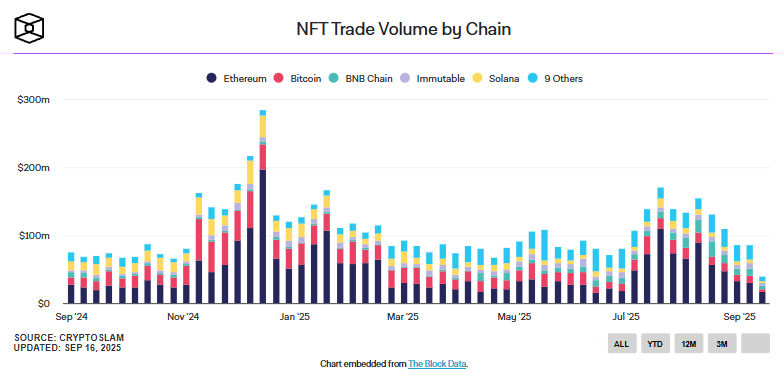
Overall, the non-fungible token market continues to be sluggish. While it never managed to reach the heights of 2022, it also failed to capitalize on the equivalent of NFTs available on Bitcoin, which had generated excitement in 2024. Trading volumes therefore continued to decline in 2025:
It should be noted that OpenSea’s slowdown also coincided with the arrival of a competitor: Blur. According to data from DappRadar, Blur currently processes a daily volume of $3.3 million… Compared to $679,000 for OpenSea.
The platform has therefore fallen behind, hence the small revolution currently underway: OpenSea 2.0, a new cryptocurrency, and rewards to encourage users to trade. Will this be enough? That remains to be seen—while NFTs seem to be here to stay, they have not generated any major enthusiasm for several years at this stage.