
Ethereum’s long-awaited revival is confirmed, with the spot ETF market booming in recent days. Faced with this situation, validators are rushing to exit their staking positions, to the point where more than 1 million ETH are waiting to be unstaked.
A queue of more than 1 million ETH
Since the adoption of the GENIUS Act regulatory framework in the United States, Ethereum has been exciting the appetites of investors who see its blockchain as the main medium associated with the expansion of stablecoins. Such is the enthusiasm that even the European Union is considering deploying its digital euro there.
This favorable context has allowed the price of ETH to rise to levels equivalent to its historic high in 2021, which had been consigned to oblivion since August 24 and its record high of nearly $5,000.
Record prices mean profit-taking. That’s why validators are currently rushing to withdraw their staked Ethers. The result is a real bottleneck involving a record amount of more than 1 million ETH, or approximately $5 billion.
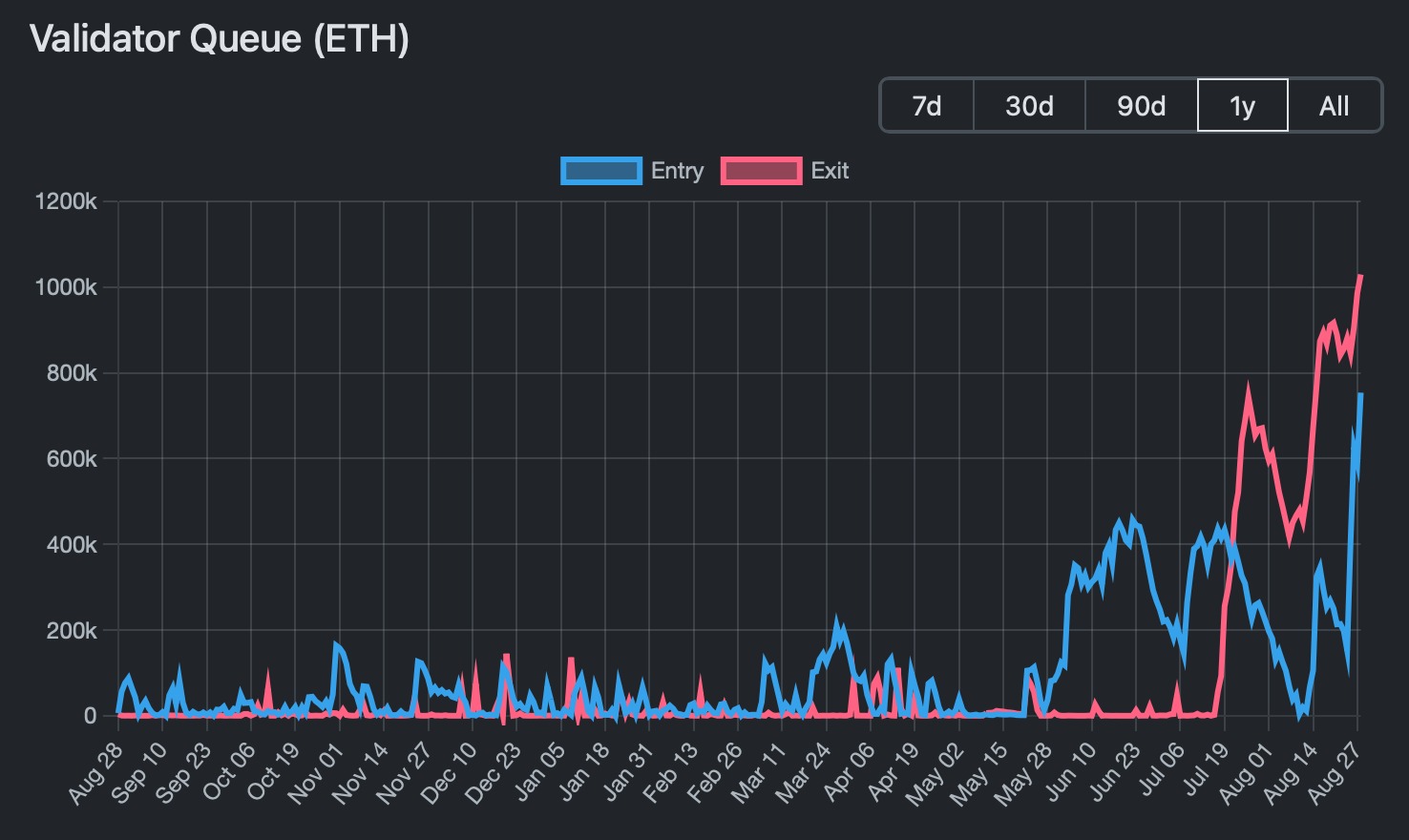
Data from the Validator Queue website shows the highest number of ETH withdrawal requests ever recorded since the Ethereum blockchain switched to its Proof of Stake model. This trend began on July 15 and shows no signs of slowing down.
Selling pressure ahead for Ethereum?
According to Ethereum developer Preston Van Loon, this queue prevents a massive, simultaneous exit of validators—particularly in the event of an attack—which could weaken the security of the blockchain at a time when it is most needed.
In practice, this currently means a record wait of 18 days and 15 hours to actually recover the ETH involved. There is also a significant period of 12 days and 19 hours for staking deposits to arrive.
Analysts such as Marcin Kazmierczak, co-founder of blockchain oracle company RedStone, believe that the selling pressure potentially triggered by these $5 billion worth of Ether waiting to be released is largely offset by the massive inflows recorded over the same period. In fact, more than 750,000 ETH are waiting to be integrated into the Ethereum blockchain’s validation nodes, representing approximately $3.5 billion.
The queue of outflows reaching 1 million ETH reflects healthy market dynamics rather than a cause for concern. What is crucial to understand is that these outflows are insignificant compared to the institutional capital flows entering Ethereum.
Marcin Kazmierczak
This situation is clearly linked to the massive influx of publicly traded companies with their cash reserves and other institutional structures into the Ether market, as their aggressive accumulation strategy allows them—as in the case of Bitcoin—to curb market volatility through a massive injection of liquidity.