
The stablecoin sector is currently experiencing unprecedented growth, driven by accelerated adoption by traditional finance and leading banking players. This equation clearly benefits the US dollar, which is heavily overrepresented in the sector, but China seems keen to accelerate its arrival on this market.
China attempts to respond to the rise of dollar-backed stablecoins
The stablecoin market has definitely entered a new era following the adoption of the GENIUS Act regulatory framework in the United States. And with good reason: more than 99% of the currently available supply of these stable cryptocurrencies is backed by the US dollar.
Such is the monopoly that the possibility of introducing a central bank digital currency (CBDC) in the United States seems completely unnecessary and of no real interest. This is all the more true given that Republican politicians are firmly opposed to such a project, which would clearly benefit the development of these private versions.
However, this renewed momentum for the international hegemony of a dollar weakened by Donald Trump’s protectionist policy is not to everyone’s liking. Indeed, China seems determined to react, if we are to believe the statements made by the governor of its central bank, Pan Gongsheng, in response to what he considers a profound challenge to the current monetary model.
This observation, made at the beginning of August, seems to be accompanied by a noticeable acceleration on the part of the Chinese government, following the recent announcement by its State Council of its intention to approve a new plan for the internationalization of the yuan in response to the current rise of stablecoins.
Use of the yuan at its lowest level for global payments
China has been aiming for many years to propel its digital yuan (e-CNY) onto the international monetary scene, leveraging its status as the world’s second-largest economy. However, this central bank digital currency has not been adopted as widely as hoped, due to government control policies that are considered too strict and problematic surveillance risks.
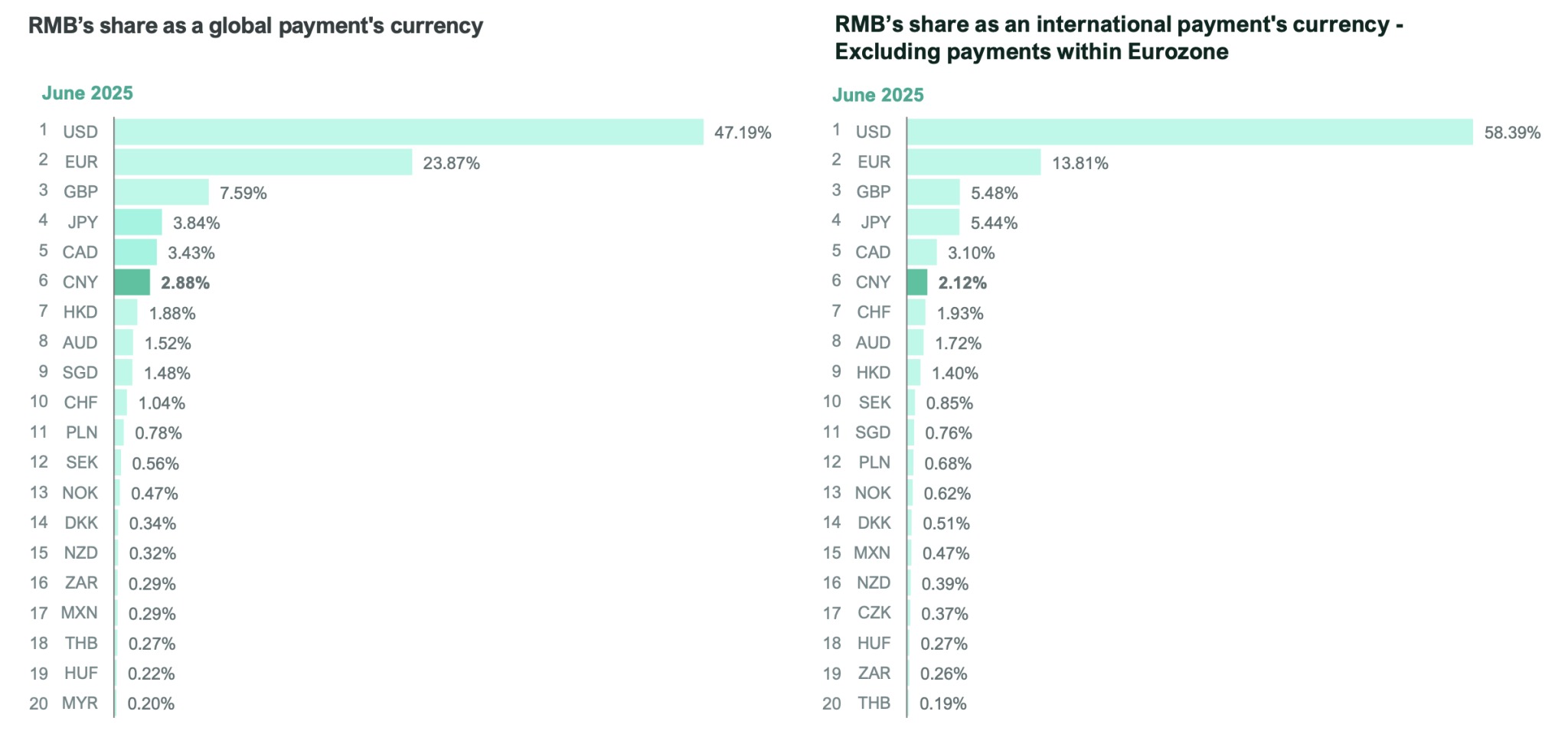
According to SWIFT data, the yuan’s (also known as the renminbi or RMB) share of global payments fell to its lowest level in June (2.88%), while the US dollar holds a market share of close to 50%.
This marks a major shift in China’s strategy given its historical aversion to anything related to cryptocurrencies, but necessity seems to be the guiding principle. According to Reuters, details of China’s plan on the subject are expected to be made public in the coming weeks, following consultations currently being held by regulatory authorities.
The real challenge in this case is to circumvent the numerous Chinese regulatory restrictions in order to develop an internationally open stablecoin market. Using Hong Kong as a control tower seems to be the best way to achieve this.