
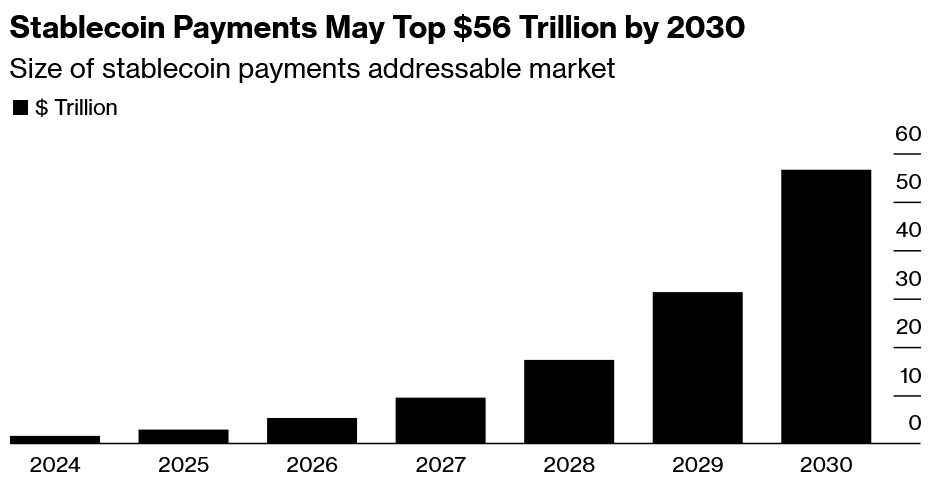
Stablecoins are undeniably one of the hottest trends right now, and that’s not about to change, according to Bloomberg. The institution estimates that flows related to this type of cryptocurrency could reach $56 trillion by 2030.
Stablecoins will continue to grow in popularity, according to Bloomberg
Analysts at Bloomberg Intelligence indicate that stablecoin transactions reached a record high in 2025: $33 trillion. This represents an 81% increase year-on-year.
The trend could accelerate: Bloomberg expects transaction volumes to exceed $56 trillion by 2030.
In terms of capitalization, stablecoins are now worth $312 billion, but this figure is growing rapidly. It could reach $2 trillion by 2028, according to data from the U.S. Treasury.
USDC overtakes USDT in transaction volume
Circle’s USDC leads the way with $1.83 trillion in transactions, followed by Tether with $1.33 trillion in USDT transactions. Together, these stablecoins account for 95% of stablecoin transactions.
USDT still leads in terms of gross capitalization. According to CoinGecko, Tether’s main stablecoin is now worth $186 billion, compared to $74 billion for USDC. The hegemony of these two protocols could be undermined in the coming years with the massive arrival of private stablecoins on the market. Many companies and financial institutions have announced the launch of their own stablecoins in recent months.
Beyond the impressive figures put forward by Bloomberg Intelligence, the rise of stablecoins raises a broader question: that of their future role in the global financial system. Some see them as the emergence of cross-border payment tools capable of competing directly with traditional banking networks. Others believe that the proliferation of stablecoins will inevitably lead to a skimming phenomenon. The coming years will tell which ones will really succeed.