
The price of Bitcoin (BTC) was shaken by the expansionist aims of the US president. Its price experienced significant volatility yesterday, before stabilizing at around $90,000 in the hours that followed. What does this say about the status of the largest cryptocurrency?
Bitcoin (BTC) price experiences a particularly volatile day
The Bitcoin price started January 21 with some optimism, regaining the psychological threshold of $90,000. However, the cryptocurrency was affected by geopolitical tensions linked to Donald Trump’s desire to conquer Greenland. Shortly after his speech in Davos, the price of BTC fell by more than $3,000 to $87,200.
But after this period of decline, the price of BTC began to rise again. This was due to an apparent change of heart by Donald Trump, who seemed to be satisfied with an agreement on Greenland just a few hours after his martial threats. As a result, Bitcoin regained all the ground it had lost, climbing back to the $90,000 threshold:
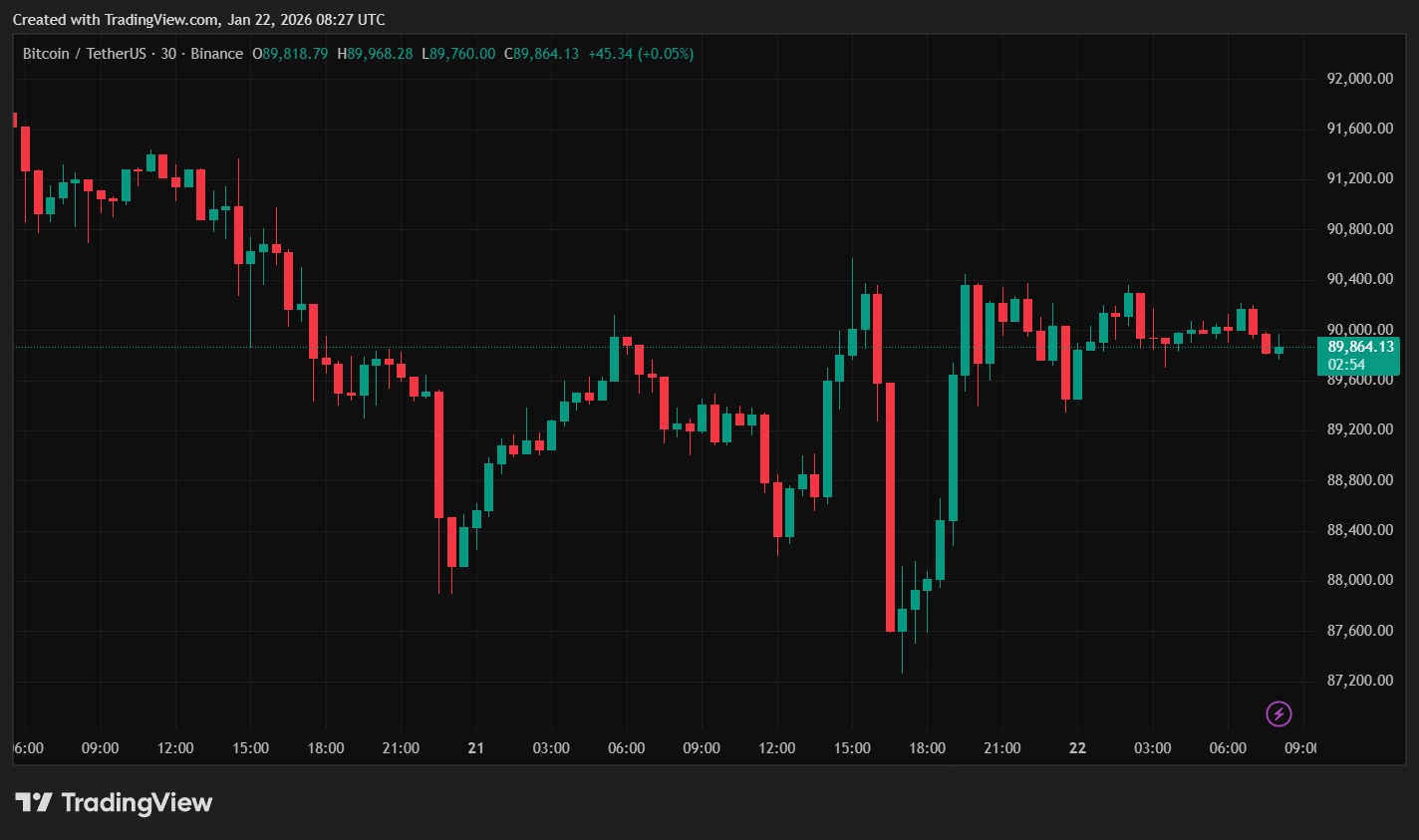
At around 9 a.m. this morning, one Bitcoin was trading at $89,910. This represents a 7% drop over the last seven days. However, the price of BTC is up 2.5% over the month.
Bitcoin’s fleeting status as a safe haven
While Donald Trump’s arrival in power had fueled hopes for Bitcoin as a reserve asset, the geopolitical events of the past year tend to show the opposite. Bitcoin’s sensitivity to geopolitical events currently prevents it from being considered a “pure” safe haven asset, unlike gold, which has broken record after record in recent months. Alex Thorn, head of research at Galaxy Digital, highlighted this paradox in an interview with the Crypto Prime podcast:
We are seeing significant geopolitical uncertainty, with gold trading at new all-time highs, while Bitcoin is underperforming. Bitcoin is not really doing what it is supposed to do—at least not in real time.
However, if we zoom out, cryptocurrency seems to have found its niche: between 2020 and 2026, BTC rose by 896%. Hence Bitcoin’s strange status, which is neither digital gold nor a “traditional” risky asset.