
Bringing the world of Bitcoin to life: A Satoshi-era wallet awakens after 15 years of dormancy
A wallet created in Bitcoin’s early days has just come back to life after more than 15 years of dormancy. Its 50 BTC, mined during the Satoshi era, are now worth over $4 million.
A Satoshi-era wallet resurfaces
Now in its 16th year, Bitcoin has already reached many milestone moments, one of the most iconic of which involved the disappearance of its anonymous founder, Satoshi Nakamoto, after his final post on the Bitcoin Talk forum in December 2010.
That date marked the official end of the Satoshi era. However, wallets created during that distant era continue to make headlines today, as in the recent case of an address that had been inactive since March 18, 2010, coming back to life.
In fact, a wallet containing 50 BTC — received as a reward for mining a block on the Bitcoin blockchain — became active again a few days ago, according to data published on the X network by the Lookonchain account.

Recent activity recorded on this address, which had been dormant since 2010
At that time, miners received 50 BTC for validating a block, compared to just 3.125 BTC today. While this difference may seem significant, the amount received was equivalent to $0.25 in 2010, whereas it now exceeds $270,000.
50 BTC, now worth $4.35 million
To fully understand the significance of this resurgence, it’s worth taking a brief look back at 2010, when 1 BTC traded for less than $0.005. It was a time when computer scientist Laszlo Hanyecz marked one of the first symbolic milestones in this history by purchasing two pizzas for the surreal sum of 10,000 BTC.
The 50 BTC in this wallet are now worth a tidy sum of $4.35 million, as of this writing. A capital gain so enormous that it’s difficult to calculate—it represents a 17.4-million-fold increase.
It’s easier to understand why this wallet was forgotten in 2010. And it also seems possible to speculate on why it’s resurfacing now, even with the BTC price on the decline.
Especially when you consider that recovering these forgotten funds is becoming a highly profitable business, as in the case of the 80,000 BTC unearthed last summer.
The question no longer seems to be how much BTC is permanently lost, but rather how much can be recovered over the next few years, given the significant profits this can generate.
Crypto: Are AI Agents Already Capable of Exploiting Vulnerabilities?
A cybersecurity firm tested the ability of AI agents to detect and exploit vulnerabilities in smart contracts, which govern a significant portion of the crypto ecosystem’s operations. The results demonstrate the need for action.
AI Agents: A Security Risk for Smart Contracts?
Some are concerned about the quantum threat to the future of Bitcoin and cryptocurrencies, but perhaps we should first prepare for the threat posed by AI agents capable of detecting—and exploit—security vulnerabilities in the protocols and other smart contracts of the crypto ecosystem.
This is an especially pressing concern within decentralized finance (DeFi), which is frequently targeted by such exploits—often highly profitable for their perpetrators—as in the recent Balancer incident, estimated at $128 million.
This presents an opportunity for researchers at Anthropic to conduct an experiment to more precisely determine “the economic impact of these capabilities.”
In fact, these specialists believe that AI agents can now “orchestrate complex network intrusions” or even serve the interests of “state-sponsored espionage.” However, no study currently exists that can “quantify the exact financial consequences of AI’s cyber capabilities.”
This is a difficult estimation that calls for an alternative approach, shifting focus “toward a domain where software vulnerabilities can be directly ‘priced’: smart contracts.” Indeed, their operating model—“ without humans in the loop” allows for a more precise measurement of the amount stolen when their vulnerabilities are exploited, by executing them in simulated environments.
Compared to arbitrary success rates, measuring capabilities in monetary terms is more useful for assessing and communicating risks to policymakers, engineers, and the general public
Anth Anthropic
Exploits that are technically feasible even for zero-day vulnerabilities
To conduct this full-scale test, specialists at Anthropic developed a dedicated benchmark environment consisting of 405 smart contracts that were exploited between 2020 and 2025 on the Ethereum, BNB Chain, and Base blockchains.
The AI’s goal is to detect existing vulnerabilities and propose a functional exploit, with performance measured by the amount of funds involved. With a total of 10 AI agents tested, 51% of the smart contracts were successfully exploited, resulting in a total loss of $550 million.
Once this first phase was completed, the second phase involved repeating the exercise with exploitations carried out after the model’s knowledge cutoff date—set for March 1, 2025—primarily using Claude Opus 4. 5, Sonnet 4.5, and GPT-5. Of the 35 isolated smart contracts, 56% were successfully exploited, resulting in an estimated total of $4.6 million.
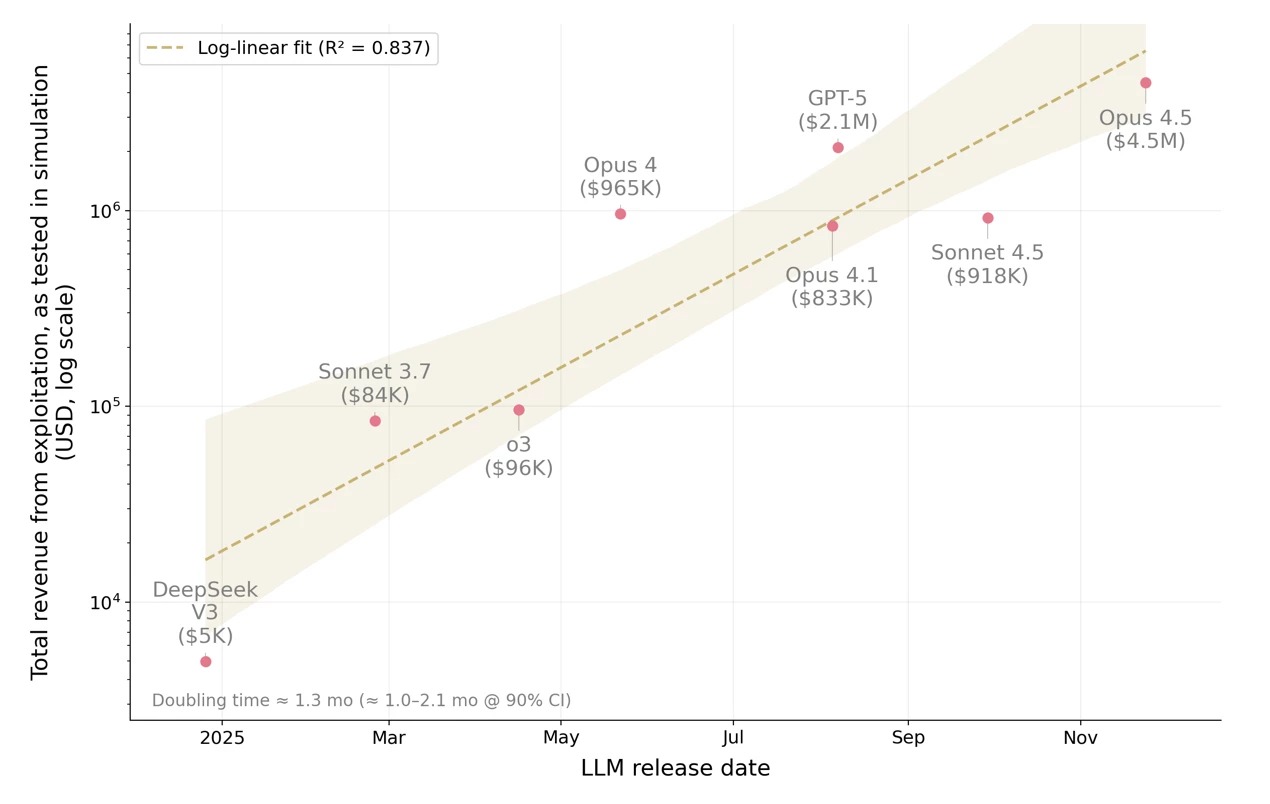
Total revenue from exploiting vulnerabilities after March 2025
Final step: detecting previously unexploited vulnerabilities (zero-day) across a sample of 2,849 recent smart contracts. In this scenario, the AI agents used (Sonnet 4.5 and GPT-5) identified two such vulnerabilities, with a total estimated value of $3,694. However, given that the cost of the GPT-5 API for the entire scan was estimated at $3,476, the return appears rather meager, though effective.
The conclusion comes from the researchers at Anthropic:
This demonstrates, as a proof of concept, that autonomous and profitable exploitation under real-world conditions is technically feasible—a result that underscores the need to proactively adopt AI for defense.
Anthropic
Kalshi’s Predictive Markets Are Coming to Solana
To dive into tokenization itself, prediction market specialist Kalshi has officially announced its arrival on Solana (SOL). Will this compete with the market leader, Polymarket?
Solana Welcomes Kalshi’s Predictive Markets
With the buzz surrounding last year’s U.S. presidential election, predictive markets took off, starting with Polymarket. However, the concept isn’t new, although blockchain brings a new level of reach to the sector.
Launched in 2018, the Kalshi platform has now taken the plunge into tokenization by launching on Solana (SOL).
To mark the occasion, $2 million has been allocated to app developers, and the technology is also expected to be available on Axiom soon. Already, liquidity aggregators Jupiter and DFlow are driving volume to Kalshi by integrating the prediction markets into their platforms.
In an interview with CNBC, John Wang, Kalshi’s head of cryptocurrencies, discussed the opportunity this sector represents for the industry:
The cryptocurrency world has many expert users. The goal is to tap into the billions of dollars in liquidity held by the cryptocurrency sector and enable developers to create third-party interfaces that utilize Kalshi’s liquidity.
While Polymarket currently leads the decentralized prediction markets space, Kalshi’s hy Kalshi’s rise is now one to watch, as it could potentially capture market share among Solana’s many users.
Furthermore, it’s worth noting that the platform has held a federal license from the Commodity Futures Trading Commission (CFTC) since November 2020, which could make it easier for it to open certain doors, notably a potential future integration with Coinbase.
Asset management giant Vanguard now allows crypto ETFs
In light of the various successes achieved by crypto ETFs, the world’s second-largest asset manager, Vanguard, has (finally) decided to allow trading in them. This marks a historic turnaround for the sector, despite the current downturn in the cryptocurrency market.
Vanguard to Allow Trading of Crypto ETFs
Even the most skeptical players in traditional finance are finally changing their minds, given the success and performance of spot crypto ETFs since their launches. And for good reason: the Bitcoin ETFs from the world’s leading asset manager, BlackRock, have now established themselves as its most profitable revenue source.
Each new launch is seeing record inflows, even for the versions most recently approved by the U.S. SEC for Solana’s SOL and Ripple’s XRP cryptocurrencies. This is enough to infuriate the 50 million brokerage clients of the world’s second-largest asset manager, Vanguard, which has historically opposed trading in these assets.
In fact, Vanguard executives had previously deemed these crypto assets too volatile and speculative to be included in “serious” investment portfolios. This stance clearly did not withstand persistent demands from investors—both retail and institutional—if its recent announcement on the subject is to be believed.
Although Vanguard does not intend to launch its own crypto products, we serve millions of investors with diverse needs and risk profiles, and we want to provide a brokerage platform that gives our clients the ability to invest in the products of their choice.
Andrew Kadjeski
This opposition, which had already been waning for several months, has just reached a positive resolution in early December with the announcement that its platform will open “to trading in ETFs and mutual funds that primarily hold cryptocurrencies .”
On the agenda: Bitcoin, Ethereum, XRP, and SOL
According to available information, this integration of crypto ETF trading will, for the time being, only apply to certain handpicked cryptocurrencies, such as Bitcoin, Ethereum (ETH), Ripple’s XRP, and Solana’s SOL. In other words, nearly all spot ETFs currently available on the U.S. market.
This expansion represents an estimated $11 trillion in global assets under management. According to Andrew Kadjeski, head of brokerage and investments at Vanguard, the firm simply needed to wait and see how the emerging spot ETF market would perform before taking the plunge.
Cryptocurrency ETFs and mutual funds have stood the test during periods of market volatility, performing as expected while maintaining their liquidity. The administrative processes required to manage these types of funds have matured, and investor preferences continue to evolve.
Andrew Kadjeski
A decision most certainly driven by the arrival of Salim Ramji, a former BlackRock executive and crypto enthusiast, as Vanguard’s CEO a little over a year ago. With the promise of adding most crypto ETFs that meet regulatory standards.
Bayern’s Thrilling Quarterfinal Match – RB Leipzig
RB coach Ole Werner had hoped for a home game in the cup. That won’t happen. The Saxons drew the toughest possible matchup.
The Bundesliga leader against the Bundesliga runner-up: RB Leipzig drew the toughest possible matchup for the DFB Cup quarterfinals. The Saxons must travel to face FC Bayern Munich. This was the result of the draw conducted by former player and coach Friedhelm Funkel at the German Football Museum in Dortmund. The quarterfinal matches will be played on February 3 and 4, as well as on February 10 and 11, 2026; the exact dates have not yet been set.
RB’s sporting director, Marcel Schäfer, took the draw in stride. “This is, of course, the toughest possible matchup for us and an absolute blockbuster in this DFB Cup quarterfinal. The 0–6 loss from the first matchday will no longer play a role in our minds; we’re a completely different team now. So we’re approaching this game as a major challenge, but we’re traveling to Munich with self-confidence, optimism, and certainly not without a chance.”
“This is a very attractive matchup; it’s a shame it’s not being played at our home stadium,” said RB ambassador Perry Bräutigam on ARD. “Bayern is, of course, miles ahead, but anything is possible in the cup.”
Bayern has always been victorious in the cup so far
This will be the third time the two teams have faced each other in the DFB Cup. In 2017, Munich won in Leipzig in the second round on penalty kicks; in 2019, Bayern won the final 3–0. But RB proved in 2023 that they can also win cup matches against the Munich team. The Saxons won 3–0 in Munich.
RB had defeated 1. FC Magdeburg 3–1 in the round of 16. Prior to that, the Saxons had won 4–2 against SV Sandhausen in the first round and then 4– 1.
Schonnebeck and Uerdingen Stay Close to Ratingen; ETB Scores Despite Being a Man Down
Last week, the top teams in the Oberliga Niederrhein stumbled. On this matchday, all of the top 6 teams won except for Baumberg. The details.
In the Oberliga Niederrhein, league leader Ratingen 04/19 set the tone on Saturday. The final score was 4–2 after 90 minutes at Adler Union Frintrop, with Ratingen managing to come back from a 0–1 deficit.
The other two matches went to teams at the bottom of the table. BW Dingden won the clash between promoted teams at Holzheimer SG 1–0, and on Friday, the last-place team from Biemenhorst showed signs of life with a 3–1 win over Baumberg.
On Sunday, the final six matches were on the schedule. SpVg Schonnebeck was under pressure at VfB Homberg. They wanted to bounce back from their 3–5 loss in the derby against ETB, and they also needed three points to keep pace with Ratingen.
And the Essen-based team delivered with a 2– 1 victory at VfB. Niko Bosnjak gave Schonnebeck the lead in the first half on a penalty kick. Around that play, Homberg’s Leon Schübel was sent off with a red card. With the numerical advantage, Luca Pinke extended the lead after the break, seemingly sealing the win.
But Homberg fought back—also on a penalty kick. Andres Dimas converted it