
To make the world of compNew FUD on Tether — Could diversifying into gold and Bitcoin spell its downfall?
Despite its undeniable successes and the clout of its USDT stablecoin, Tether remains the perennial crypto giant that everyone loves to bash. The latest example: a doomsday scenario imagined by Arthur Hayes regarding its diversification into gold and Bitcoin.
Tether: Could Diversification into Gold and BTC Make USDT Insolvent?
The growth of the cryptocurrency sector has already given rise to several giants, including the undisputed leader of the stablecoin market, Tether, and its USDT, currently valued at $185 billion—representing more than 60% of the market share.
This position has been achieved despite frequent criticism regarding its high level of centralization, as well as the management of its reserves, which is considered too opaque. As a result, the company continues to rack up successes and profits while simultaneously being excluded from major regulatory jurisdictions such as the European Union and the United States.
A paradox that has sparked widespread speculation about its true strength or its ability to guarantee the solvency of its USDT stablecoin. This question has recently been brought back into the spotlight by investor Arthur Hayes, who views this as “the beginning of the first rounds of a massive interest rate trade .”
Indeed, the co-founder and former CEO of the cryptocurrency exchange BitMEX believes that Tether’s latest quarterly report highlights a corporate strategy designed to counter a potential cut in Fed rates, “which would crush the interest income” from its reserves, which are heavily exposed to U.S. Treasury bills.
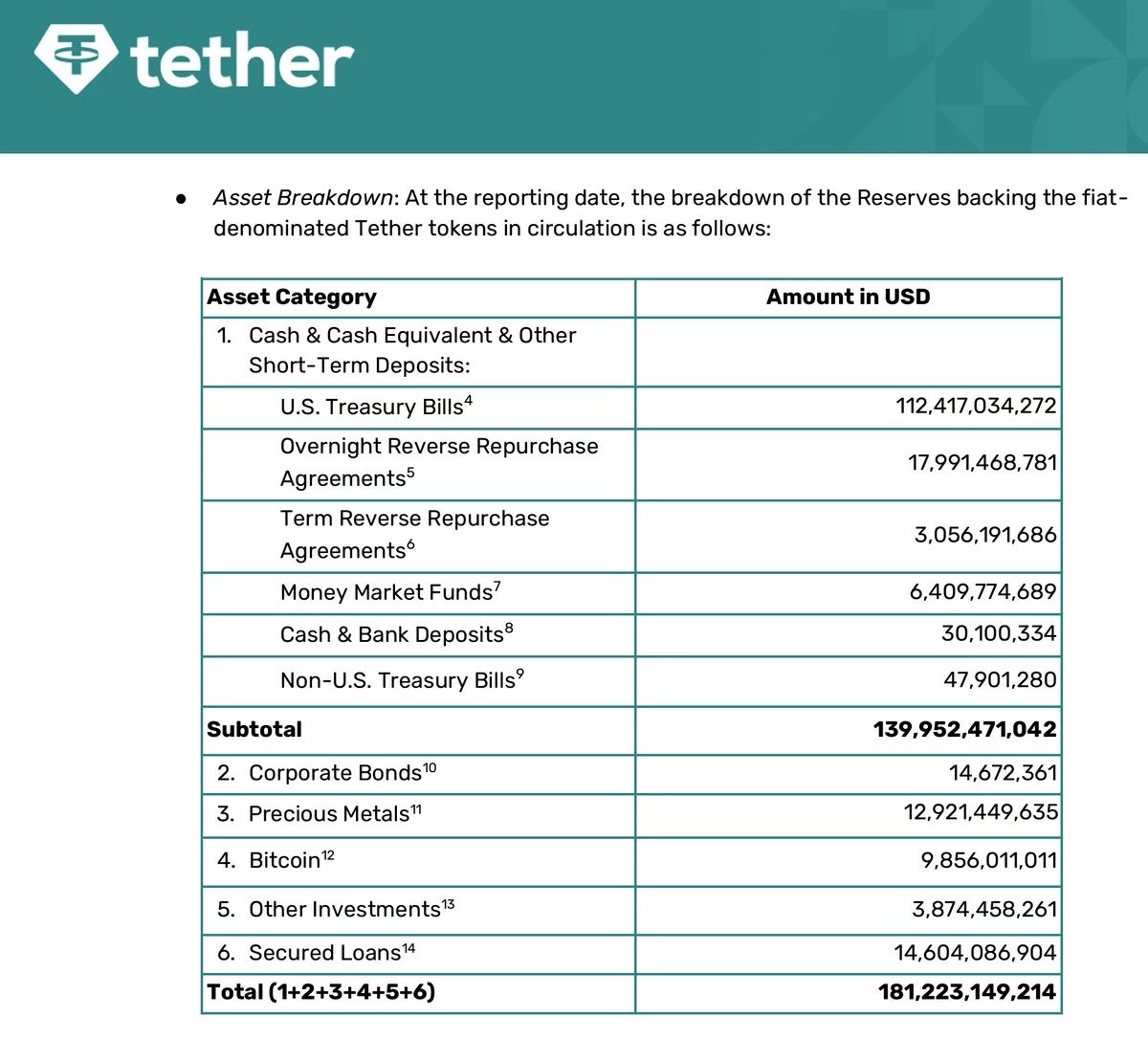
Tether’s latest quarterly report mentioned by Arthur Hayes
In response, they are buying gold and BTC, which should theoretically skyrocket in value as the price of silver falls. But a drop of about 30% in these positions would wipe out their capital, and then USDT would theoretically become insolvent.
Arthur Hayes
New FUD Against Tether, According to CEO Paolo Ardoino
With this post, Arthur Hayes appears to be predicting the imminent insolvency of USDT, linked to the current decline in Bitcoin and the correction in the price of gold since its last peak—all due to Tether’s diversification policy, which is supposed to ensure greater stability.
A new attempt at FUD against Tether, according to its CEO Paolo Ardoino, orchestrated by “certain influencers who are either bad at math or incentivized to promote [its] competitors.” And for good reason: its latest quarterly report also reiterates that “Tether will continue to maintain a buffer of excess reserves amounting to several billion dollars and the Group’s total equity approaching $30 billion .”
This doomsday scenario has also been called into question by Joseph Ayoub, former head of crypto research at Citi, after “hundreds of hours spent writing research on Tether.” Indeed, he explains how the reported assets differ from the company’s actual assets and how Tether stands out as “one of the most cash-generating companies in the world” with only 150 employees.
All of this allows us to estimate the value of their equity somewhere between $50 billion and $100 billion. Although they’ve indicated they’re seeking to raise $20 billion at a 3% stake, which would value them at around $500 billion. That probably won’t happen, and it’s likely overvalued, but it’s still very valuable equity.
Joseph Ayoub
Just an attempt to manipulate the market?
All these denials cast doubt on Arthur Hayes’ claims, which are considered alarmist, to say the least. All the more so when considering his recurring attempts to sway the market in his favor, coupled with a stated desire to see “the mainstream media go wild over this.”
Could this instead be a strategy designed to trigger a more significant pullback in the crypto market, with the aim of finding a good entry point? This is a possibility very clearly considered by Ki Young Ju, founder and CEO of the analytics firm CryptoQuant:
Translation: I’m currently in a bad position, and I want crypto prices to fall so I can buy at lower levels.
Ki Young Ju
This is a serious question.
Strategy’s CEO is considering selling Bitcoin to pay dividends
The current decline in Bitcoin is not good news for Digital Asset Treasuries (DATs) that specialize in accumulating the most iconic cryptocurrency. This reality is even prompting the CEO of industry leader Strategy to consider selling a portion of its BTC to pay dividends to its shareholders.
Strategy has nothing to do with a “hyper-dilutive Ponzi scheme”
The current downturn in the cryptocurrency market is putting the Digital Asset Treasuries (DAT) sector through a full-scale stress test, a sector that has seen unprecedented growth since the beginning of the year.
In fact, these publicly traded companies—which have become specialists in crypto accumulation, often with (very) shaky financial structures—find themselves in a very precarious position as shareholders seek higher returns based on supposedly attractive holdings-per-share ratios (mNAV).
However, Phong Le, CEO of the industry leader Strategy, sought to reassure listeners about this reality during a recent appearance on the “What did Bitcoin” podcast. He explained how his company—and its current holdings of 648,870 BTC—have nothing to do with the “hyper-dilutive Ponzi scheme” conjured up by the “mental gymnastics” of certain observers.
Just as we introduced people to Bitcoin-backed debt, we’re now introducing them to Bitcoin-backed credit, and we’re just getting started. I think that, for the foreseeable future, we’re still talking about 40% to 50% annualized returns over a period of 4 or 5 years.
Phong Le
Could this be a way to reassure investors, given the sharp decline in its MSTR stock—down nearly 60% from its peak last July? The question arises, especially in light of the prospect of its possible exclusion from the Nasdaq 100 and MSCI USA indices early next year.
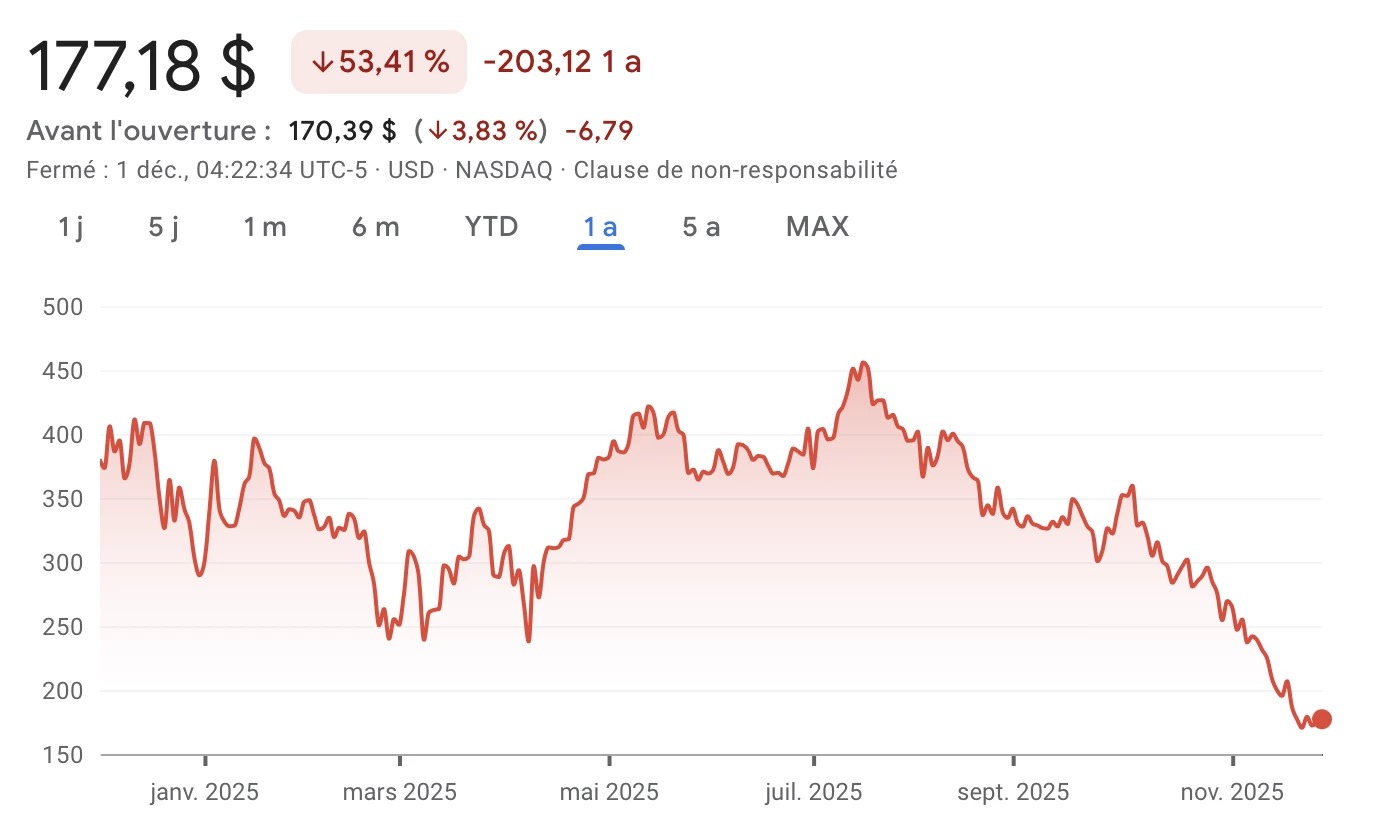
Strategy’s MSTR stock has seen a significant decline in recent months
Selling Bitcoin to Pay Dividends
A delicate situation greatly exacerbated by the current decline in the price of BTC, which has fallen back below $90,000 at the start of this week. This raises the question once again of whether Strategy might start selling Bitcoin, despite Michael Saylor’s recent denial.
A scenario that now appears very clearly as a possibility, according to Phong Le, but only as a last resort.
We can sell Bitcoin, and we would do so if we had to finance dividends when the mNAV falls below 1x. It would be a last resort: mathematically sound, but narratively tricky.
Phong Le
The problem? This mNAV figure has already been below the 1x level since November 12, according to data from Strategy Tracker. That is, almost exactly when suspicions of BTC sales began circulating on social media, following a series of transfers carried out by Strategy.
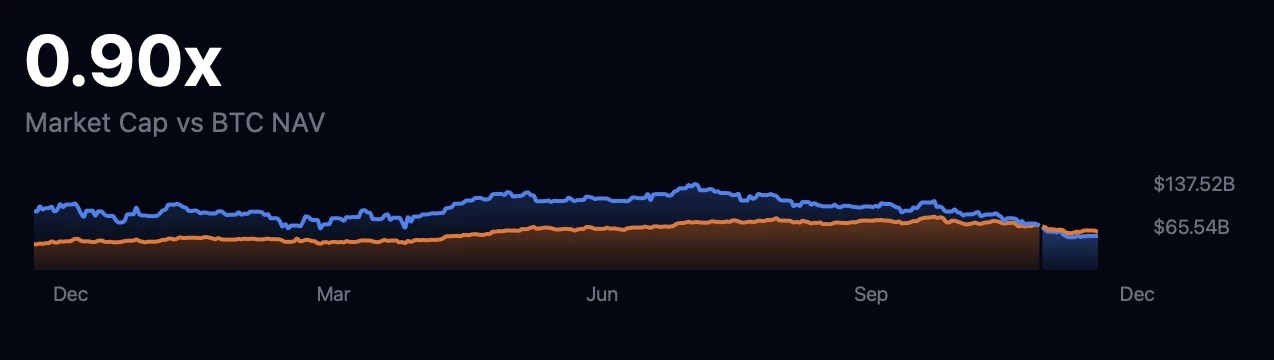
Strategy’s mNAV is trading below the 1x level
As Phong Le is quick to point out, an official announcement of a Bitcoin sale could have a significant psychological impact on the market. He seeks to reassure, however, by explaining that “if Bitcoin outperforms the S&P 500, Strategy wins.”
New problem: BTC is down 10% over the past year, compared to a 13% gain for the S&P 500.
Why is Bitcoin (BTC) falling back to $86,000?
Overnight, the price of Bitcoin (BTC) fell again, dragging the rest of the cryptocurrency market down with it. What can we say about this new bearish trend?
Bitcoin (BTC) and cryptocurrencies stumble again
Last week, the price of Bitcoin (BTC) managed to reclaim the $90,000 level, but that attempt now appears to have failed, as the asset suffered a sharp drop overnight, briefly dipping below $86,000:

BTC price (hourly data)
At the time of writing, one bitcoin is trading at $86,300, down 5.2% over the past 24 hours. More broadly, the rest of the cryptocurrency market is also taking a hit, with total market capitalization down 4.9% and some of the top 10 cryptocurrencies losing more than 8%, such as ADA and DOGE:
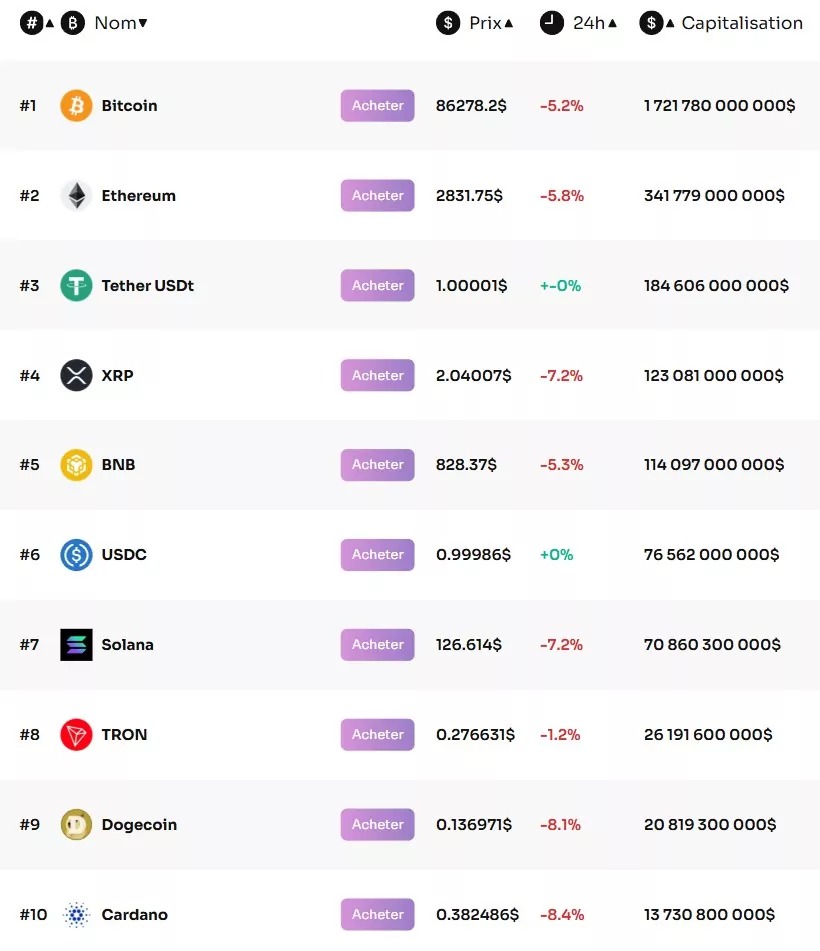
Overview of the top 10 cryptocurrencies
During every bearish (or bullish) trend, it’s common to look for reasons to explain the movement, and a few possibilities can therefore be explored.
Probable reasons for this decline
In terms of liquidations on perpetual markets, we can note $641.5 million in positions that were forcibly closed, and of this total, $567 million came from long positions. Admittedly, the amounts involved are substantial, but far from significant compared to what we see during waves of panic.
Last Thursday, we revisited S&P Global’s warnings regarding Tether, which further exacerbated the prevailing gloomy sentiment. Since then, Paolo Ardoino, Tether’s CEO, has pointed out that Tether still has excess liquidity relative to its liabilities—specifically, a $30 billion surplus at the end of the last quarter. At the same time, the Treasury bonds held by the company are reportedly generating $500 million in monthly profits.