
What are the weak signals to watch in the crypto ecosystem? In this new monthly column, I highlight two emerging trends that could very well shape the future of Web3: prediction markets, which serve as true leading indicators of reality, and the creator economy, which is undergoing a major transformation with innovative models like Zora’s. Analysis.
Weak Signals Not to Be Underestimated
Each month, in this column, I’ll share two or three weak signals that have caught my attention. The goal is to highlight crypto projects that are still relatively unknown, often featuring innovative mechanisms, and sometimes even still in the experimental stage.
Taking an interest in these types of projects offers several advantages. In fact, being an early adopter of certain protocols not only gives you exposure to future airdrops but also allows you to ride the wave if the narrative takes off and gains increasing media attention.
To successfully capitalize on weak signals, it’s essential to set aside preconceptions: just because an idea has failed in the past doesn’t mean it won’t achieve product-market fit with a different team or a different approach.
That said, caution is advised with recent projects. Indeed, the risk of a hack is generally higher than with proven and regularly audited protocols. Furthermore, the cryptocurrencies associated with these young projects are generally more volatile than established assets like Bitcoin or Ether.
For this first edition, we’ll cover two topics that have particularly caught my attention over the past few weeks: prediction markets and the creator economy.
Prediction Markets: An Unexpected Public Benefit
Prediction markets are often mistakenly equated with simple sports betting platforms. However, they are fundamentally different.
While sports betting is a game of chance, prediction markets are more akin to financial markets where users bet on future scenarios based on their knowledge and analysis.
Furthermore, prediction markets are not limited to sports betting. A market can pertain to a political election, a monetary policy decision, the outcome of a media event, and so on.
A striking example: during the last U.S. presidential election, prediction markets better anticipated Donald Trump’s victory than traditional polls.
This effectiveness is largely due to the fact that participants are putting their money on the line. They therefore have a strong incentive to be right. Furthermore, we have observed a behavior that is quite revealing of the reliability of prediction markets: newly created wallets sometimes take positions with rather opportune size and timing.
This is what is known as “insider trading (indiser),” and it is one of the fundamental principles of prediction markets: insider trading does not exist (for now). People who have an informational advantage regarding the outcome of an event therefore have every reason to bet in order to pocket profits without fear of potential legal action.
A recent case perfectly illustrates this phenomenon: on the Polymarket platform, a market titled “Nobel Peace Prize Winner 2025” saw its odds suddenly reverse in favor of María Corina Machado, even though Yulia Navalnaya had been the clear favorite.
About 10 hours later, María Corina Machado did indeed receive the prize. The trader behind this shift clearly had information that the rest of the market did not.
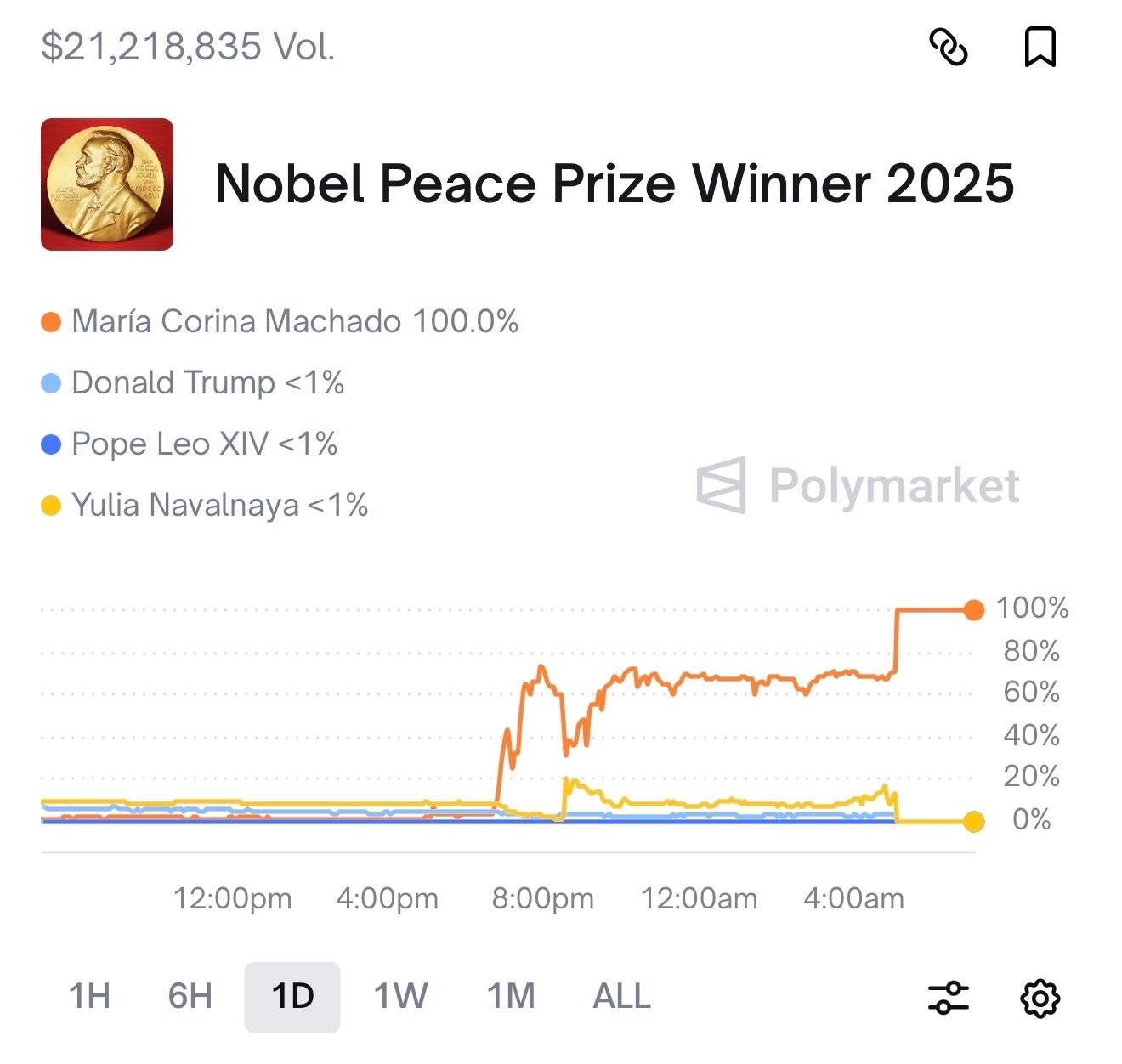
Chart showing the ‘Nobel Peace Prize Winner 2025’ market on Polymarket
What this teaches us is that prediction markets can be a particularly valuable source of information. For example, investors have every reason to anticipate the Fed’s next monetary policy decision.
There are now many prediction markets, each with its own unique characteristics. The sector is nevertheless dominated by Polymarket and Kalshi, two giants in terms of the trading volumes they generate:

Chart showing weekly trading volumes on the Polymarket (blue) and Kalshi (green) platforms since the beginning of 2025
For example, Polymarket reported $841.5 million in trading volume, while Kalshi reported $909 million for the week of October 6–12.
Other prediction markets, such as Limitless or Myriad, although smaller in terms of volume, offer interesting features: crypto-native betting, a superior user experience, and more.
It is precisely these players that I am keeping a close eye on: they could benefit from significant media exposure when Polymarket goes public.
Consider the popularity that all decentralized exchanges (DEXs) for perpetual contracts enjoyed following the launch of Aster (publicly supported by Changpeng Zhao, founder of Binance). I believe we’ll see a relatively similar phenomenon when Polymarket goes public and other prediction markets launch their tokens.
There is therefore an opportunity to engage with these prediction markets and potentially become eligible for an airdrop, where the token’s price could be driven by the hype surrounding prediction markets.
The Creator Economy with Zora
If there’s one other project that has caught my attention in recent weeks, it’s Zora, a social app experimenting with a unique monetization system. In fact, every profile—and even every post published—is linked to a cryptocurrency. These are known as “content coins” and “creator coins.”
The principle is as follows: each creator receives a share of the trading fees generated by their content coin or creator coin. Users can either speculate on content or a creator that might go viral, or simply support their favorite creators—much like tipping—by accumulating crypto tokens linked to their content.
This new way of monetizing content is still very much experimental, and there’s no guarantee it will succeed. Nevertheless, it’s this kind of experimentation that catches my attention because it’s fertile ground for even more experimentation.
For example, an analyst at Messari is testing an innovative model: he takes trading positions publicly on Zora, and if he realizes gains, he uses a percentage of those gains to buy back his creator coin. This creates buying pressure that could drive the token’s price higher, thereby incentivizing holders to keep his creator coin beyond mere viral speculation.
In another example, an on-chain analyst offers access to his private Telegram group in exchange for 2.5 million of his creator coin. He then burns 2 million tokens and keeps the rest as compensation for his work.
The goal here is not to highlight X or Y coin, but rather to demonstrate how Zora’s model—and the experiments associated with it—can breathe new life into the creator economy, while also benefiting token holders.
These two weak signals are just a glimpse of the emerging dynamics that I plan to continue exploring in future editions. The goal remains the same: to help you identify, understand, and potentially capitalize on the projects that are shaping the crypto of tomorrow right now.
Source: Artemis