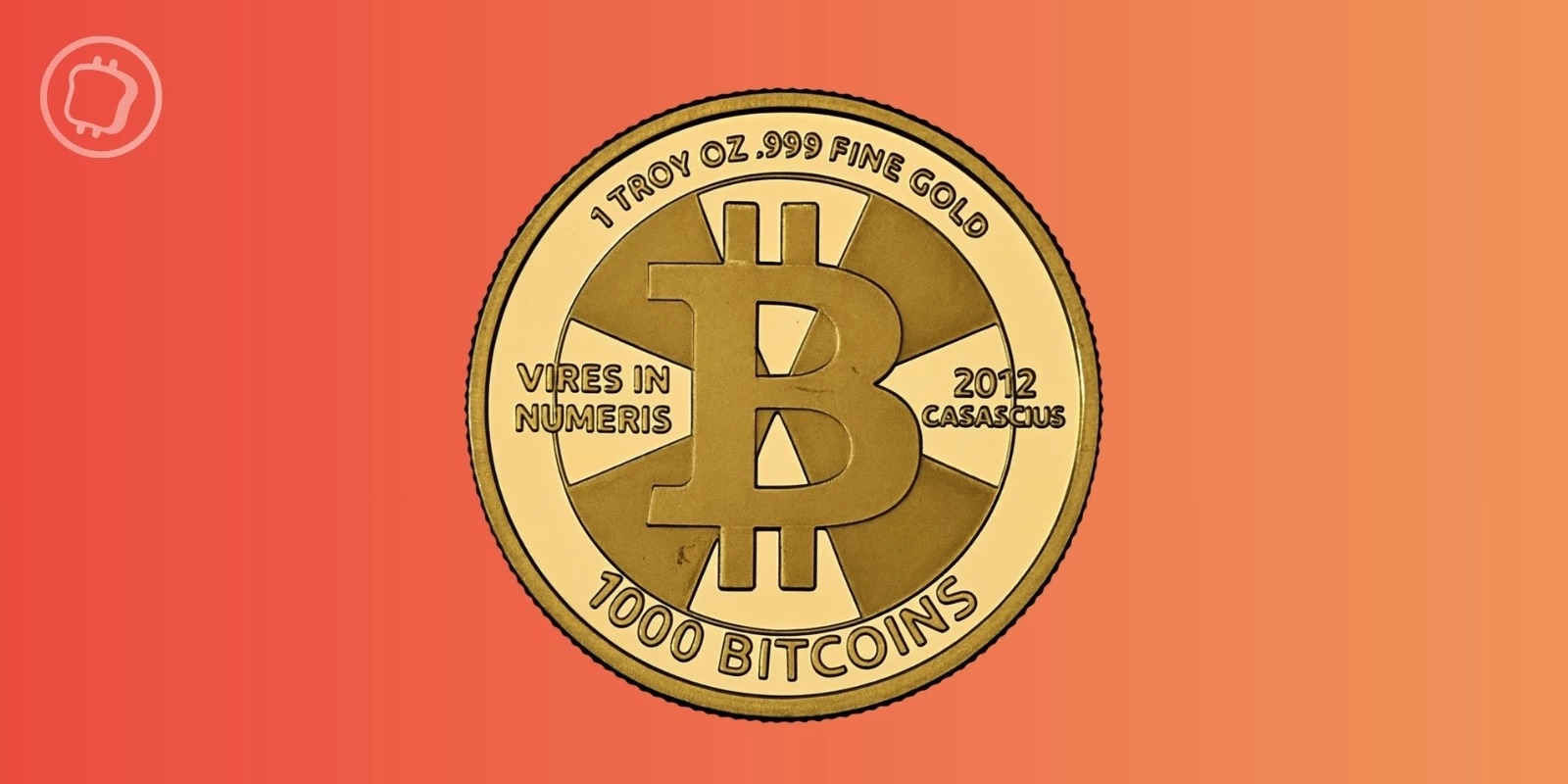
Between 2011 and 2013, a man named Mike Caldwell created physical coins linked to Bitcoin called Casascius Coins, featuring different amounts and rarities. Two of them, each containing 1,000 BTC, have just been reactivated after 13 years of dormancy.
2 Casascius Coins worth 1,000 BTC resurface
Since its creation in 2009, Bitcoin has often been criticized for its intangible nature. A reality to which Mike Caldwell, a software engineer from Utah known by the pseudonym Casascius, sought to provide a very real solution starting in 2011 with the creation of his famous Casascius Coins.
In fact, each of these metal coins contains real bitcoins embedded inside, in the form of a private key hidden and protected by a hologram designed to ensure their security. There are several types, with different amounts and characteristics, such as the metal used, which may represent a certain amount of gold.
While some, made of brass, contain only 1 BTC, it is the rarer specimens that have recently come back to life after more than 13 years of dormancy. Indeed, transactions involving two Casascius Coins worth 1,000 BTC from 2011 and 2012 have recently appeared on the blockchain, according to information shared by the X Documenting Bitcoin account. Estimated value: over $180 million.
Two Casascius bitcoin, each holding 1,000 bitcoin, have just moved after sitting untouched for more than 13 years. Casascius coins are ‘physical bitcoins’ from the early days, containing a private key hidden under a tamper-evident hologram that can be redeemed on the blockchain. pic.twitter.com/mBZsRXcRP6
— Documenting ₿itcoin (@DocumentingBTC) December 5, 2025
Two Casascius bitcoins, each containing 1,000 BTC, have just been moved after remaining untouched for over 13 years. Casascius coins are early “physical bitcoins,” containing a private key hidden beneath a tamper-proof hologram that can be traded on the blockchain.
Documenting Bitcoin
There is still $1.6 billion in BTC to be unlocked
Between 2011 and 2013, these Casascius Coins were sold at the BTC price at the time of their creation, with a premium added based on their specific features and rarity. For the 1,000 BTC “Gold Cas” models involved in this case, their prices were therefore around $5,000 in December 2011 and $12,000 in October 2012.

Details of the Casascius Coins in question
At the time of writing, the Casascius Tracker website indicates that 10,260 BTC appear as redeemed, compared to 17,678 still considered “active” within their cold wallets, equivalent to $1.6 billion still dormant since that time.
Notable fact: production of Casascius Coins ceased in November 2013, almost exactly when Bitcoin first surpassed $1,000. The reason for this suspension at the time was a complaint from FinCEN, which considered that these BTC-preloaded coins enabled money transfers subject to anti-money laundering (AML) regulations.
Another notable fact: unlocking these Casascius Coins at 1,000 BTC should allow their holders to claim certain cryptocurrencies associated with Bitcoin forks, such as Bitcoin Cash (BCH), representing an additional profit of nearly $600,000 per unlocked coin.