Is the U.S. economic model running out of steam? Numerous indicators suggest that the world’s leading economy is in trouble. Bitcoin has fallen to $60,000 and has seen its price halve since its October record high
In a new bearish surge, the price of Bitcoin nearly broke through the $60,000 level overnight. Currently, BTC has seen its price halved since its all-time high (ATH) last fall.
Bitcoin (BTC) sees its price break through new symbolic levels
Overnight from Thursday to Friday, Bitcoin (BTC) extended its losses from recent days, dropping to nearly $60,000. Since then, the asset has rebounded to $64,800, but is still down 8.7% over the past 24 hours:
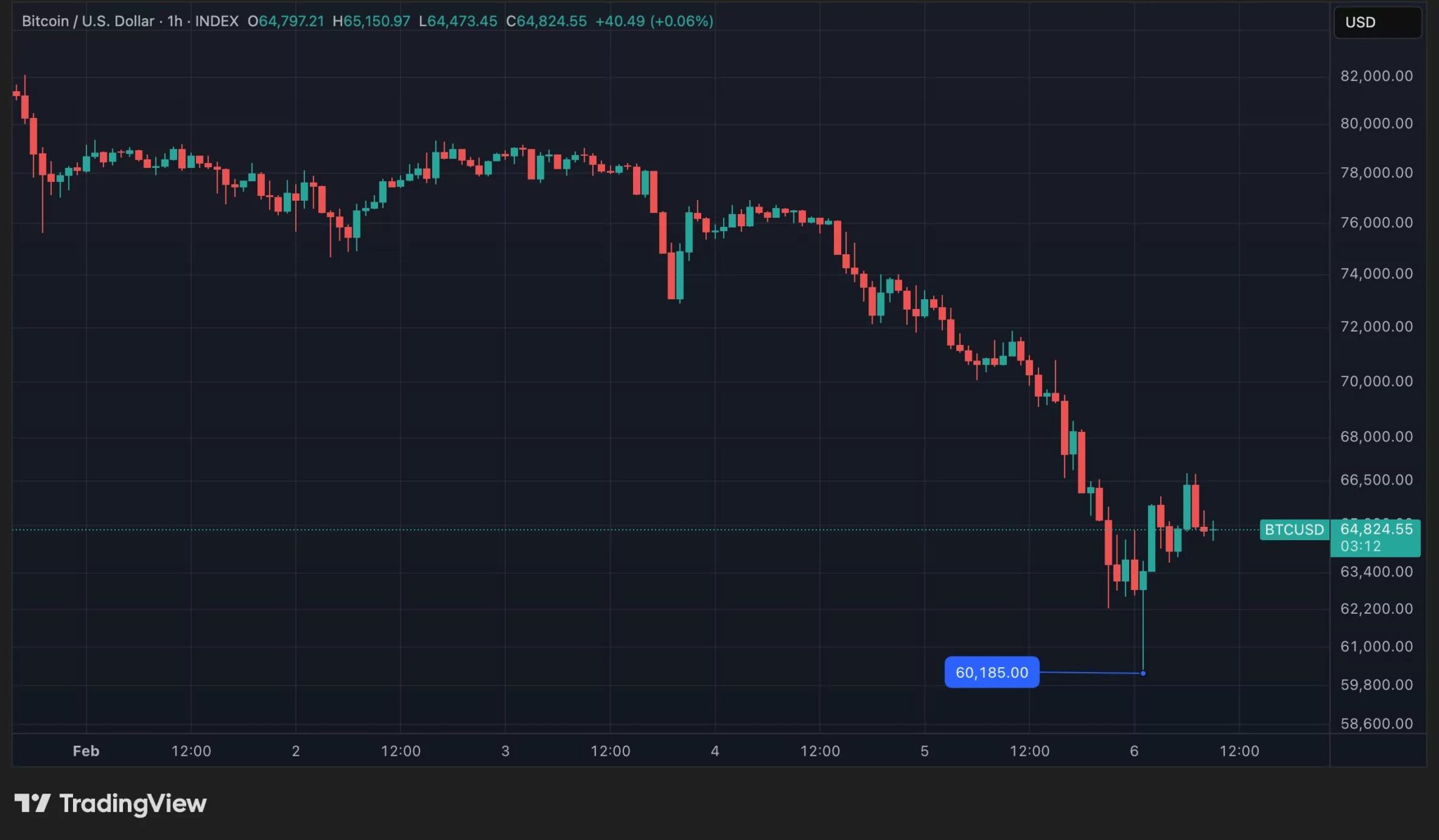
BTC price (hourly data)
At midnight Paris time, BTC closed out Thursday down 13.98%, a drop not seen since the collapse of the FTX cryptocurrency platform, when the price of Bitcoin fell by more than 14% on November 9, 2022.
Bitcoin’s price is now down 48.5% from its all-time high (ATH) of $126,000 on October 6. On the Polymarket prediction market platform, traders now believe that BTC is more likely to fall below $30,000 than to surpass its record high by 2026. Furthermore, the probability of falling below $55,000 has risen to 73%, while the probability of falling below $50,000 stands at 59%:

Polymarket prediction market on the price of Bitcoin in 2026
For the month of February, Polymarket users also estimate that there is a 31% chance the $55,000 threshold will be broken. Meanwhile, CoinMarketCap’s Fear and Greed Index has fallen to 5, which corresponds to a level of “Extreme Fear.”
Of course, the current bearish climate is ripe for all sorts of speculation that BTC will continue to fall. This is entirely possible, but in these moments of panic, it can also be easy to forget Bitcoin’s fundamental values. Despite the crisis, this does not detract from BTC’s role as a store of value, and while past performance is no guarantee of future results, let’s not forget that, even after such a correction, the asset still boasts a performance of over 18,000% over 10 years.
is reportedly entering a period of recession. Let’s take stock…
United States: Record Layoffs at the Start of the Year
Donald Trump’s arrival in the White House clearly marks a shift in the management of the U.S. economy, both domestically and internationally, to the point that he recently praised the significant decline in the dollar that has occurred since the start of his term.
This situation is compounded by the abysmal U.S. debt, now estimated at $38.5 trillion—or, to put this figure in more concrete terms, a national debt estimated at approximately $111,000 per American citizen, which entails paying $3 billion in interest per day.
In this already complicated context, new data has just shaken the little confidence that some analysts still had: more than 100,000 job losses were recorded in January alone, a record not seen since 2009, in the midst of the recession.
January layoffs hit a 17-year high. U.S. employers announced 108,435 layoffs in January, a 205% increase from December and the highest January total since 2009, according to Challenger, Gray & Christmas.
Walter Bloomberg
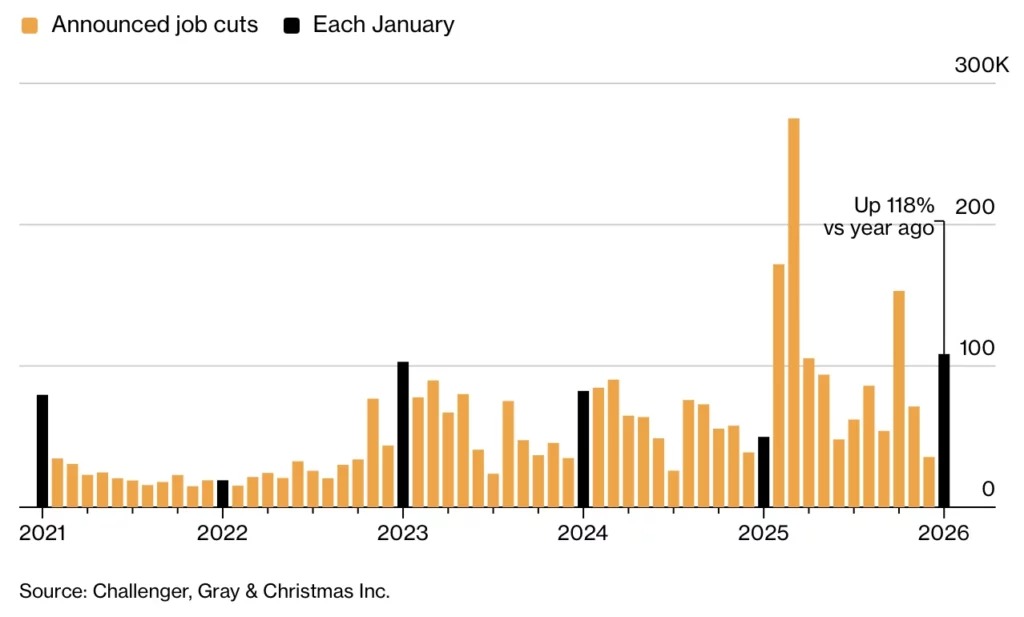
Worst January for job cut announcements since 2009
At the forefront of these job cuts are giants UPS (30,000) and Amazon (16,000), whose stock has just plummeted by more than 10% following the release of its Q4 2025 results.
A total that is “particularly high for a January,” according to an official at Challenger, Gray & Christmas, who notes that “employers are not very optimistic about the outlook for 2026.”
Is the U.S. economy entering a recession?
A wave of layoffs that can be linked to the critical situation facing many tech companies, which are struggling to meet their loan payments. As a result, the distress rate for tech bonds has reached a high not seen since the fourth quarter of 2023, nearing 9.5%.
At the same time, the real estate market is struggling to find buyers. This is a major problem, as this sector is seen as essential to maintaining a strong economy. Indeed, as the X Crypto Rover account explains, “when real estate slows down, it affects construction, banks, credit, and consumer confidence—all sectors closely linked to recessions
.”
In this context, a rate cut by the Federal Reserve (Fed) could help alleviate these economic tensions. This has been a recurring demand from Donald Trump, which recently led to outright harassment of Fed Chair Jerome Powell, to the point of undermining market confidence in the institution’s necessary independence. And it goes without saying that the announced arrival of his replacement raises more questions than it answers on this subject.
Finally, the yield spread between 2-year and 10-year U.S. Treasury bonds is currently at a historically high level over the past four years. This situation, known as “bear steepening,” results from persistent inflation, high debt, and a widespread loss of confidence.
All of these factors generally appear to be the early signs of an imminent recession.