
With the price of Bitcoin (BTC) falling below $80,000 this weekend, what will be the low point of this bear market? Let’s try to predict the future based on lessons from the past.
How low can we expect Bitcoin (BTC) to go?
Over the weekend, the price of Bitcoin (BTC) fell below $80,000 for the first time since April 2025, dragging other cryptocurrencies down with it.
Now that it is clear we have indeed been in a bear market for some time, we can ask ourselves how far this decline will go.
To estimate this, we can look to the past to determine the magnitude of the corrections BTC has faced throughout its history.
To do this, we examined the BTC price on a monthly chart by zooming out significantly to view the last four major corrections from previous cycles:
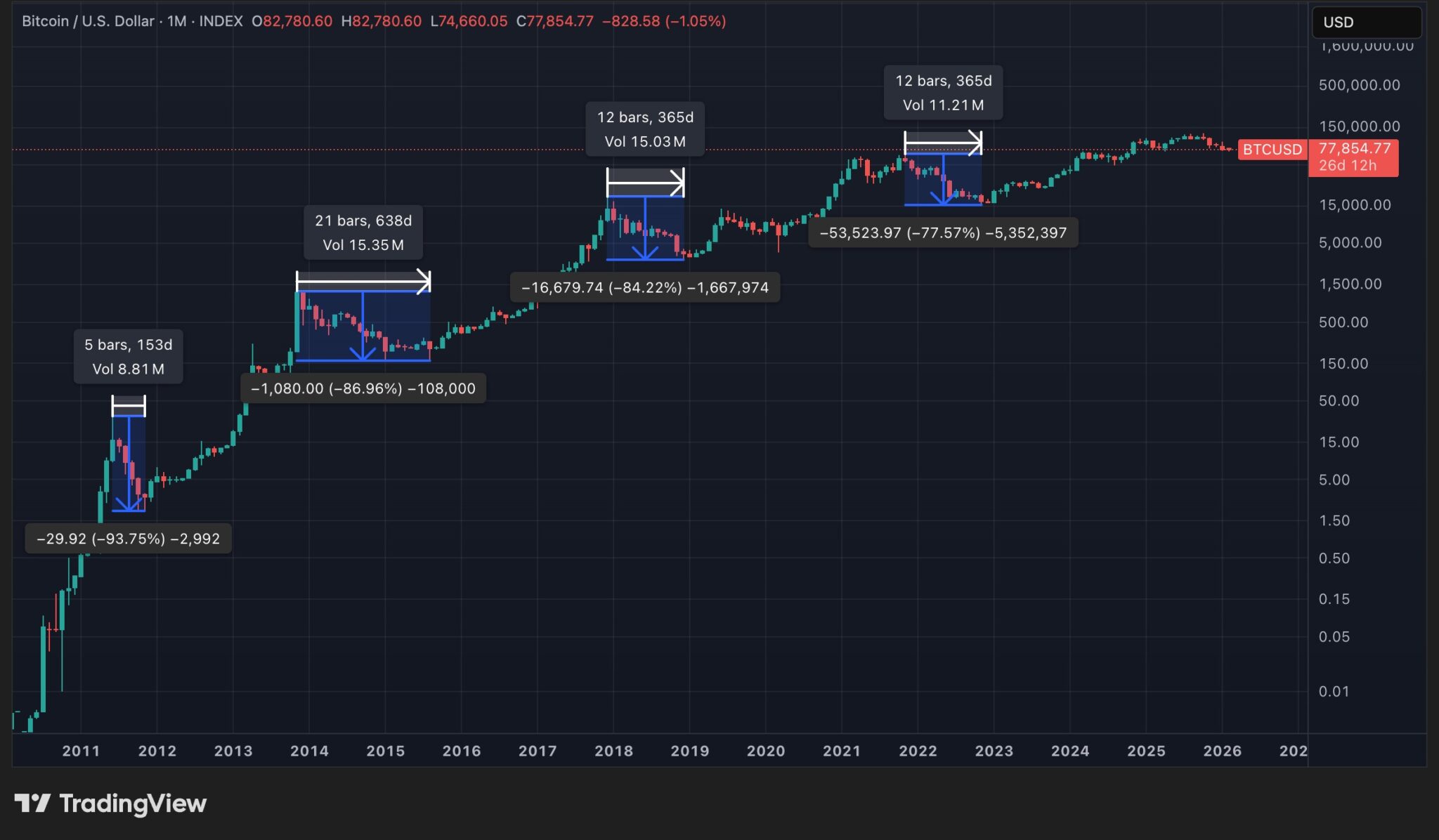
History of BTC declines
Between the previous all-time high (ATH) and the last low before a bullish rally, BTC has thus lost between 77.57% and 93.75% per cycle, over a period of 5 to 12 months.
What is notable is that, to date, prices have fallen slightly less with each new bear market than during the previous cycle—a trend that also holds true for the various bull runs.
Thus, we might expect a less severe decline during this bear market, especially as Bitcoin is increasingly adopted by traditional finance.
However, the scenario of a bottom having already been reached would be completely unprecedented in the asset’s history. And for good reason: between its October ATH and this weekend’s low, BTC fell by “only” 40.85% over a period of just four months.
Assuming a decline of the same magnitude as that of the 2022 bear market—which was the shallowest—this would result in a price target of $28,300.
Although too little data is currently available and the model is therefore not relevant, we can also note that the magnitude of the price decline is, on average, 6% smaller with each cycle. With this in mind, we could hypothesize a 72.84% decline for the current move, which would imply a low of $34,280 for BTC.
For now, these are merely assumptions based on past data, but the bull run we have just witnessed also showed a much smaller increase than what we had previously experienced.
Therefore, we can only engage in speculation and remain cautious in our projections.
Furthermore, a more positive scenario could involve observing the 50-month moving average, which has served as a relatively reliable support level in the past. If the BTC price were to simply touch it, this would represent a 55% decline from the ATH, resulting in a price target of $56,800:
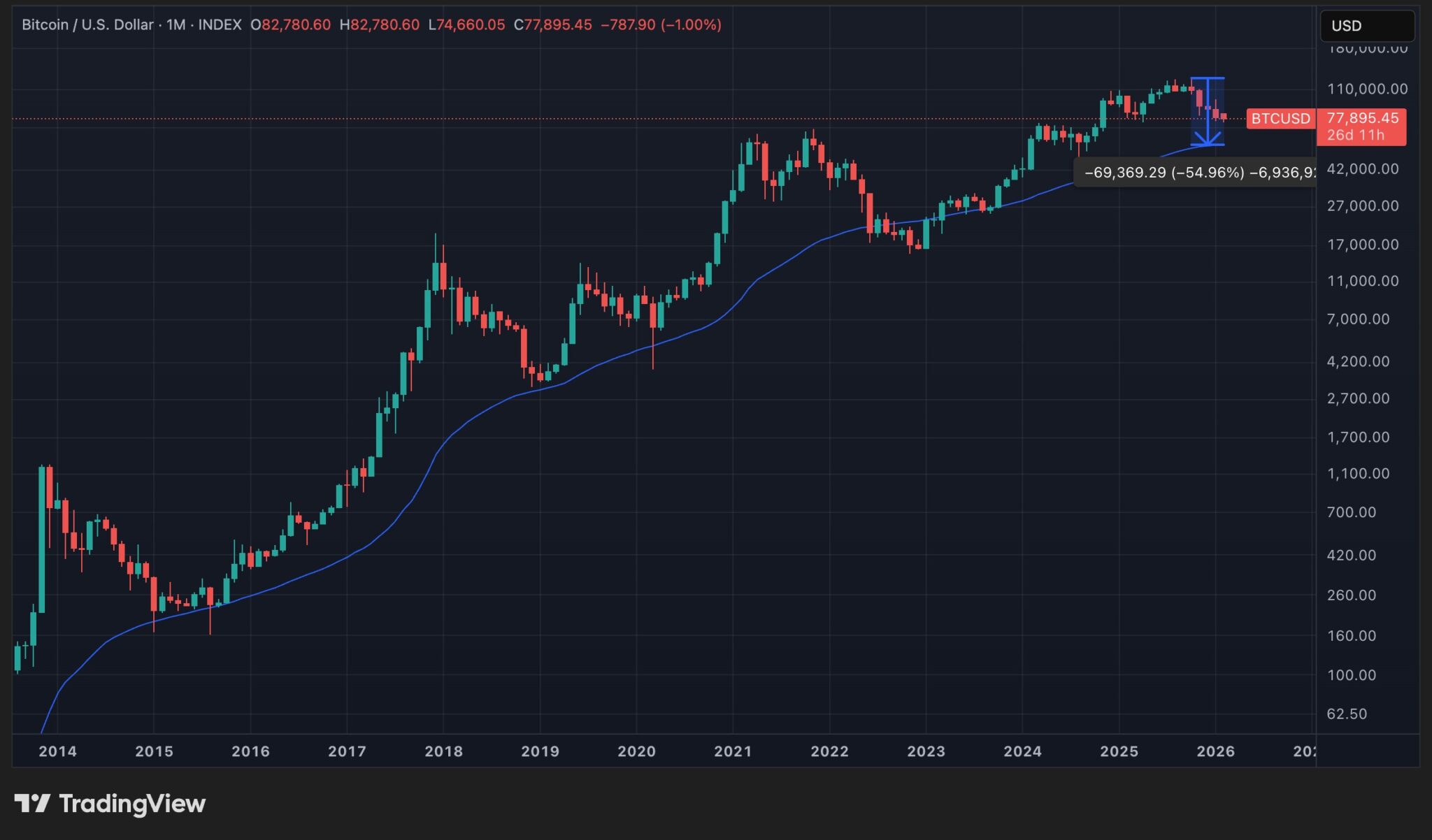
50-month moving average on BTC
Regardless of the direction prices take over the coming months, current levels could already represent an attractive entry point from a long-term perspective, suggesting that investors consider implementing a dollar-cost averaging (DCA) strategy.