
The Variational platform, driven by its flagship product Omni, has established itself as a key player in decentralized cryptocurrency trading. Thanks to a unique liquidity management system and an unprecedented loss reimbursement policy, it is attracting the attention of investors on the lookout for the ecosystem’s next major airdrop. Find out how to earn points and maximize your chances of receiving the $VAR token distribution scheduled for 2026.
What is Variational?
Variational is a protocol designed to make investing in and trading decentralized assets much easier and more accessible to everyone. To achieve this, they developed Omni, a perpetual DEX built on an unconventional infrastructure.
Omni is the perpetual DEX where farmers primarily focus; it is Variational’s flagship application and product. It offers over 500 assets—all cryptocurrencies—and operates on a classic oracle system that retrieves information from reliable sources to display a price. To function, Omni directly uses Variational’s infrastructure, but also—and most importantly—a system running on a highly efficient OLP.
The Omni Liquidity Provider (OLP) serves as the platform’s market maker (MM); it can be broken down into three components:
- The vault: where liquidity is stored;
- The market-making engine: its goal is to keep spreads (the difference) as tight as possible. To do this, for every position A taken by the user, the market maker will take position B. Example: if Bob opens a long position, then the platform will open a short position; the goal being to keep price spreads as small as possible so that your trades are executed at the best possible price, while allowing the OLP to earn a small profit on this spread and avoid taking on too much risk;
- The risk management system, which is closely linked to the market-making system.
This operation also has other very interesting advantages, this time more user-oriented: first of all, there are no fees, since Omni uses an internal MM, there is no need to fund a third-party organization, so the platform does not need to charge fees to generate revenue.
The internet MM also allows for the listing of a wide variety of assets, because thanks to Variational, there is no need to add external MMs; they only need a reliable price (via an oracle), a pricing strategy, and liquidity to manage risk (provided via vaults).
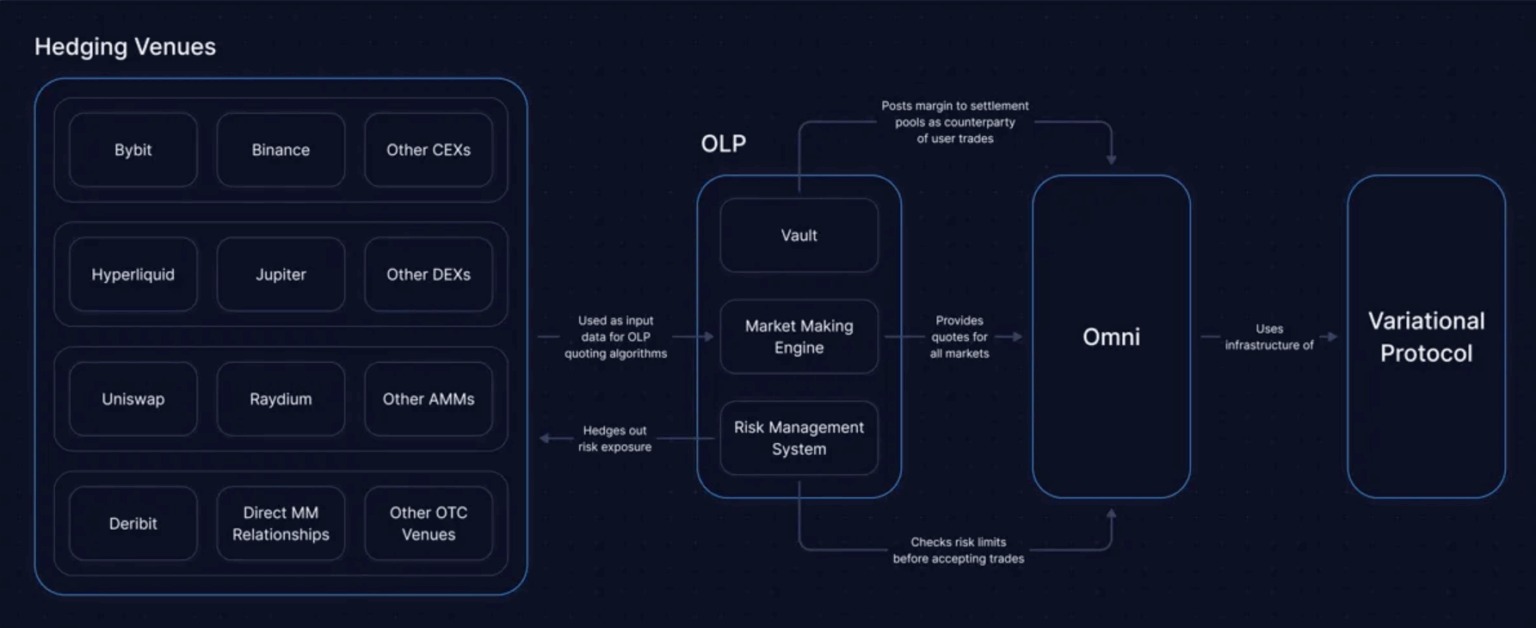
How the OLP works on Variational
But that’s not all—the platform also benefits from a major advantage: loss refunds. Nearly 10% of the revenue from trading activity on Omni is sent directly to the “Loss Refund Pool” (LRP).
Here’s how it works: whenever a user incurs a loss of more than $1 AND the LRP has a balance exceeding 100 USDC, the user has a chance to receive a refund. However, this chance is based on the user’s ranking on the leaderboard. The refund is governed by two main rules:
- The refund amount is the greater of 100% of the realized loss or 20% of the total LRP balance;
- A maximum of 3 loss refunds per 24 hours is allowed; beyond this limit, no further refunds will be possible.
Although fairly uncommon in the perpetual DEX space, this approach is interesting because it encourages users to use the platform (to climb tiers and qualify for refunds more easily), while also protecting them by prompting them to execute less risky trades to avoid reaching the point where no refund is available. This approach, as on-chain data indicates, helps maintain a steady user base for the platform.
How to farm the Variational airdrop?
If you don’t know where to start, no worries—here’s an example strategy to implement to start using Variational’s Omni platform correctly.
Wallet
To get started, go to the Omni app website and connect your wallet. The documentation recommends using MetaMask or Rabby on Google Chrome. If you have a referral link, now is the time to use it; this will increase your points and also benefit the person who gave you the link.
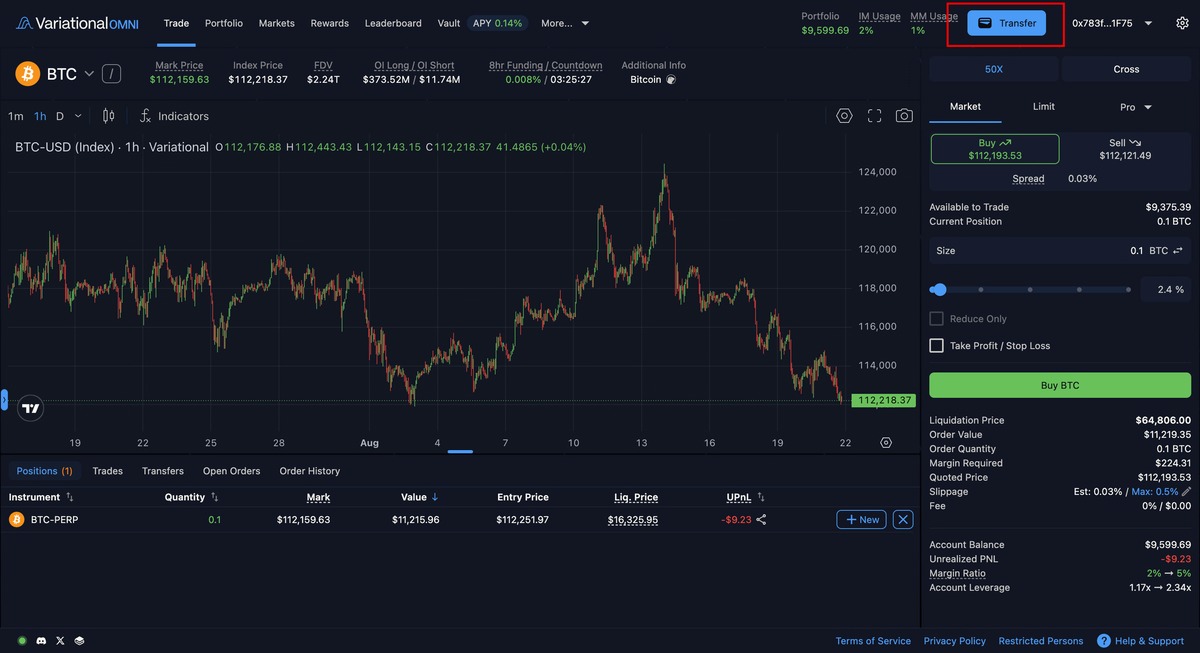
Deposit tab on Variational
To deposit funds, you’ll need USDC on Arbitrum One. You can obtain it through DEXs like Uniswap or via centralized platforms such as Binance or Coinbase. When you make a deposit, a $0.10 fee will be included in the transaction—just as it is when you withdraw—so be sure to factor this in when depositing.
Trading
The trading aspect is, of course, the most important; it will determine your trading volume and P&L. These two factors will help you climb the leaderboard, thereby improving your ranking and boost rate, as well as your chances of receiving a refund in the event of a loss.
With over 500 pairs available, there’s plenty to choose from. Even though nothing has been specified in the documentation or confirmed by the platform, varying your pairs may be a good idea, as the protocol does not offer a boost on specific pairs. Be careful, however, not to end up with too many open positions, as this would increase your risk.
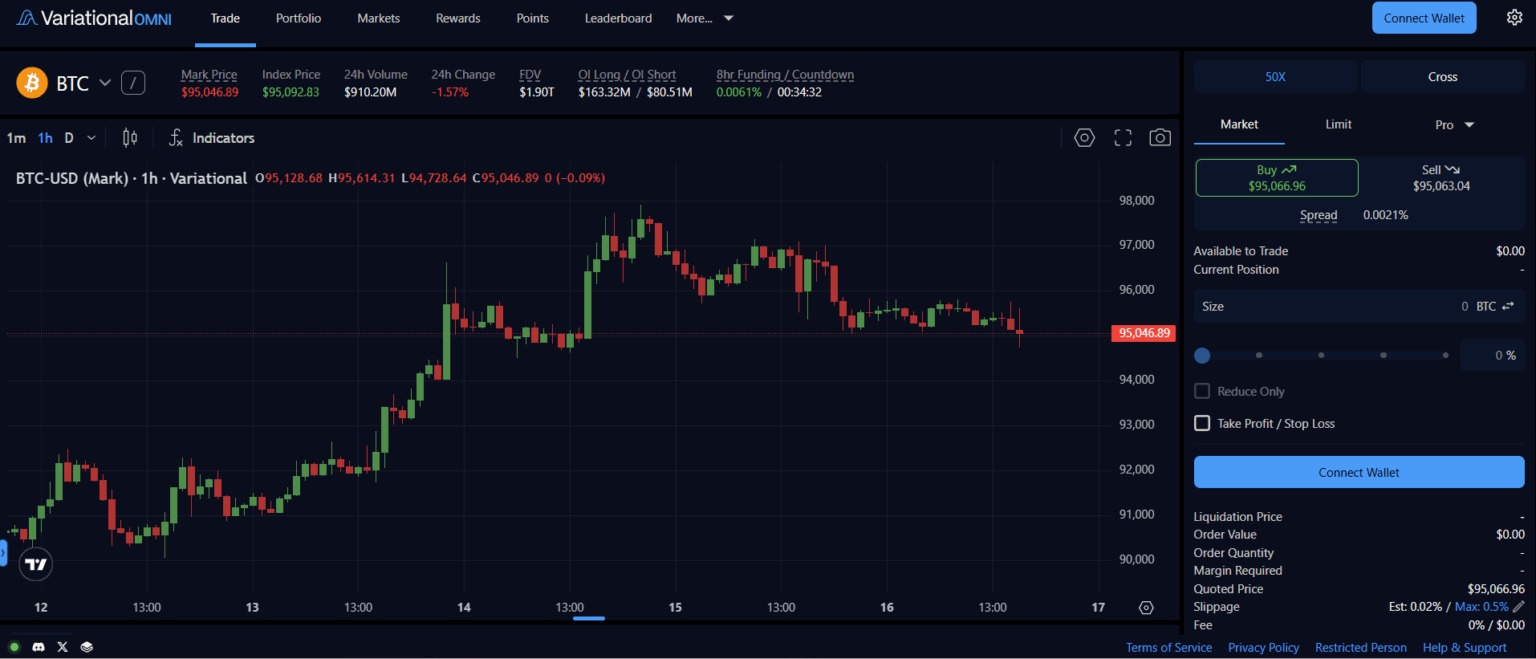
Main trading dashboard
Moreover, as with all similar products, the risk associated with leverage should not be overlooked. Although it can artificially boost your trading activity, these are high-risk tools recommended only for experienced traders. You should also avoid having too many open positions at once, as this incurs significant fees.
Points and Leaderboard
With a program launched on December 17, 2025, over 3 million points have been distributed to traders who were already using the platform. Points are distributed every 6 days, and this weekly distribution is expected to end no later than the end of the third quarter of 2026.
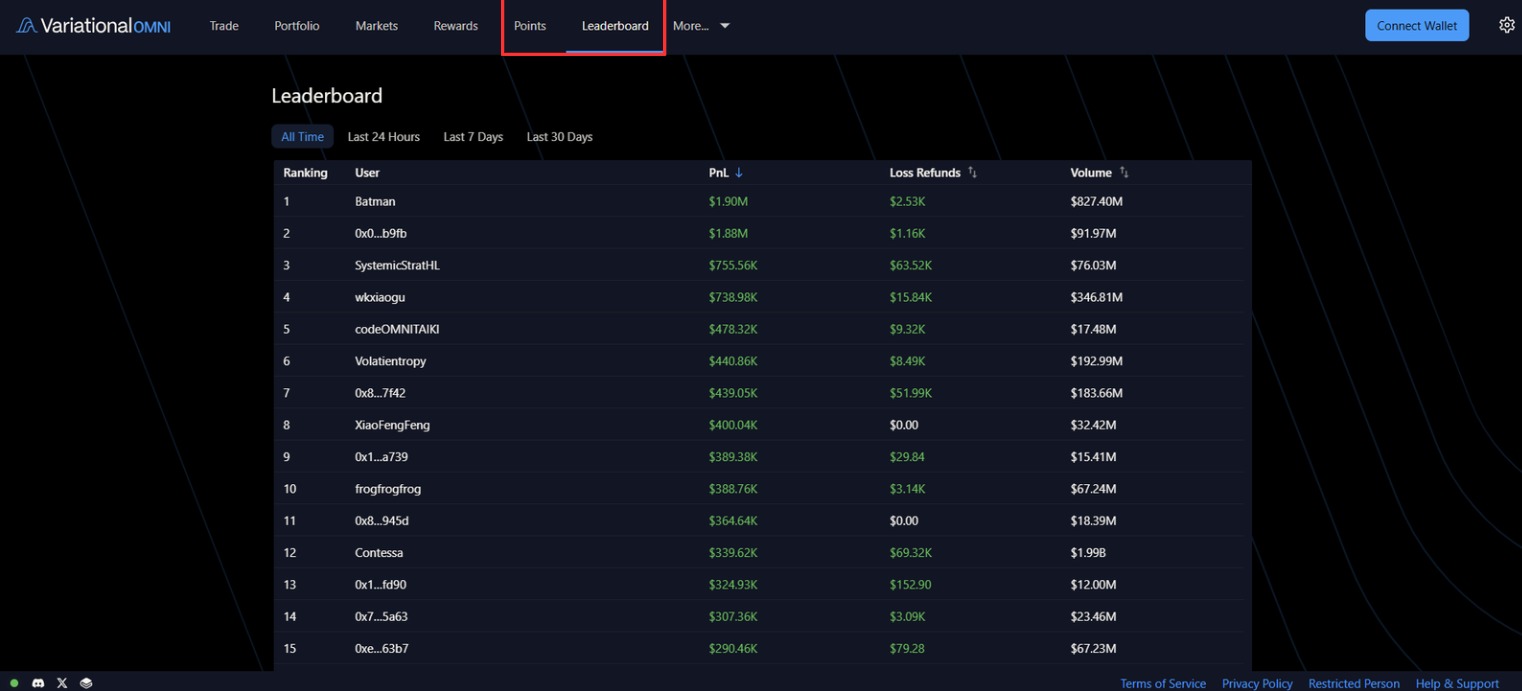
Variational user rankings
Variational’s points system is farming-oriented, with numerous boosts and upgrades available. The platform features a tiered ranking system ranging from Bronze to Grandmaster, which grants varying amounts of bonus rewards.
These rewards are directly linked to traders’ activity over the past 30 days, further proof of Variational’s commitment to retaining its users and encouraging them to generate trading volume.
Why trade on Variational?
Due to its architecture, Variational offers a very wide variety of products. For now, only cryptocurrencies are available (though there are currently over 500), but the platform aims to integrate RWAs and indices.
In terms of figures, Omni currently reports over $100 billion in trading volume, open interest exceeding $750 million, and, most notably, over $2 million in refunds.
These figures demonstrate that the platform indeed has the financial resources to meet any need. Furthermore, in addition to the initial financial contribution provided by Variational to ensure the OLP’s successful launch, the platform has raised over $11 million thanks to support from leading investors such as Coinbase Ventures, Bain Capital Crypto, Mirana, Caladan, PeakXV, and DragonFly.
The platform has confirmed that nearly 50% of the supply of the future $VAR token will be distributed to the community and that 30% of the protocol’s revenue will be burned to purchase $VAR.
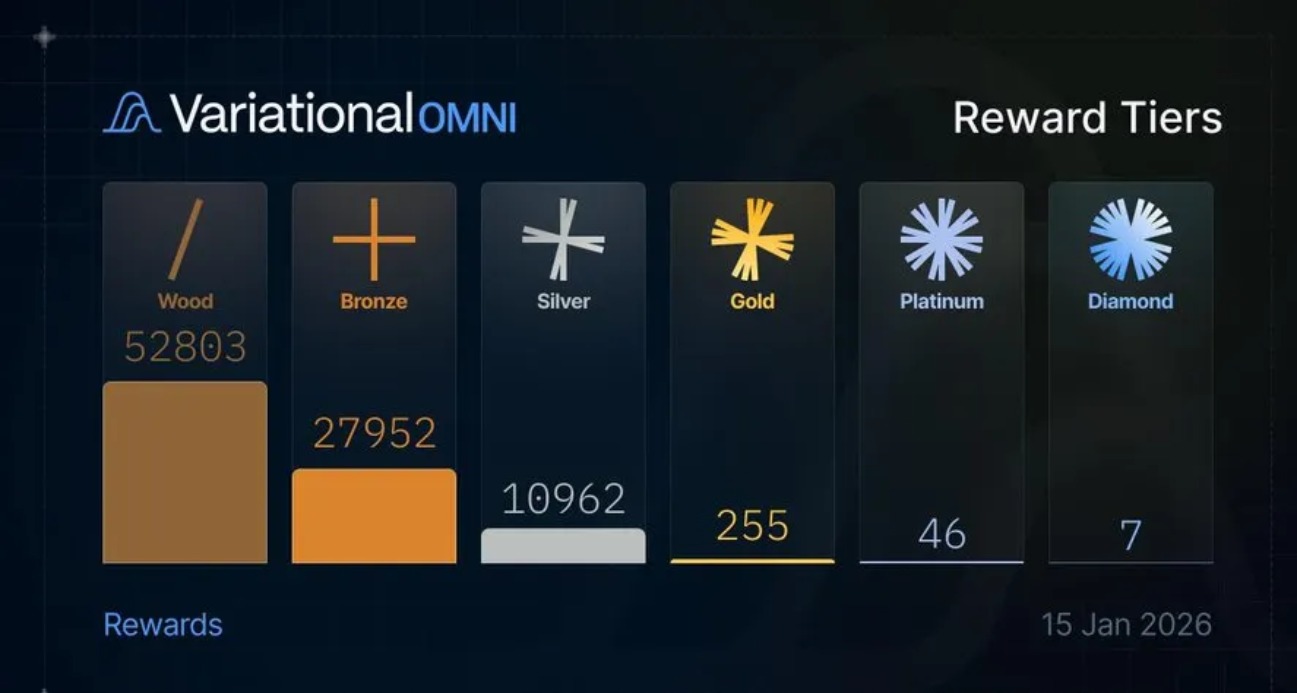
Variational token distribution on January 15, 2026
Variational on-chain data
With over 90,000 addresses created and an average of 30,000 active addresses daily, there is only one conclusion to draw: the Variational protocol works, and users are returning.
Beyond this data, user retention and engagement are impressive, as the retention rate stands at 33%, whereas it typically hovers around 20%. It remains to be seen what it will be after the airdrop.
In terms of Total Value Locked (TVL), there are no surprises. The figures show that 50% of liquidity is split between the largest wallets in the Top 10 (20%) and the Top 100–1,000 (30%).
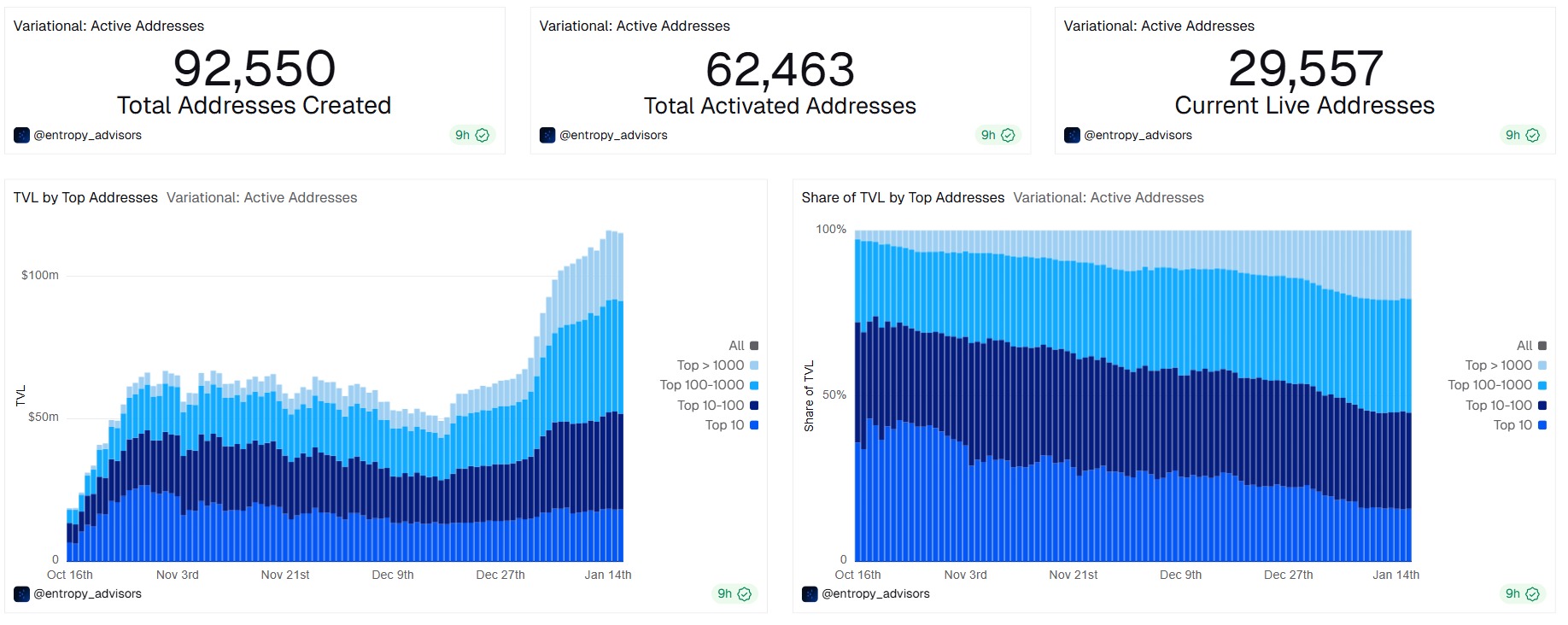
TVL and Variational addresses on DUNE
Another very interesting metric is the loss refund distribution: Does the platform still refund its users? The answer is yes, but it does so differently than in its early days.
In fact, the platform reached its peak refund amount on October 16, 2025, with over $150,000 in refunds. As of mid-January, $50,000 is being refunded each day—three times less.
There is an explanation for this: the number of users. In October, there were 2,000 active users; currently, there are over 19,000. Consequently, there are more people to reimburse, and since there are more users, the probability of receiving a refund decreases, hence the decline. This is therefore not a sign of a slowdown or a loss of money for the protocol, but rather a sign of growth; one need only look at the size of the refund pool, which has been steadily increasing since early December.
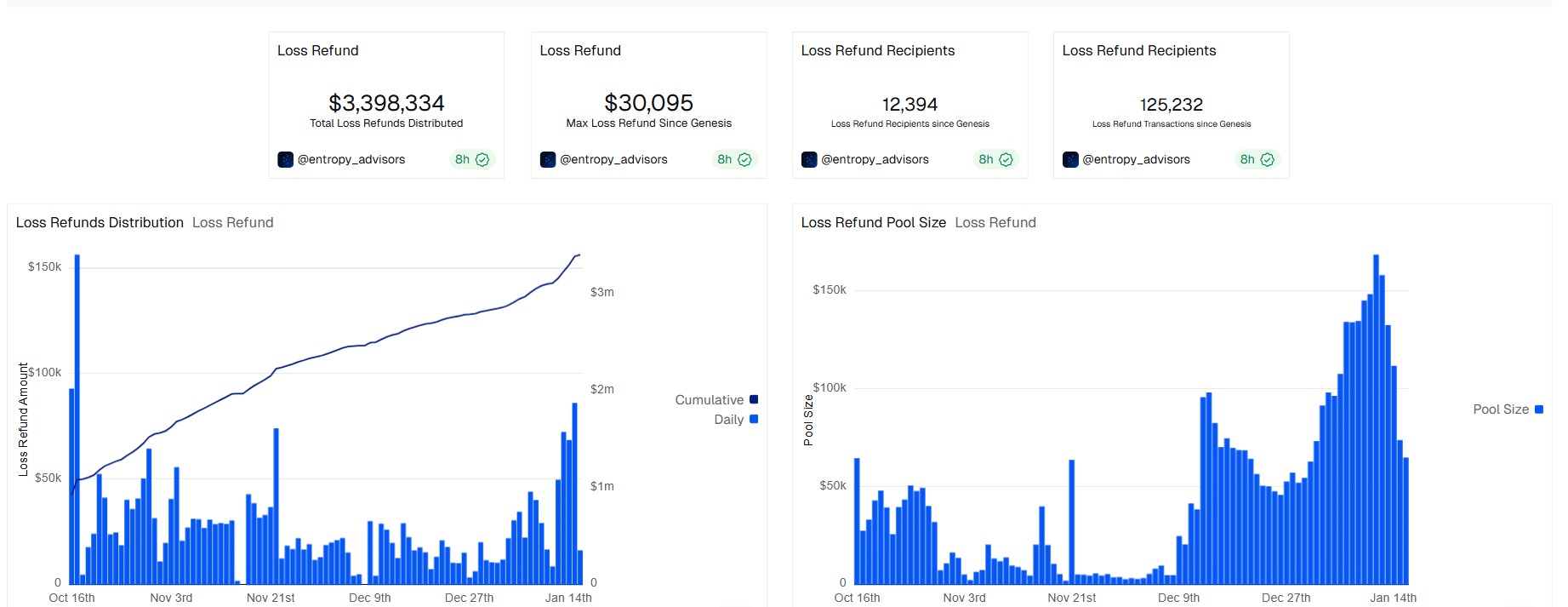
Variational refund data on DUNE
Conclusion
Variational is positioning itself as one of the most promising airdrops of 2026, despite the lack of communication regarding the $VAR token itself (such as the TGE date, tokenomics, or total supply). The protocol has successfully earned users’ trust to retain active and regular traders.
This lack of communication is overshadowed by the protocol’s innovations in security and efficiency. Finally, support from major financial players such as Coinbase Ventures and Peak further strengthens the Variational protocol’s already established reputation. It may be worth keeping an eye on it.