
The Ethereum blockchain has seen a notable surge in activity since its latest Fusaka upgrade, setting a new record for daily transactions while fees remain at an all-time low. At the same time, the validator backlog has finally dropped below the 24-hour mark.
New Activity Record on Ethereum
Clearly, there is a before and after following Ethereum’s latest major update last December, codenamed Fusaka. And for good reason: this hard fork included major changes, such as an increase in the gas limit of its blocks and optimized management of “blobs” using dedicated BPOs.
Since its official deployment, activity on its blockchain has continued to rise, reaching a new all-time high earlier this week with 2.88 million transactions processed in a single day, according to data from Etherscan—a more than 70% increase compared to the records set during the 2021 bull market.
One of the obvious reasons for this significant increase in activity on the Ethereum blockchain is undoubtedly the relatively low level of its gas fees, with transactions costing an average of 0.04 gwei—less than $0.01. As a result, a standard swap currently costs just 5 cents.
This smooth operation is also—and finally—reflected in the management of its validators, following weeks of absurdly long waiting times that were still exceeding one month just a week ago. In fact, this wait time has finally dropped below 24 hours, even though the wait to join the network remains at over 47 days.
“Ultra sound money” that still has to prove itself
Despite these very good results, Ethereum has still not managed to win a crucial battle that began with its transition to Proof of Stake (PoS)—The Merge—in September 2022: becoming “ultra sound money” with a deflationary focus, modeled after Bitcoin.
In fact, the available supply of ETH has continued to show a steady increase since that date, although it seems fair to say that this remains under control. According to data from the Ultra Sound Money website, this increase amounts to a total of 866,696 additional ETH (currently $2.6 billion), despite a burn of over 2 million units during this period.
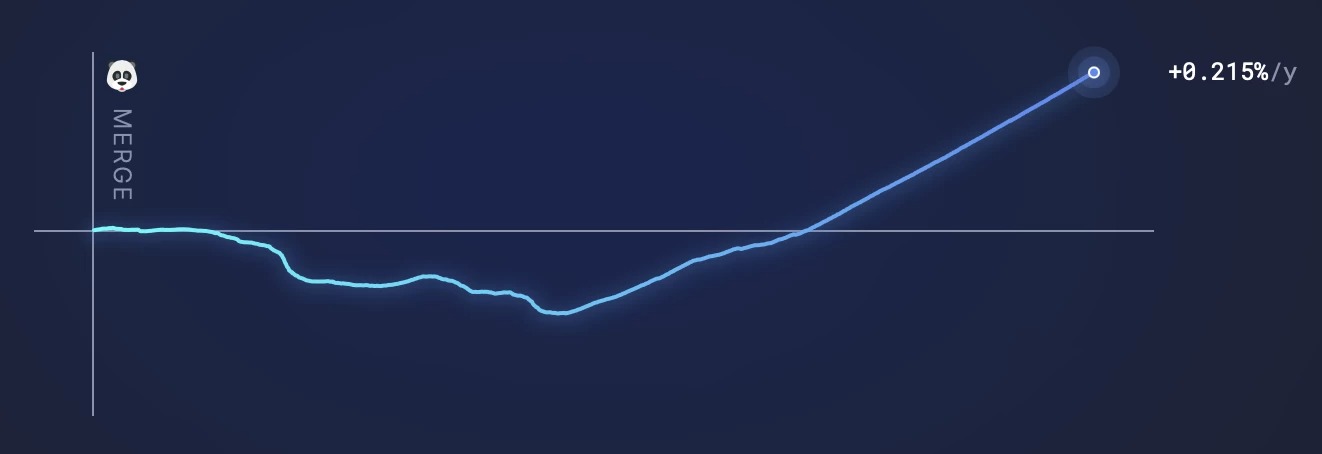
The available supply of ETH continues to increase over time
It therefore appears that usage of the Ethereum blockchain is not yet sufficient to generate enough fees to result in a total burn that would make ETH deflationary.
Perhaps the current surge in activity will be enough to reverse the trend?