On October 31, 2025, the Bitcoin white paper turns 17. Published by the mysterious Satoshi Nakamoto, this 9-page document proposed a peer-to-peer payment system without intermediaries. A concept that has since transformed our relationship with money, finance, and sovereignty.
The Bitcoin white paper: a document that revolutionized our world
October 31, 2025 marks the 17th anniversary of the publication of the Bitcoin white paper, a document of just 9 pages that is transforming the global economy.
Titled “Bitcoin: A Peer-to-Peer Electronic Cash System,” it was published by the mysterious Satoshi Nakamoto, a pseudonym that remains unidentified to this day.
This seminal text presents an innovative idea that many had tried to create unsuccessfully before him: an electronic payment system operating without a trusted intermediary, without the need for a bank.
By combining several existing technologies—cryptography, proof of work, node distribution, and blockchain—the white paper proposes a protocol for transferring value securely, transparently, and irreversibly over the Internet.
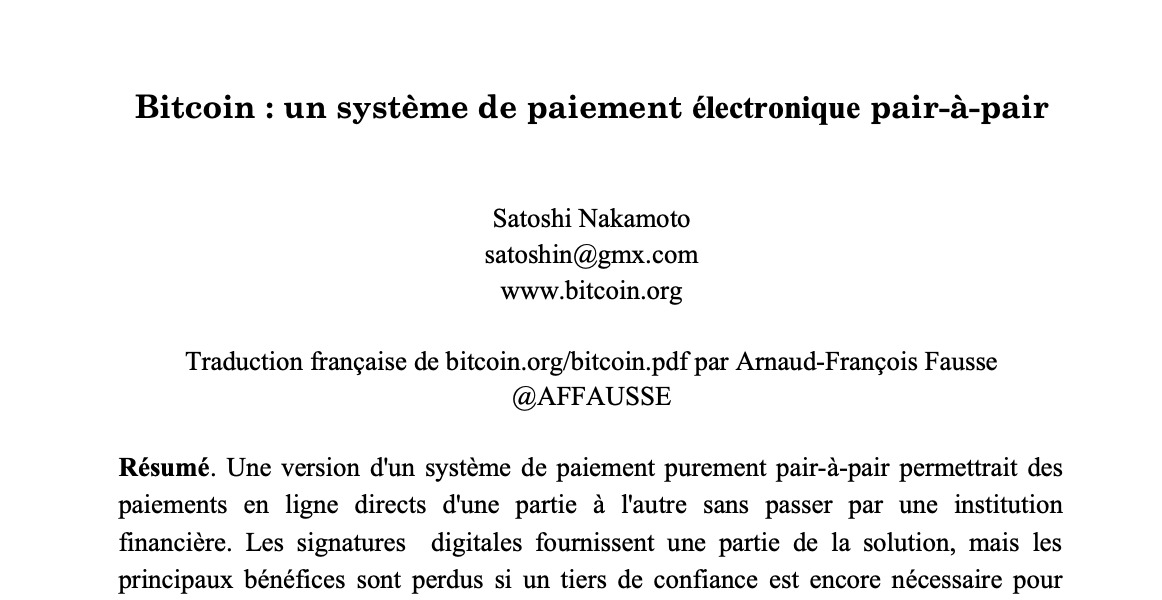
Excerpt from the Bitcoin White Paper
Published on October 31, 2008, on a mailing list dedicated to cryptography, in the midst of the subprime financial crisis, this proposal arrived at a time when confidence in banking institutions was collapsing. The document describes how network participants can validate transactions by expending computational power, thereby securing the entire chain of events.
This computational power is manifested as energy expenditure, which creates a fascinating paradox: in the physical world, the older a piece of information is, the less reliable it is, as it may have been altered, falsified, or erased. With Bitcoin, it’s exactly the opposite: the older the information, the more reliable it is, because it has been verified, validated, and shared by hundreds of thousands of computers spread across the globe.
Has Bitcoin lived up to its promises?
Since its creation, Bitcoin has become much more than a simple financial transaction system: today, it is viewed by millions of people as a store of value, a tool for financial sovereignty, and a hedge against inflation.
But has it lived up to its original promise of becoming digital cash?
Well… not really. Or at least, it depends on your perspective. For some, the Bitcoin network is too slow, too expensive, and too complex to serve as a currency for everyday use. But these “flaws” are actually the hallmarks of a resilient network.
Change even one of its parameters—block size, confirmation speed, money supply, or the proof-of-work mechanism—and you end up with a weakened network, less robust against the test of time and attacks.
It is precisely to preserve this neutrality and resilience that layer-2 solutions have emerged: the Lightning Network, Liquid, Ark, and Spark. Although imperfect and involving compromises, these layers aim to make Bitcoin a true means of payment while maintaining the security of the base layer.
In 17 years, Bitcoin has gone from a fringe idea to a global phenomenon. Satoshi Nakamoto’s white paper remains one of the most influential documents of the 21st century, a manifesto for free, decentralized, and censorship-resistant finance.