
The Variational platform, powered by its flagship product Omni, is now establishing itself as a key player in decentralized cryptocurrency trading. Thanks to a unique liquidity management system and an unprecedented loss reimbursement policy, it is attracting the attention of investors looking for the next big airdrop in the ecosystem. Find out how to accumulate points and maximize your chances of benefiting from the $VAR token distribution scheduled for 2026.
What is Variational?
Variational is a protocol that aims to make investing and trading in decentralized assets much easier and more accessible for everyone. To do this, they have developed Omni, a perpetual DEX built on an unusual infrastructure.
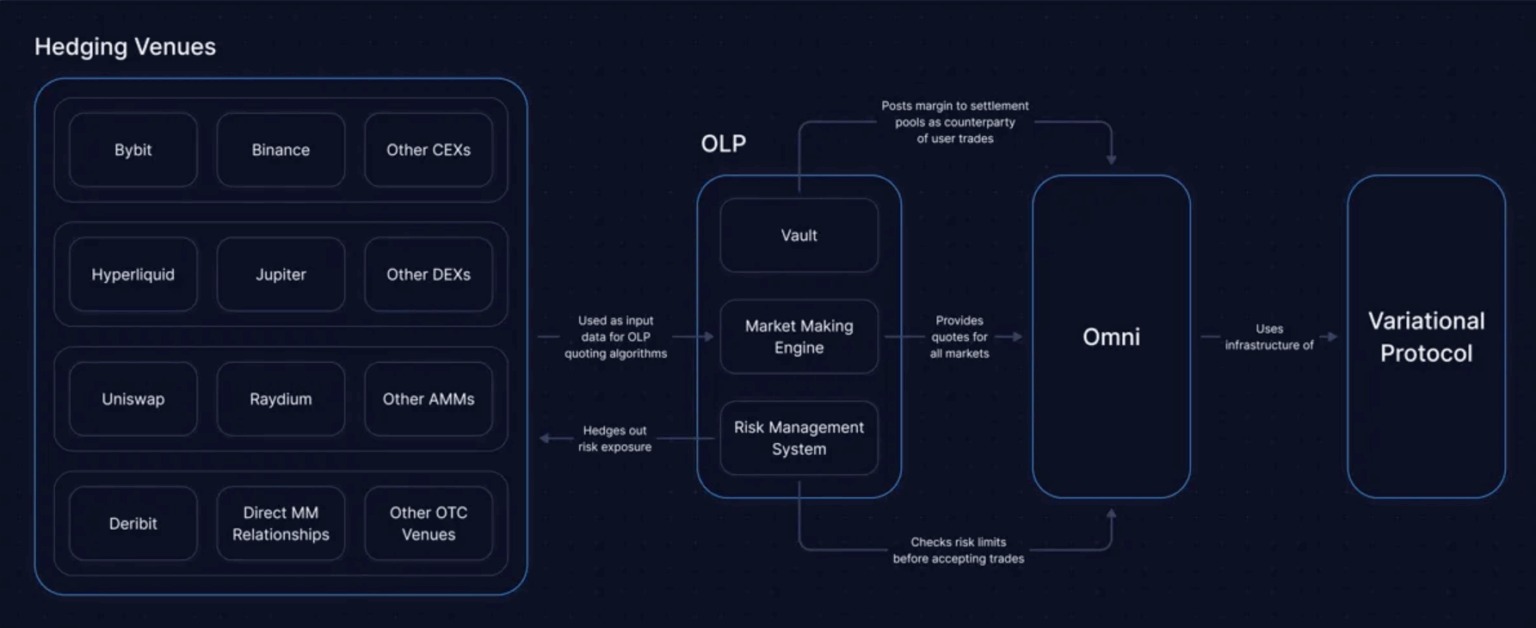
Omni is the perpetual DEX where farmers mainly concentrate. It is Variational’s flagship application and product, offering more than 500 assets, all cryptocurrencies, and operating on a classic oracle system that retrieves information from reliable sources in order to display a price. To function, Omni directly uses Variational’s infrastructure, but also, and above all, a system running on a highly efficient OLP. The Omni Liquidity Provider (OLP) is what serves as the platform’s market maker (MM). It can be broken down into three components:
- The vault: where liquidity is stored;
- The market-making engine: its objective is to keep spreads (differences) as tight as possible. To do this, for each position A taken by the user, the market maker will take position B. Example: if Bob opens a long position, then the platform will open a short position; The goal is to keep price differences (spreads) as small as possible so that your trades are at the best possible price, while allowing the OLP to earn a little money on this difference (the spread) and not take too many risks.
- The risk management system, which is closely linked to the market-making system.
This system also has other very interesting advantages, this time more user-oriented. First of all, there are no fees, since Omni uses an internal MM, there is no need to finance a third-party organization, so the platform does not need fees to generate revenue.
The internal MM also allows for a wide variety of assets to be listed, because thanks to Variational, there is no need to add external MMs. They only need a reliable price (via an oracle), a pricing strategy, and liquidity to manage risk (provided via vaults).
But that’s not all. The platform also has another major advantage: loss refunds. Nearly 10% of the revenue from trading on Omni is sent directly to the Loss Refund Pool (LRP).
The mechanism is as follows: every time a user incurs a loss of more than $1 AND the LRP has a balance of more than 100 USDC, the user has the opportunity to receive a refund. However, this opportunity is based on the user’s ranking in the leaderboard. The refund is governed by two main rules:
- The refund amount is the minimum between 100% of the loss incurred and 20% of the total RPL balance;
- A maximum of 3 loss refunds are allowed in 24 hours; beyond this number, they will no longer be possible.
Although quite uncommon in the field of perpetual DEXs, this approach is interesting because it encourages users to use the platform (to move up in tiers and be more easily reimbursed), but also protects them by executing less risky trades to avoid reaching the point of non-reimbursement.
This choice, as On-Chain data indicates, helps maintain a steady level of users for the platform.
How to farm the Variational airdrop?
If you don’t know where to start, don’t worry, here is an example of a strategy to implement to start using the Variational Omni platform correctly.
Wallet
To get started, go to the Omni app website and connect your wallet. The documentation recommends using MetaMask or Rabby on Google Chrome. If you have a referral link, now is the time to use it. This will increase your points and also benefit the person who gave you the link.
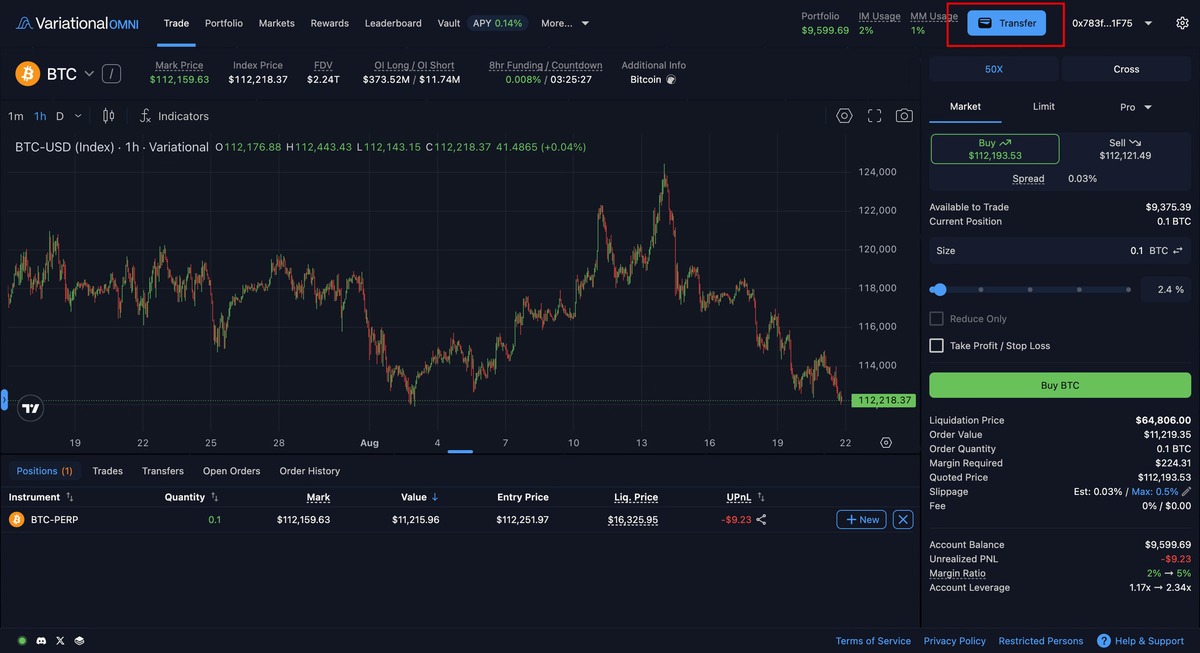
To deposit funds, you will need USDC on Arbitrum One. You can obtain it through DEXs such as Uniswap or through centralized platforms such as Binance or Coinbase. When you make a deposit, a $0.10 fee will be included in the transaction, just as when you make a withdrawal, so be sure to take this into account when making your deposit.
Trading
The trading aspect is, of course, the most important part, as it will dictate your volume and PNL. These two factors will move you up the leaderboard, improving your ranking and boost rate, but also your chances of receiving a refund in the event of a loss.
With over 500 pairs available, there is plenty of choice. Although nothing has been specified in the documentation or confirmed by the platform, varying the pairs may be a good idea, as the protocol does not offer a boost on specific pairs. Be careful, however, not to end up with too many open positions, as this would increase your risk.
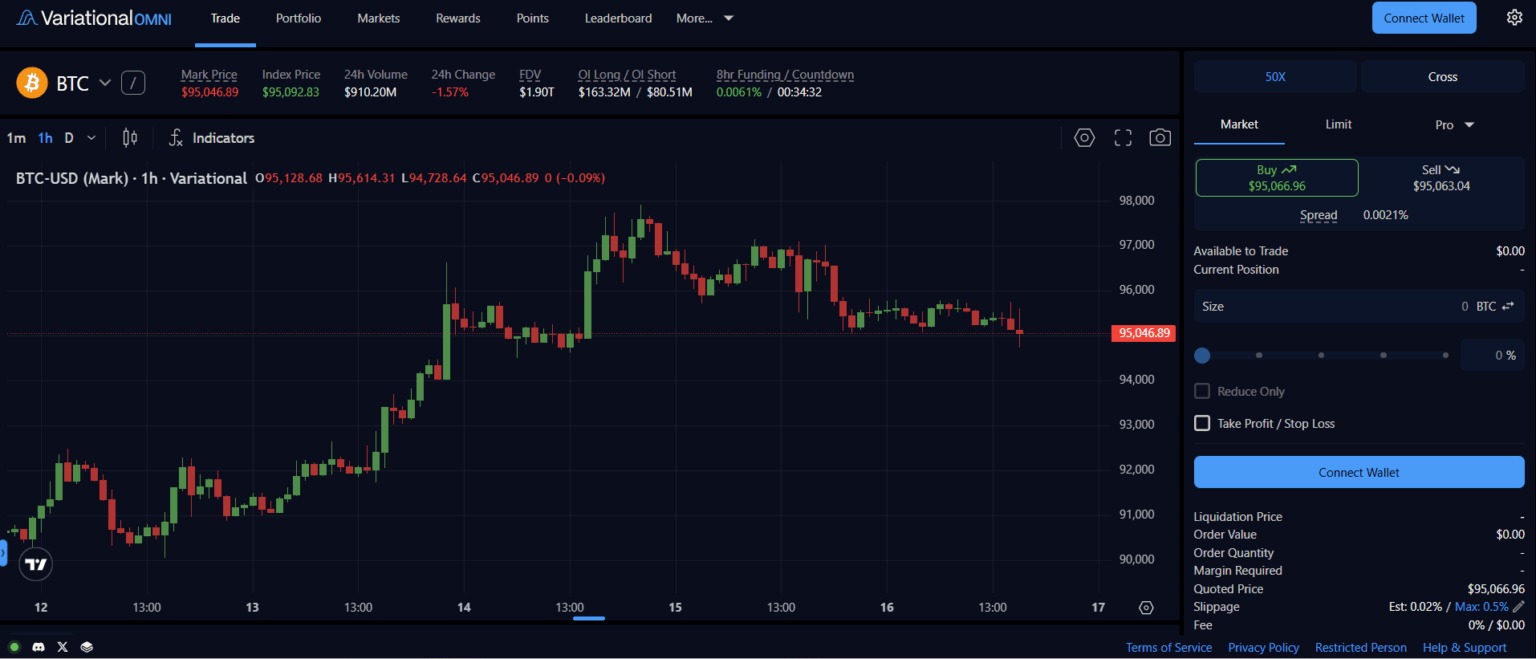
Furthermore, as with all similar products, the risk of leverage should not be overlooked. Although it can artificially increase your activity, these are very risky tools and are recommended for experienced traders. You should also avoid having too many open positions at once, as this can be very costly in terms of fees.
Points and leaderboard
With a program launched on December 17, 2025, more than 3 million points have been distributed to traders who were already using the platform. Points are distributed every 6 days, and this weekly distribution is expected to end no later than the end of the third quarter of 2026.
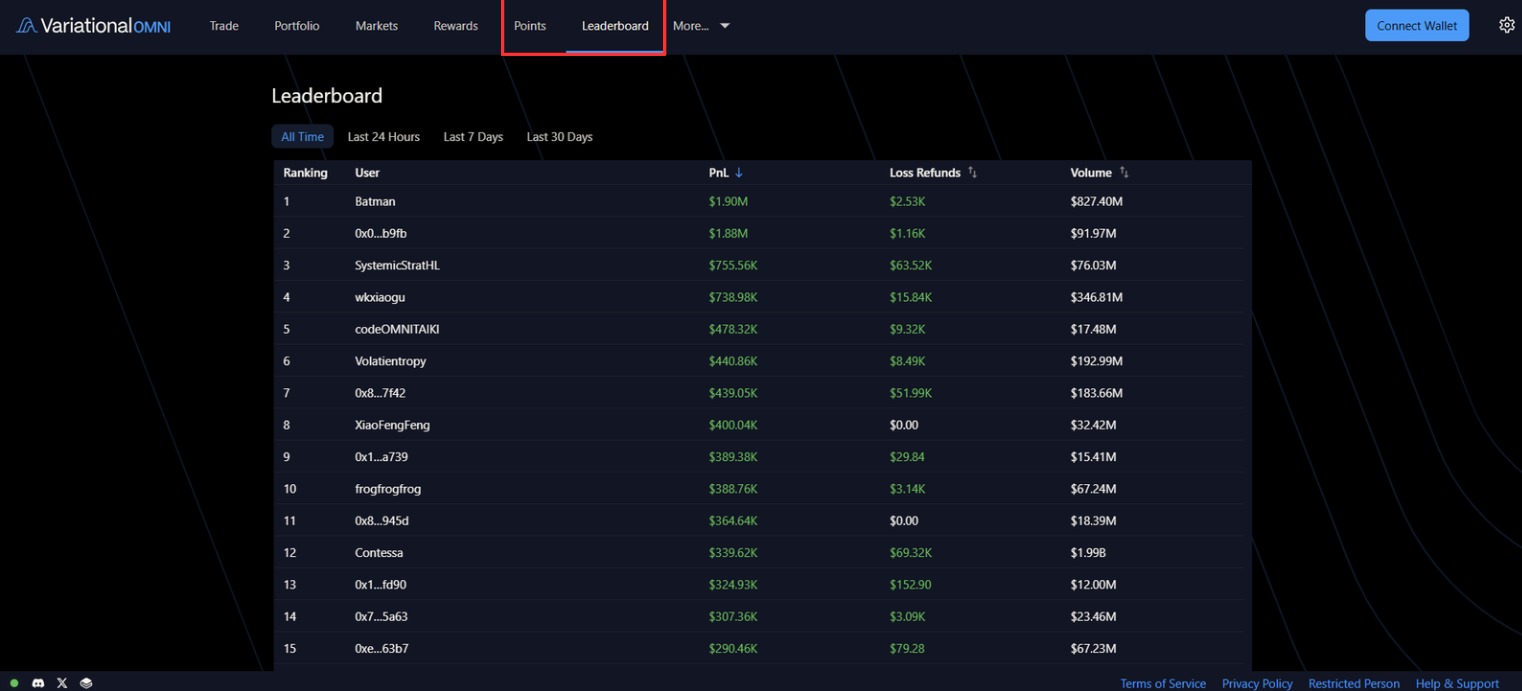
Variational’s points system is farming-oriented, with numerous boosts and improvements available. The platform offers a third-party ranking system, ranging from Bronze to Grandmaster, which grants varying amounts of bonus rewards. These rewards are directly linked to traders’ activity over the last 30 days, further proof of Variational’s desire to retain its users and encourage them to trade in high volumes.
Why choose Variational?
Thanks to its architecture, Variational offers a wide variety of products. For the moment, only cryptocurrencies are available (although there are currently more than 500), but the platform aims to integrate RWAs and indices.
In terms of figures, Omni currently has more than $100 billion in volume, open interest of more than $750 million, and, most importantly, more than $2 million in refunds.
These figures show that the platform does indeed have the financial resources to meet any need. In addition to the initial financial contribution provided by Variational to get the OLP off to a good start, the platform has raised over $11 million thanks to the support of leading players such as Coinbase Ventures, Bain Capital Crypto, Mirana, Caladan, PeakXV, and DragonFly.
The platform has confirmed that nearly 50% of the supply of the future $VAR token will be distributed to the community and that 30% of the protocol’s revenue will be burned to purchase $VAR.
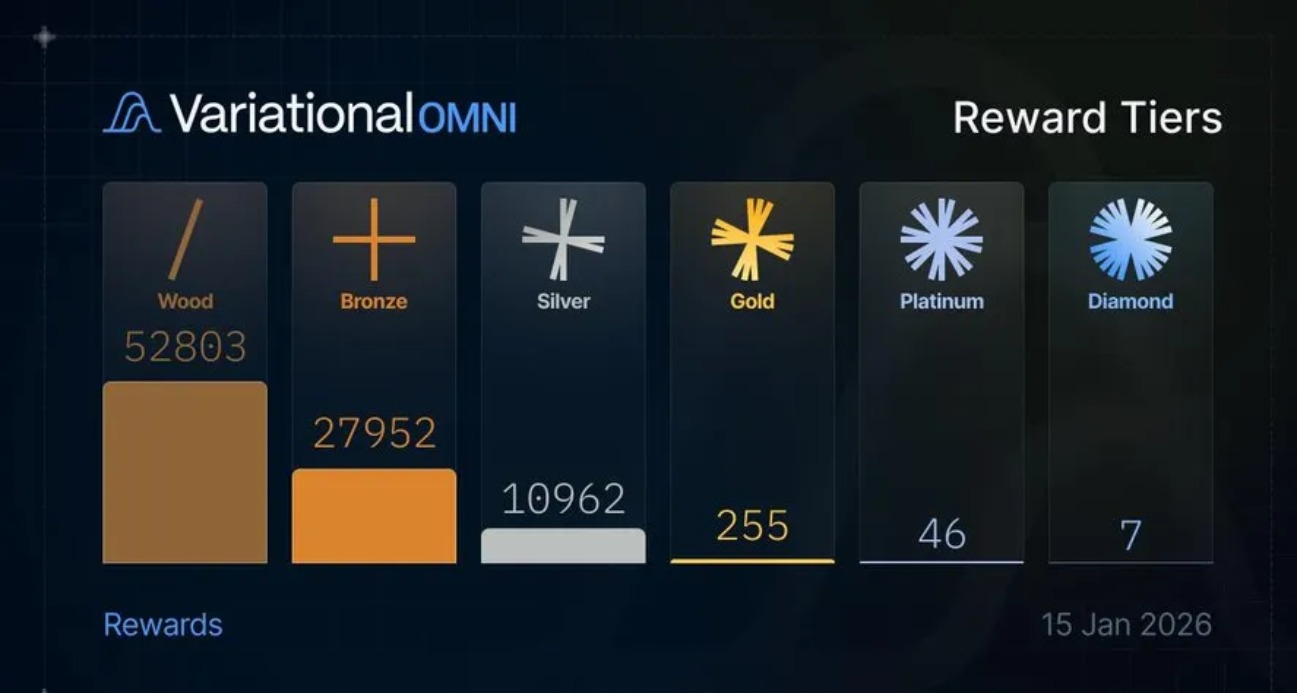
Variational’s on-chain data
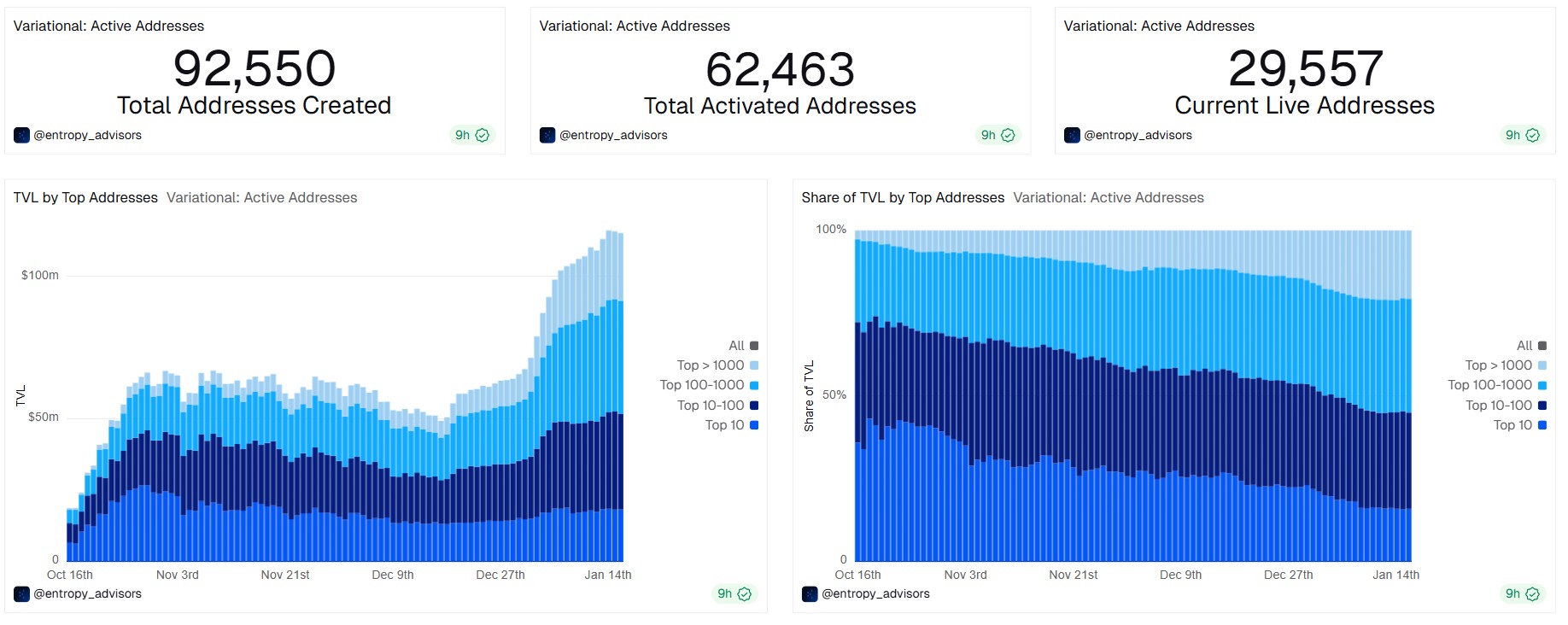
With over 90,000 addresses created and an average of 30,000 active addresses daily, there is only one conclusion to be drawn: the Variational protocol works and users are returning.
Beyond this data, user retention and regularity are impressive, as the retention rate is 33%, whereas it is usually closer to 20%. It remains to be seen what it will be after the airdrop. In terms of total value locked (TVL), there are no surprises. The figures show us that 50% of liquidity is shared between the largest wallets in the Top 10 (20%) and the Top 100-1000 (30%).
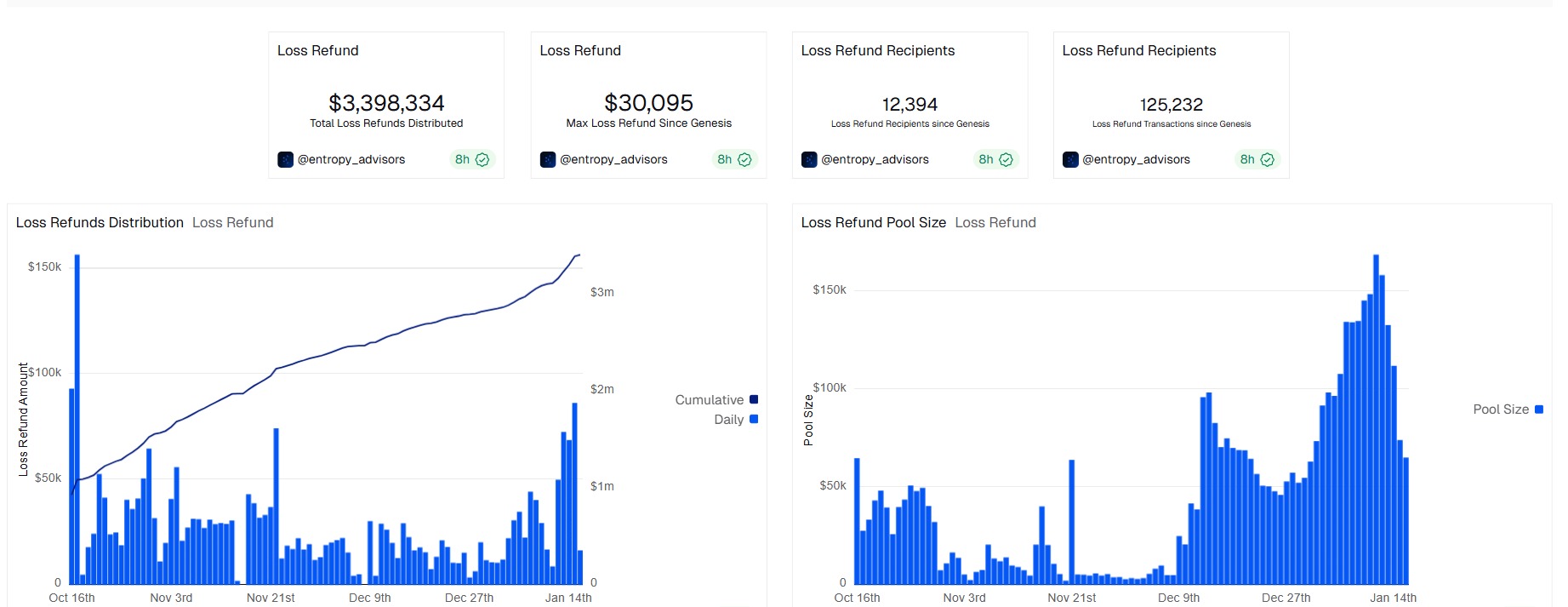
Another very interesting metric is the Loss refund distribution: Does the platform always refund its users? The answer is yes, but it does so differently than when it first started. The platform reached its peak refund on October 16, 2025, with more than $150,000 in refunds. In mid-January, $50,000 is refunded each day, which is three times less. There is an explanation for this: the number of users. In October, there were 2,000 active users, while currently there are more than 19,000. This means there are more people to reimburse, and since there are more users, the percentage chance of being reimbursed decreases, hence the decline. This is therefore not a sign of a slowdown or a loss of money for the protocol, but rather a sign of gain. Just look at the size of the refund pool, which has been steadily increasing since the beginning of December.
Conclusion
Variational is positioning itself as one of the most promising airdrops of 2026, despite the lack of communication about the $VAR token itself (such as the TGE date, tokenomics, or total supply). The protocol has gained the trust of users to retain active and regular traders.
This lack of communication is overshadowed by the protocol’s innovations in terms of security and efficiency. Finally, the support of major financial players such as Coinbase Venture and Peak reinforces the already established image of the Variational protocol. It could be interesting to keep an eye on it.