Every year, the investment fund a16z Crypto publishes a highly anticipated report on major upcoming developments in the cryptocurrency industry. This report seeks to identify the fundamental transformations that could change the use, adoption, and integration of blockchain technologies around the world. Stablecoins, privacy, asset tokenization, artificial intelligence, and predictive markets: we break down the major trends to remember and what they really mean.
Stablecoins: the backbone of digital finance
Stablecoins seem to be continuing on the path they began in 2025, that of a global financial instrument no longer reserved for crypto users. Whether for businesses, banks, or even countries, stablecoins are now an integral part of the global financial landscape.
Indexed to fiat currencies such as the dollar, stablecoins enable value to be exchanged quickly, without a banking intermediary, at low cost and on a global scale. In 2026, a16z anticipates an acceleration in their adoption, particularly for international payments, cash management, and business-to-business settlements.
Their use is now obvious: currently, sending money from one country to another can take several days and generate significant fees. With a stablecoin, the transaction can be settled in minutes, without using the traditional banking system.
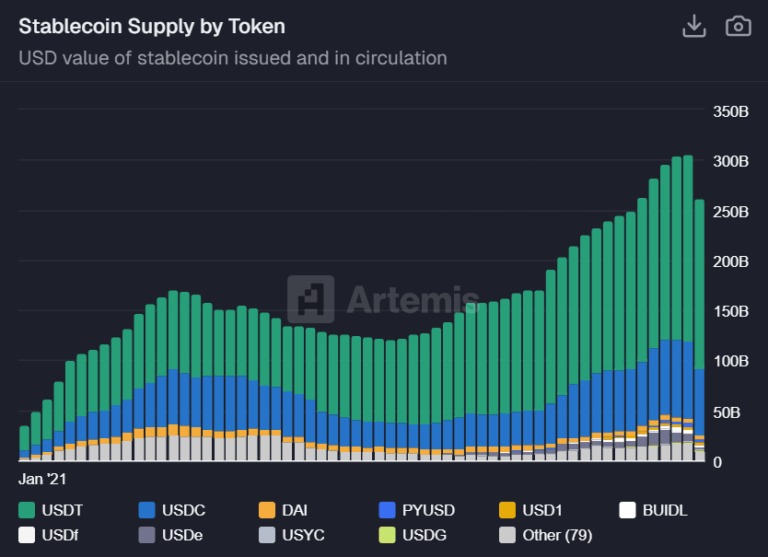
The report also highlights the growing interest of financial institutions and governments. Some banks are already experimenting with internal stablecoins, while several governments are considering clearer regulatory frameworks. This dynamic is clearly reflected in the data. Since 2021, the supply of stablecoins has been steadily increasing. But it was in 2024 that the acceleration really took off: supply rose from around $134 billion to nearly $300 billion today, more than doubling in the space of 24 months. The main players remain USDT, USDC, DAI, and USDe.
Privacy, a sector that has become essential
Zcash, Litecoin, and Monero: the privacy coin sector appreciated at the end of 2025, driven by the momentum of regulations and users’ desire to strengthen their anonymity, thus putting confidentiality back at the center of the debate.
In many cases, making everything public makes no sense. A company does not want to expose its financial flows to its competitors. An individual has no reason to display their entire assets online. Yet this is often what current public blockchains allow.
One of the technologies mentioned in the report is zero-knowledge proofs, known as SNARKs (Succinct Non-Interactive ARguments of Knowledge). These systems make it possible to prove that a transaction is valid without revealing its details. This capability could make blockchain more suitable for institutional or regulated uses.
SNARK
A SNARK is a technique that allows you to prove that information is true without showing that information. In crypto, it is used to verify transactions or calculations while keeping amounts, addresses, or private data hidden from other users and the public.
The a16z report highlights advances in privacy technologies that can hide certain data while maintaining transaction security and verifiability. By 2026, these solutions could become the norm, particularly for professional and institutional uses.
RWA: tokenization of real assets moves into high gear
Often associated with stablecoins for their real-world use, RWAs are among the topics most highlighted by a16z. The idea is to represent traditional assets on the blockchain: stocks, bonds, real estate, commodities, and even Treasury bills. This is a new market opening up to institutions, one that is faster, more liquid, more decentralized, and offers new opportunities.
Until now, these initiatives have often remained experimental. But according to the report, 2026 could mark a turning point. Why? Because the infrastructure is now more robust, the regulations are clearer, and the demand is very real.
Several protocols stand out in this segment, such as Pendle, Maple, Ondo, and Morpho. Despite an unfavorable market environment in 2025, these projects were able to forge strategic partnerships and gain credibility with traditional financial players.
a16z emphasizes that this evolution is not intended to replace traditional finance, but to make it more efficient. By reducing intermediaries, delays, and costs, tokenization could transform historically illiquid markets.
AI agents are also subject to regulation
Artificial intelligence occupies a central place in the report. But not from a speculative angle. For a16z, blockchain can play a key role in the coordination, remuneration, and governance of AI systems.
A key point is the shift from “Know Your Customer” to “Know Your Agent.” Today, automated agents outnumber humans, particularly in financial services, but they still lack official identities. Without a clear framework, they are blocked by platforms and payment systems. KYA aims to provide agents with verifiable cryptographic identities linked to their operator, their rules of action, and their responsibility. Thanks to blockchain, these agents can interact, make payments, and be remunerated in a transparent manner. In concrete terms, the challenge goes beyond simply executing algorithms. It is a question of determining who provides the data, who performs the calculations, and how the value is redistributed.
Predictive markets: anticipating rather than speculating
Similar to privacy coins, this is a sector that has carved out a place for itself in 2025, with a giant like Polymarket, which is now a benchmark and is cited by Donald Trump at conferences. This sector has exploded and defied all predictions about it. Far from being simple betting tools, they are often very effective at aggregating information.
By financially incentivizing participants to share their expectations, they often produce more reliable forecasts than many polls. However, they point out that prediction markets will not replace existing traditional systems such as polls, but can still serve as a benchmark for general trends. It is therefore more of a guidance tool than a real decision-making tool.
For example, a company could use an internal prediction market to estimate the success of a product, or an investor could use it to assess macroeconomic risk. Thanks to blockchain, these systems become transparent, resistant to censorship, and accessible to all.
Key takeaways from the a16z report
The a16z report does not predict a future of unrealistic promises or spectacular price increases. It describes an industry that is gaining maturity, utility, and credibility.
If 2026 truly marks this transition, then the value of crypto will no longer come solely from technological innovation, but from its practical adoption and real impact on the economy. It is precisely this shift in perspective that makes this report particularly important.