After several successful integrations on Pendle, Morpho, Euler, and Kamino, SyrupUSDC, Maple Finance’s stablecoin, is about to take another decisive step forward: its integration on AAVE V3. The announcement marks a strategic turning point for the RWA ecosystem. Beyond a simple technical partnership, this collaboration between Maple and AAVE symbolizes a convergence between two major players in DeFi.
A two-way collaboration
To understand the significance of this partnership, it is important to understand what SyrupUSDC represents. Launched by Maple in 2024, SyrupUSDC is an innovative yield-bearing stablecoin backed by loans from leading corporations and institutional funds. Each token is secured by carefully vetted receivables, ensuring robust security and generating stable yields directly on the blockchain.
This asset is fundamental to Maple Finance, as it combines stability, transparency, and profitability, strengthening the platform’s position as a leader in decentralized institutional finance. By facilitating access to predictable returns while minimizing risk, SyrupUSDC meets the strict requirements of institutional investors, making it a strategic pillar for the Maple ecosystem.
For AAVE, the arrival of such an asset is part of a clear strategy: to expand the collateral sector while opening the door to native yield products. The listing of SyrupUSDC on AAVE V3 would be accompanied by an initial allocation of $250,000 in incentives funded by Maple to stimulate liquidity and encourage the adoption of the stablecoin in leverage and looping strategies.
Definition
Looping is a strategy that involves borrowing an asset that you already hold as collateral, then using it to borrow again, and so on. This mechanism allows you to multiply your exposure to an asset or increase the return on your capital. However, it also increases the risk of liquidation, as each loop increases leverage and makes the position more sensitive to price changes.
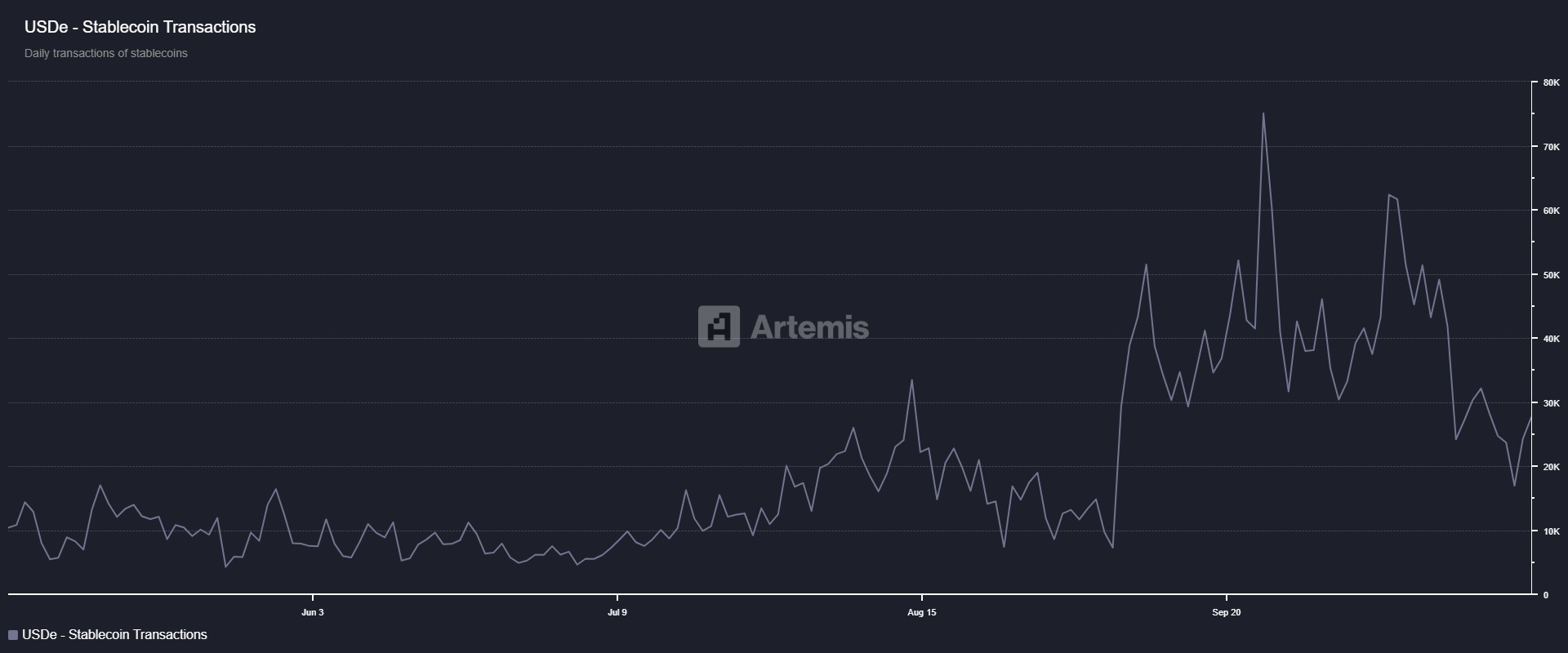
This initiative echoes a well-known phenomenon in DeFi: “The AAVE Effect.” Each asset listed on AAVE benefits from increased visibility and demand, automatically leading to an increase in its TVL (Total Value Locked) and liquidity on other protocols. This was the case for sUSDe (Ethena), which prior to its integration on July 29, 2025, recorded a transaction volume of around 6-7,000 per day, a figure that now stands at over 30,000 transactions per day. That’s the “AAVE Effect.”
In short, this is an opportunity for Maple to anchor SyrupUSDC at the heart of DeFi, rather than just in a siloed ecosystem. And for AAVE, it’s a chance to establish itself as the leading infrastructure for tokenized RWAs, while strengthening its offering.
The union of RWAs and decentralized infrastructure
This partnership between Maple and AAVE goes far beyond a logic of yield. It embodies a structural evolution of DeFi: the entry of real-world assets into leading decentralized protocols.
On the one hand, Maple Finance represents the realization of RWAs: a platform capable of tokenizing institutional loans, ensuring transparency, and offering stable returns backed by real cash flows. On the other hand, AAVE provides a liquid, interoperable, and secure architecture that serves as the backbone of on-chain finance.
By integrating SyrupUSDC, AAVE is not just adding an additional asset: it is opening the door to large-scale tokenization of institutional credit. It is the fusion of real-world reliability and decentralized efficiency. Every SyrupUSDC deposited could be used tomorrow to finance businesses via Maple, while generating returns within a fully on-chain ecosystem. In the ecosystem, the signs are clear: SyrupUSDC volumes on Pendle are increasing, positions on Morpho are multiplying, and yield loops on Kamino are diversifying. Investors are already anticipating the leverage opportunities and increased liquidity that a listing on AAVE could bring.
Ultimately, this partnership could mark the beginning of a new DeFi standard for RWAs, where real-world value flows freely through decentralized protocols, without intermediaries, without friction, but with transparency and security. AAVE provides the mechanics, Maple provides the raw material. Together, they are redefining what “on-chain credit” means.
What blockchain data tells us
On the SyrupUSDC side, the asset is experiencing rapid growth and confirming its place as a major player in DeFi. Thanks to the launch of its version 2, the protocol is going from strength to strength. The chart showing AUM (Assets Under Management), i.e., the number of SyrupUSDC, was 286 million on April 1, 2025, and is now 2 billion on October 27 of this year. This makes SyrupUSDC the most widely used product on Maple Finance.
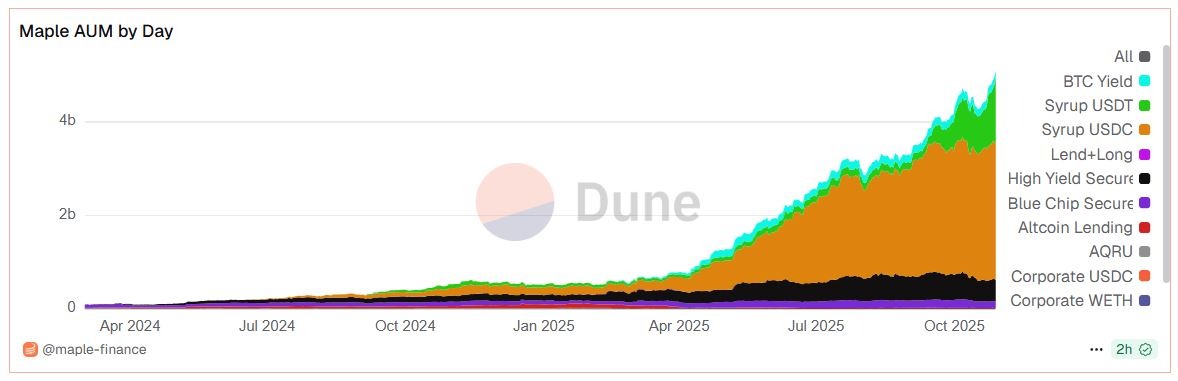
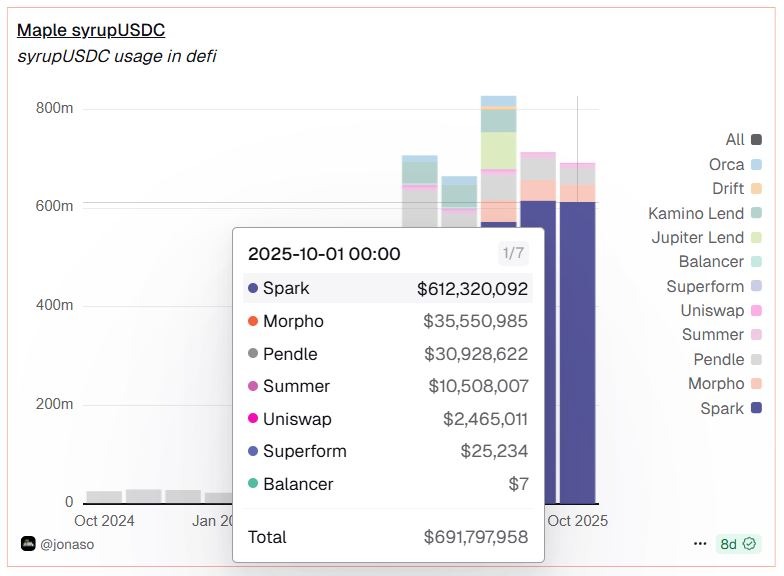
The SyrupUSDC stablecoin is also used in the DeFi ecosystem. With nearly $692 million deployed mainly on Spark (88%), it can also be found on Morpho (5%) and Pendle (5%). These figures illustrate that SyrupUSDC plays a concrete role in lending, borrowing, and generating on-chain returns, confirming its adoption and growing liquidity within decentralized finance.
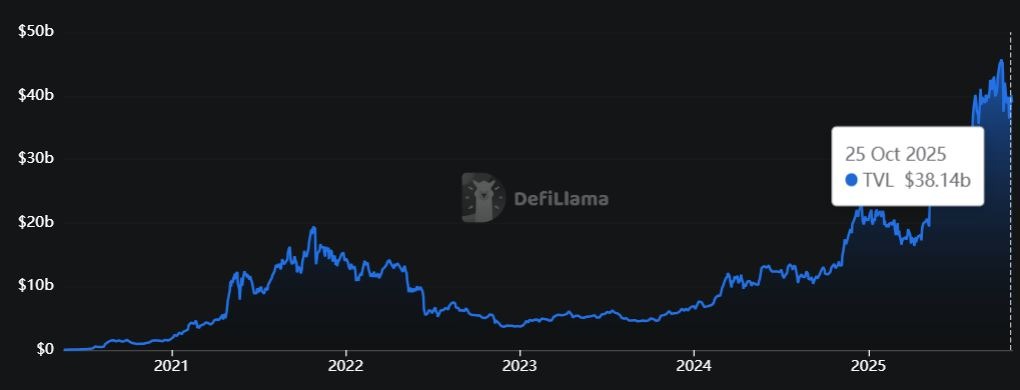
If there’s one protocol that never disappoints, it’s AAVE. A quick glance at its TVL reveals one thing: it’s only going up. Over the course of 2024, the protocol recorded an increase of nearly 300%, a trend that looks set to continue in 2025. Driven by numerous partnerships with innovative projects, traditional players, and users themselves, Maple Finance couldn’t have asked for a better collaboration.