
Having disappeared from the radar in 2011, Satoshi Nakamoto, creator of Bitcoin, continues to make history in silence. Thanks to the spectacular rise in the price of BTC, his inactive wallet now ranks him among the world’s richest people.
The creator of Bitcoin, the richest pseudonym in history
In October 2008, a certain Satoshi Nakamoto published a seminal document: the Bitcoin White Paper. In it, he proposed a monetary revolution, a decentralized payment system operating on a peer-to-peer basis, without a trusted third party. In 2011, after launching the protocol and interacting with the first developers, he disappeared from the internet. He never returned. Satoshi was the first to mine Bitcoins to maintain the network in its early days. It is estimated that he accumulated around 1,125,000 BTC, spread across numerous public addresses. These funds have never been moved or spent. By disappearing before he became famous, he allowed Bitcoin to develop without his influence, and he also left behind the most valuable inactive wallet in history. His disappearance, just as Bitcoin was beginning to take off, is a testament to his noble ambitions, untainted by a desire for fame or fortune.
Today, with Bitcoin trading above $122,000, Satoshi’s supposed wallet is valued at over $130 billion.
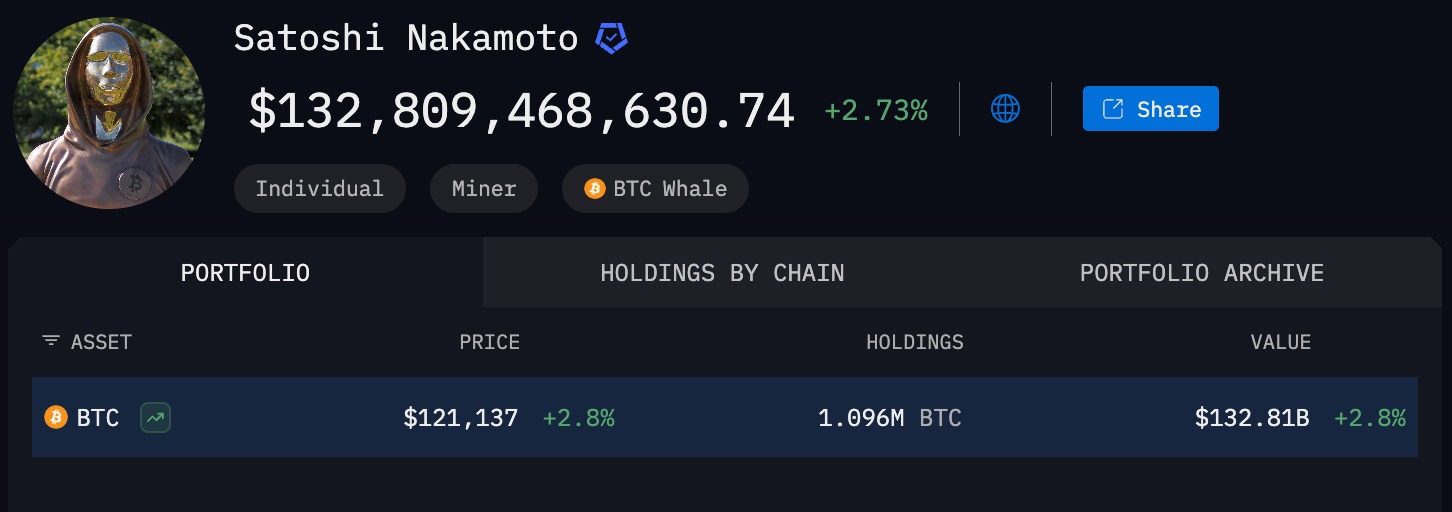
This virtually propels him to 11th place in the ranking of the world’s richest people, ahead of Michael Dell ($125.1 billion) and just behind Sergey Brin ($142.3 billion), co-founder of Google.
Nakamoto also ranks ahead of iconic figures such as Amancio Ortega (Zara) and Bill Gates (Microsoft). The contrast is striking: while Musk, Zuckerberg and Bezos dominate the spotlight, Satoshi remains a silent shadow at the top of the global wealth rankings, probably without even wanting to be there.
Can Satoshi’s Bitcoins be stolen?
Last week, numerous theories circulated about the reasons behind the movement of 80,000 BTC that had remained inactive for 14 years, dating back to the Satoshi era. The story fuels a lot of speculation, but above all, it reminds us that some old wallets may be vulnerable. This vulnerability could be exploited either by someone who has identified a flaw in the entropy used to generate the first Bitcoin private keys, or, in a few years or even decades, through the emergence of quantum computers.
However, if Satoshi’s Bitcoins were to be found, it is possible that the person holding them would take an ethical approach and choose to destroy them. Even if they were resold, the impact on the price would only be temporary, without calling into question the fundamentals of Nakamoto’s consensus.
In Peer to Peer, we welcomed UrbanTech21, who is passionate about the history of Bitcoin and Satoshi Nakamoto. Together, we explored theories about his identity. The replay is available on YouTube and our streaming platforms.