
Why Are These Two Cryptos in Free Fall? Analysis
October 10 will go down as one of the most turbulent days in crypto history. A tsunami of liquidations swept through the market, leaving some projects in serious trouble. Aptos and Bittensor were among the hardest hit. Why did they plummet so sharply? Is their future in jeopardy?
Extreme conditions for the crypto market
The crypto market is characterized by volatility far greater than that of traditional assets (stocks, real estate, etc. ). Investors know this. Yet even the most cautious investors suffered considerable losses on October 10.
This was the largest liquidation event ever observed in the crypto world. Neither the collapse of FTX nor that of Terra Luna had caused such a tidal wave. This phenomenon is telling. The majority of projects were hit the full brunt of this extreme volatility. Some will manage to bounce back, slowly rebuilding their credibility and investor confidence. For others, it’s already too late: the crash was so brutal that a recovery seems impossible.
In this article, we’ll analyze two cryptocurrencies that were severely impacted in November. We’ll highlight the key factors that contributed to the decline of the APT and the TAO token:

Aptos: -36.6%
Aptos is a Layer 1 blockchain born from the ashes of Diem, a crypto project abandoned by Facebook (Meta) due to regulatory pressure. Based on the Move language, Aptos is an ultra-fast blockchain. It offers significantly lower transaction fees than the Ethereum blockchain, making it well-suited for the high-frequency trading sector.

Chart showing the APT token price, weekly data
As shown in the chart above, the price of the APT token has never recovered from the crash on October 10. Over the past 30 days, its value has plummeted by nearly 37%. Since the week of October 10, the decline has even reached 63%, or nearly two-thirds of its market capitalization.
While we’re discussing the technical aspect here, other fundamental and on-chain factors also help explain this plunge.
Aptos is often referred to as “VC Chain” due to its massive venture capital funding. According to DropsTab, the project has raised over $350 million across two funding rounds. Of the five rounds in total, three remain opaque in terms of their terms.

Information on the various funding rounds completed by the Aptos project
These fundraisings come with a trade-off: institutional investors gradually recoup their investment by selling their tokens, with the goal of making a profit (or limiting their losses) .
This process, known as token unlocks, acts as a drag on the token’s price. If demand does not offset the increase in supply caused by the unlocks, the price automatically drops.
Each month, 11.31 million APT tokens are released, further exacerbating this imbalance between supply and demand.
Furthermore, on-chain data from the Aptos blockchain does not bode well:
- From October to November, fees generated by the blockchain fell by 32.4%;
- Over the same period, the trading volume of the APT token fell by more than 33.5%.
In summary, Aptos is navigating a period of significant turbulence. The token has broken through its technical support levels, and neither the tokenomics nor on-chain activity appear capable of reversing the trend.
Bittensor (TAO): -40.2%
Launched in November 2021, Bittensor positions itself as a project combining artificial intelligence (AI) and blockchain. Every Bittensor participant (individuals, software, or hardware) freely contributes to the system by providing AI models, data, or computing power.
Paradoxically, the price of the TAO token held up well against the October 10 shock, even beginning a recovery the very next day. However, in November, its value plummeted by more than 40% . Currently, it is testing a major technical support level on the weekly chart—the last line of defense before a potential drop toward $215.
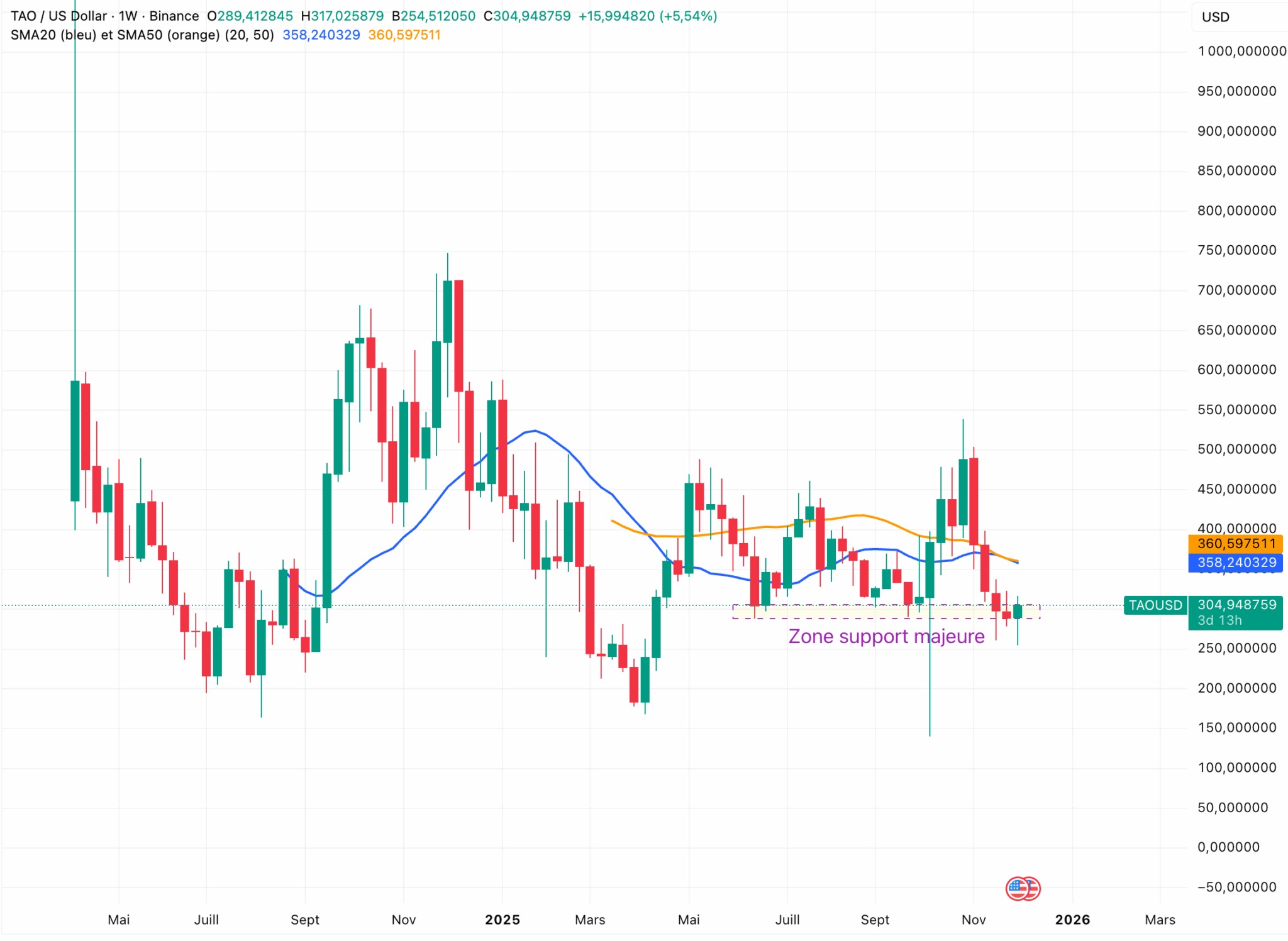
Chart showing the TAO price, weekly data
It’s important to put this decline into context: the entire crypto market posted lackluster performance in November, with BTC down 13% and ETH down 17%. These are particularly challenging conditions, with very few altcoins posting positive returns.
However, this isn’t the only possible explanation for TAO’s decline. In fact , Bittensor is reaching a pivotal moment in its history. On December 12, Bittensor will undergo its first halving.
In other words, the number of TAO issued each day will be cut in half, from 7,200 to 3,600. Although this type of event is generally considered beneficial in the long term for the appreciation of a cryptocurrency (less supply), it can also slow the growth of the Bittensor ecosystem.
Indeed, network participants (miners, validators, etc.) will see their incentives (financial rewards) cut in half. Echoing this issue, data from the Token Terminal platform suggests that the number of core developers dropped dramatically over the summer, falling from 70 people to a reduced team of fewer than 20: p>
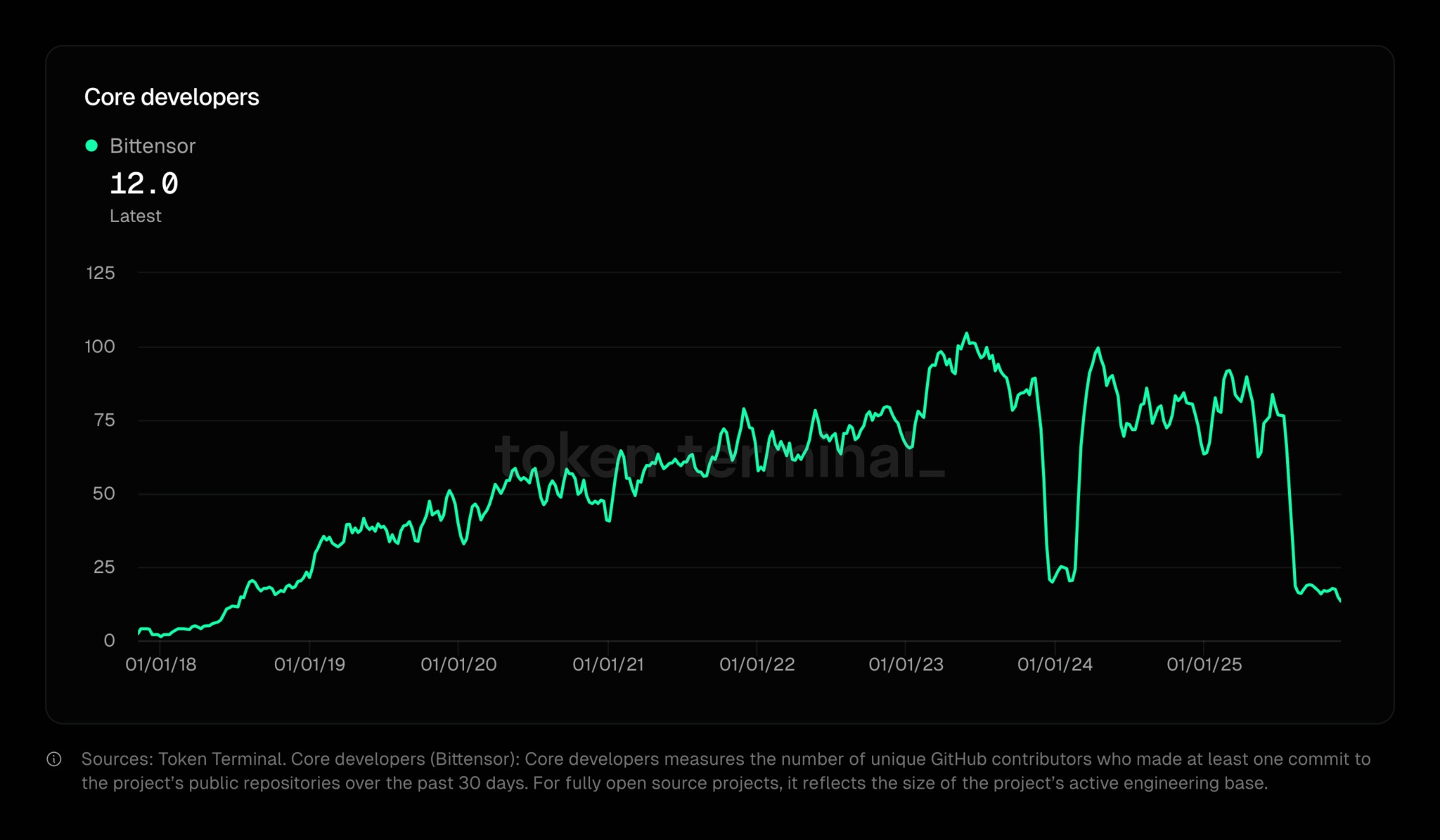
Graph showing the number of active core developers on the Bittensor blockchain
Another worrying sign: TAO’s trading volume has plummeted in recent weeks. It fell from $3.56 billion (week of October 13) to $1.01 billion at the end of November—a 72% drop. This decline reflects a clear disengagement among traders.
In summary, Bittensor is at a pivotal moment in its history. Between maintaining its technical support and adjusting its post-halving business model, the coming weeks will be crucial for the project’s future.
Imminent Shortage of Memory Chips for Computing? A Real Heist in AI Data Centers
The rapid expansion of data centers designed to run AI is driving unprecedented competition in the market for memory chips used in computing. And needless to say, the decision by industry giant Micron to exit the public sector market won’t help matters.
Computing memory crisis: a “full-blown heist unfolding”
The rapid development of artificial intelligence (AI) is reshaping numerous sectors, far beyond the simple fact that it is gradually and successfully performing increasingly complex tasks that until now involved intellectual and creative professions reserved for humans.
In fact, another battle is being waged from a more technical perspective, in the market for memory chips intended for computing , particularly the well-known DRAM chips. At the heart of the issue: data centers in constant need of RAM and computing power, to the obvious detriment of the consumer computing market.
This observation has been made by numerous IT specialists, to the point where the X account known by the pseudonym Deus Ex Silicium has described a “full-blown heist currently underway” in the sector, with prices for DDR4, DDR5, and NAND Flash RAM memory rising sharply since September, and “peaks of over 500% expected by next summer.”

Memory chip prices have risen sharply since September
A memory shortage in which the giant Nvidia—which does not directly produce this type of chip—appears to be an aggravating factor, due to its dominant position in the AI accelerator market. But it has reportedly finally been caught up in this crisis. In fact, some sources indicate that it is now shipping its GPUs without the video memory chips (VRAM) that were previously included, leaving its partners to handle the complexities of sourcing them.
Tech giant Micron is exiting the consumer market to specialize in AI
A complicated situation that could well become even more so, if we are to believe the recent announcement by industry giant Micron regarding the planned discontinuation by June 2026 of its consumer memory chips, sold under the Crucial brand.
The goal of this decision? To allow Micron to exit the consumer market where it has been offering has been offering its products for 30 years, in order to focus exclusively on its most profitable business: selling memory directly to AI data centers operated by companies such as OpenAI, Google, and others.
This shift toward AI also affects Bitcoin blockchain miners, particularly as a way to increase the profitability of their power supply in the face of BTC mining becoming less and less profitable.
From a more technical perspective, the current memory chip crisis does not directly affect the production of the ASICs needed for their operations, but rather involves a broader reorganization of the global semiconductor on a global scale. In any case, an inevitable increase in operating costs seems likely.
ers comp
Top Crypto Performers for November
With November marked by a drop of more than 13% in the price of Bitcoin, few cryptocurrencies are performing well. However, a few die-hard altcoins are holding their own: find out which ones and the reasons behind their outperformance, bucking the overall market trend
A Difficult November for the Crypto Market
While Bitcoin’s price posted a negative return of -13% over the past 30 days, Ether, for its part, experienced a steeper decline of approximately -17%.
Few altcoins managed to perform well under such conditions. And yet, some cryptocurrencies managed to post respectable returns.
Among the top 5 best-performing cryptos in November are KAS, XMR, QNT, WLFI, and RAIN: p>
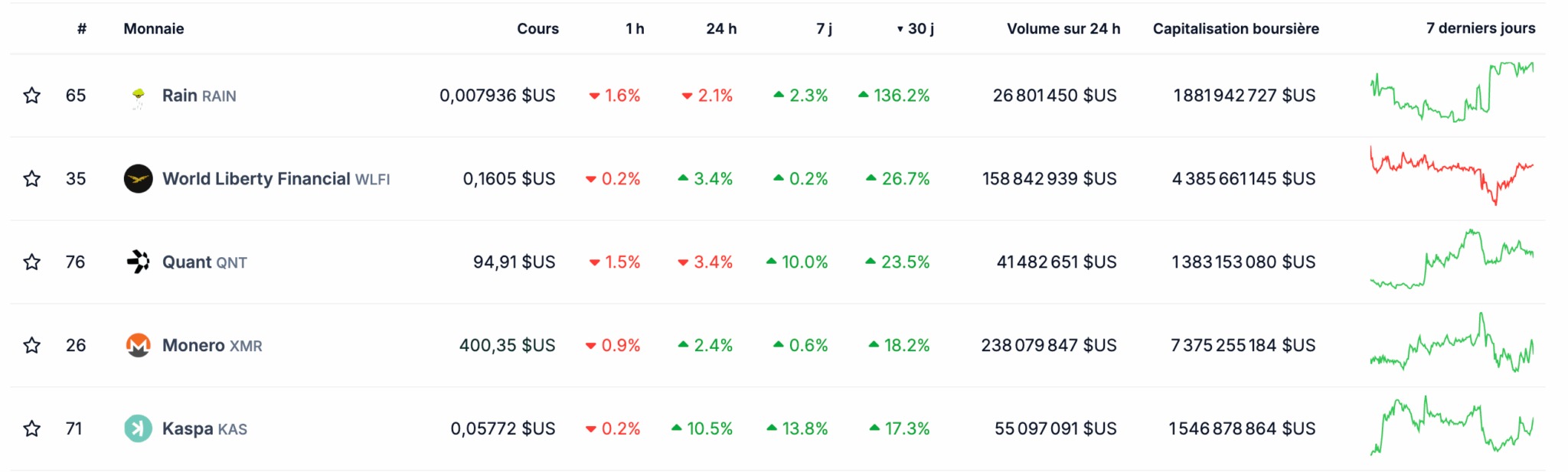
The 5 best-performing cryptocurrencies in November
5 – Kaspa (KAS) : +17.3%
Launched in November 2021, the Kaspa project draws heavily on Bitcoin, whether in terms of principles, methodology, or its proof-of-work (PoW) environment.
In fact, Kaspa is based on the GhostDAG protocol, which extends the Nakamoto consensus to a Directed Acyclic Graph (DAG) system, with the goal of making it more scalable than its first implementation, Bitcoin.
Over the past 30 days, the price of the KAS cryptocurrency has risen by more than 17%. Among the potential reasons for this performance is the launch of Kaspa’s first decentralized bridge, which greatly improves its interoperability with EVM blockchains.
Following this major milestone, Dymension has integrated KAS as a base asset. In other words, Dymension’s rollapps can now choose to use KAS to pay gas fees.
In summary, Kaspa has made a significant technological advancement, combined with new demand for KAS.
4 – Monero (XMR): +18.2% h2>
Monero is a blockchain focused on anonymity, where transactions are made untraceable through the use of several cryptographic techniques. Monero’s native cryptocurrency shares the same name as the blockchain and is known by the ticker XMR.
Over the past 30 days, the price of XMR has surged by more than 18%.
< br />Although the reasons behind this price surge remain unclear, it is likely that Monero benefited from a rotation of capital. Indeed, the privacy coin narrative was in full swing during the month of October, particularly with Zcash, which posted exceptional performance over that period.
Thus, it is possible that capital that had shifted away from Zcash has now flowed back into Monero. In fact, the XMR cryptocurrency remains, to this day, the crypto with the highest market capitalization in the privacy coin sector. It therefore remains a “safe bet” in the minds of investors, regardless of whether there is hype surrounding a particular narrative or not.
3 – Quant (QNT): +23.5%
Quant is a project focused on a very specific segment: institutional interoperability. Unlike most blockchains, which seek to attract users or developers, Quant directly targets banks, enterprises, and financial infrastructures that want to connect their existing systems to different blockchains without having to rebuild their entire architecture.
Its flagship product, Overledger, is not a blockchain but a multi- that allows interaction with multiple public and private blockchains as if they were part of a single environment.
Over the past 30 days, the price of the QNT cryptocurrency has risen by 23.5%.
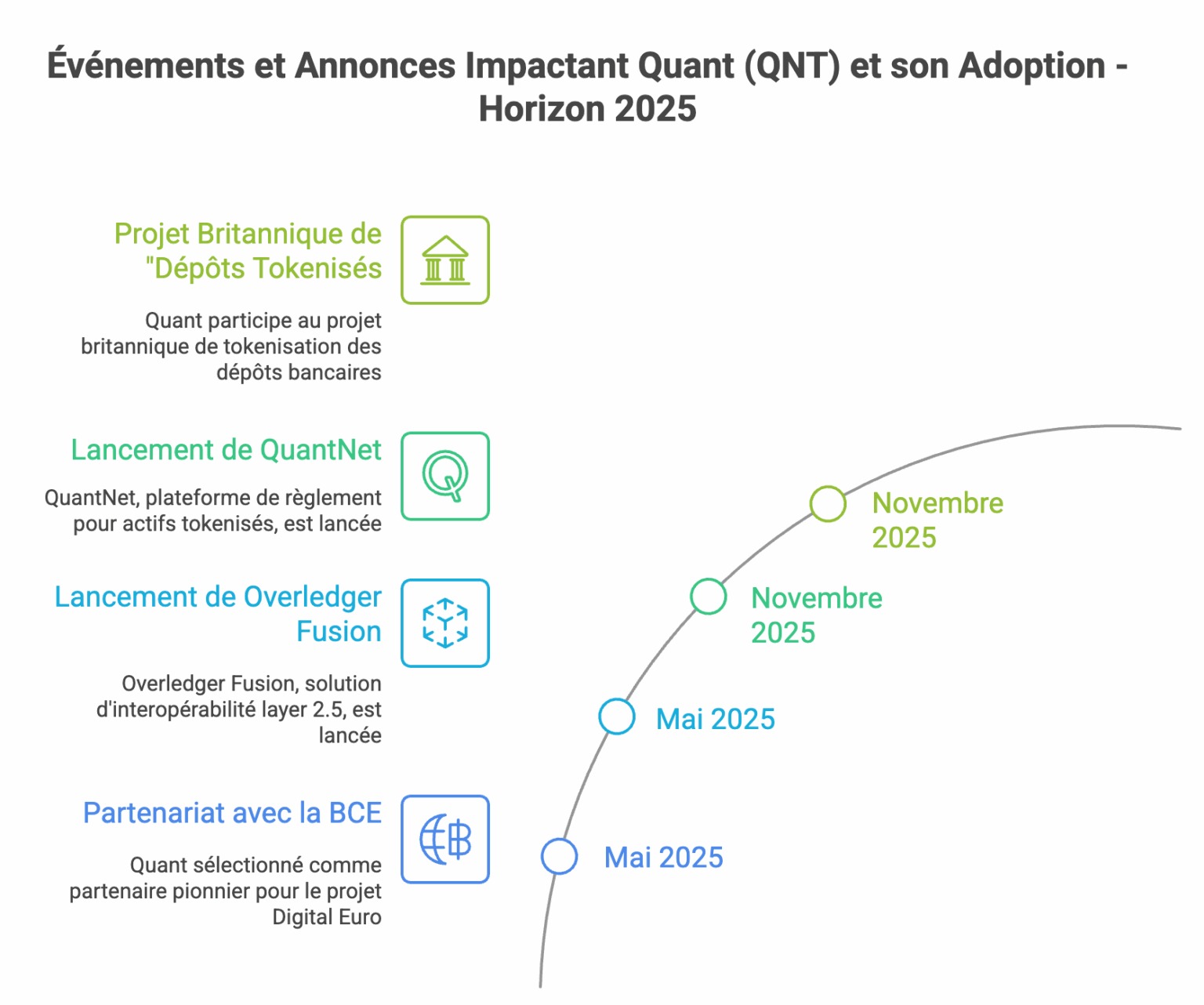
Chart showing the key milestones of the Quant project in 2025
Among the potential reasons for QNT’s performance, we can notably cite Quant’s collaboration with various institutions, such as the European Central Bank (ECB) on the digital euro (CBDC) project. More recently, Quant announced its participation in a British tokenized deposits project launched by a banking consortium in the United Kingdom.
However, a word of caution: beyond the hype, it is difficult to analyze the actual growth or demand for this type of project.
2 – World Liberty Financial (WLFI): +26.7%
World Liberty Financial is a decentralized finance (DeFi) protocol launched in 2024, closely linked to U.S. President Donald Trump and his family. Presented as an attempt to “improve the dollar ,” the project consists of two pillars: a stablecoin, the USD1, backed by the U.S. dollar, and a governance token, the WLFI.

Chart showing the market capitalization of the USD1 stablecoin
According to data from the DeFiLlama analytics platform, the USD1 stablecoin is now the 7th most capitalized stablecoin, with $2.75 billion.
Beyond this fundamental data, the project recently announced a buyback & burn program for its WLFI token. This type of mechanism is generally very popular with investors, who may view it as a form of value redistribution.
Over the past 30 days, the price of the WLFI cryptocurrency has risen by 26.7%.
1 – Rain: +136.2%
Rain Protocol is a decentralized prediction market built on the Arbitrum blockchain and interoperable with the Base, BNB Chain, and Ethereum blockchains. It aims to be the “Uniswap of prediction markets”: anyone can create markets (public or private) on a wide range of events, without prior authorization.
The RAIN token is the protocol’s native cryptocurrency: it is used to participate in the ecosystem, pay for or participate in markets, and engage in governance. Currently in beta, Rain touts a permissionless model, combining resolutions via oracles and artificial intelligence (AI) systems.
Over the past 30 days, the price of the RAIN token has skyrocketed, rising by 136% during this period.
Among the potential reasons for this surge is the fact that a Nasdaq-listed company chose to invest $212 million in the RAIN token. Indeed, prediction markets are on the rise, as evidenced by recent funding rounds at the two industry leaders, Polymarket and Kalshi.
However, we recommend exercising caution regarding the RAIN token. Companies that adopt a crypto treasury system often have a failing business model, and these strategic shifts are frequently “last-ditch” attempts to stay afloat.
Furthermore, if the company decides to abandon its crypto treasury project, the RAIN token could be significantly impacted.
Honorable Mentions
Among the cryptocurrencies not included in the previous ranking—due to their market capitalization falling outside the Top 100—we can mention:
The TEL token from the Telcoin project, which has risen 100% over the past 30 days.
The MYX token from the MYX Finance decentralized exchange (DEX) for perpetual contracts (perps), MYX Finance, with a 66.4% return over the past 30 days.
The BAT token from Basic Attention, the native token of the Brave browser, used to reward users for their attention and to fund a decentralized advertising model, with a 46% return over the past 30 days.
Token unlocks that could shake up the crypto market in December 2 025
Every month, regardless of market conditions, the same pattern repeats itself. Millions of new tokens are released onto the market, potentially putting selling pressure on the price of the crypto in question. Find out which token unlocks to watch in December to stay one step ahead.
The 5 crypto unlocks to watch in December
While most altcoins have underperformed over the past 30 days, a well-oiled mechanism could further exacerbate this trend: the infamous token unlocks.
Indeed, as is customary, millions of tokens will be released in December.
Although a token unlock does not necessarily mean a drop in the price of the asset in question, this event contributes, at the very least, to widening the supply relative to demand, which can result in selling pressure.
This month, there are significant token unlocks to be aware of and monitor, particularly for the ENA, APT, PUMP, STRK, and ASTER tokens:

Token unlocks to watch in December
Ethena (ENA)
- Quantity: 94.19 million ENA tokens;
- Value: $23.37 million;
- Unlock date: December 2;
- Unlocked quantity as a percentage of the circulating supply: 1.27%.
Ethena is a decentralized finance (DeFi) protocol that offers an alternative to traditional stablecoins through a product called USDe, a “synthetic” stablecoin pegged to the U.S. dollar.
Unlike reserve-backed stablecoins (such as USDT or USDC), USDe is kept stable through a hedging strategy based on crypto derivatives.
The ENA token is the governance token of the Ethena protocol. It allows holders to participate in decisions regarding the protocol’s development and to earn staking rewards.
Over the past 30 days, the price of the ENA token has fallen by approximately 30%. Indeed, the project is struggling to recover from the liquidation event that occurred on October 10. Since that event (indicated by the white arrow on the chart), Ethena’s flagship product, USDe, has fallen by more than 50% in terms of market capitalization:

Chart showing the market capitalization of USDe (in purple), DAI (in yellow), and USDS (in blue)
On December 2, Ethena will unlock $94.19 million worth of ENA tokens, representing approximately $23.4 million, or 1.27% of its total market capitalization.
Aptos (APT)
- Quantity: 11.31 million APT tokens;
- Value: $22.02 million;
- Unlock date: December 12;
- Unlocked quantity as a percentage of the circulating supply: 1.54%.
Aptos is a Layer 1 blockchain born from the ashes of Diem, a crypto project abandoned by Facebook (Meta) due to regulatory pressure. Built on the Move language, Aptos is an ultra-fast blockchain. It offers significantly lower transaction fees than the Ethereum blockchain, making it well-suited for the high-frequency trading sector.
Over the past 30 days, the price of the APT cryptocurrency has fallen by more than 39%. Although some on-chain metrics on-chain metrics for the Aptos blockchain are relatively encouraging, selling pressure remains higher than demand, which automatically drives the price down.
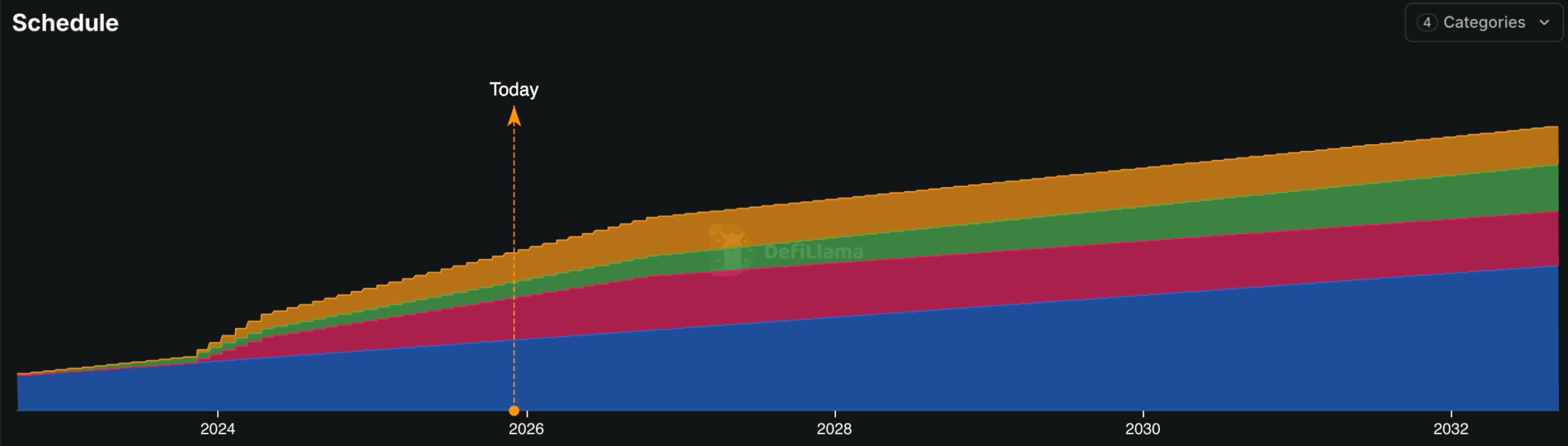
Chart showing APT token unlocks
As we can see in the chart above, new APT tokens are entering the market every month, contributing to this imbalance between supply and demand. On December 12, 11.31 million APT tokens will be unlocked, representing over $22 million and 1.54% of its market capitalization.
Pump.fun (PUMP)
- Quantity: 10 billion PUMP tokens;
- Value: $30.08 million;
- Unlock date: December 14;
- Amount unlocked relative to circulating supply: 1.7%.
Pump.fun is a popular token launchpad platform, typically for memecoins, on the Solana blockchain.
With the crypto market currently performing poorly, speculation—particularly on protocols like Pump.fun—is being impacted. Nevertheless, the project remains one of the most undervalued to date based on its Market Cap/ Revenue (MC/R) ratio of 4.4.
In other words, the Pump.fun project injects about a quarter of its market capitalization into the token each year through a buyback mechanism (purchasing tokens on the market) . This mechanism, highly valued by investors, has the benefit of reducing supply, which can lead to a price increase or, at the very least, mitigate the impact of token unlocks.

Chart showing the MC/R ratio of the PUMP token
On December 14, 10 billion PUMP tokens will be unlocked, representing over $30 million, or 1.7% of its market capitalization. Over the past 30 days, the price of the PUMP cryptocurrency has fallen by nearly 30%.
StarkNet (STARK)
- Quantity: 127.6 million STRK tokens;
- Value: $16.02 million;
- Unlock date: December 15;
- Amount unlocked relative to circulating supply: 2.66%.
StarkNet is a scalability solution for the Ethereum blockchain, based on the Cairo language. The project also aims to expand into the Bitcoin ecosystem, particularly to develop Bitcoin finance (BTCFi).
StarkNet is one of those projects heavily overfunded by venture capital (VC) firms. During the project’s various funding rounds, over $282.5 million was raised. A hefty sum, which comes with its own set of trade-offs.
In fact, the STRK token is subject to high inflation due to the project’s monthly token unlocks, which creates a gap between the crypto’s market cap and its price. While the total market cap increases as unlocks occur, dilution automatically drives the price of the STRK token downward:
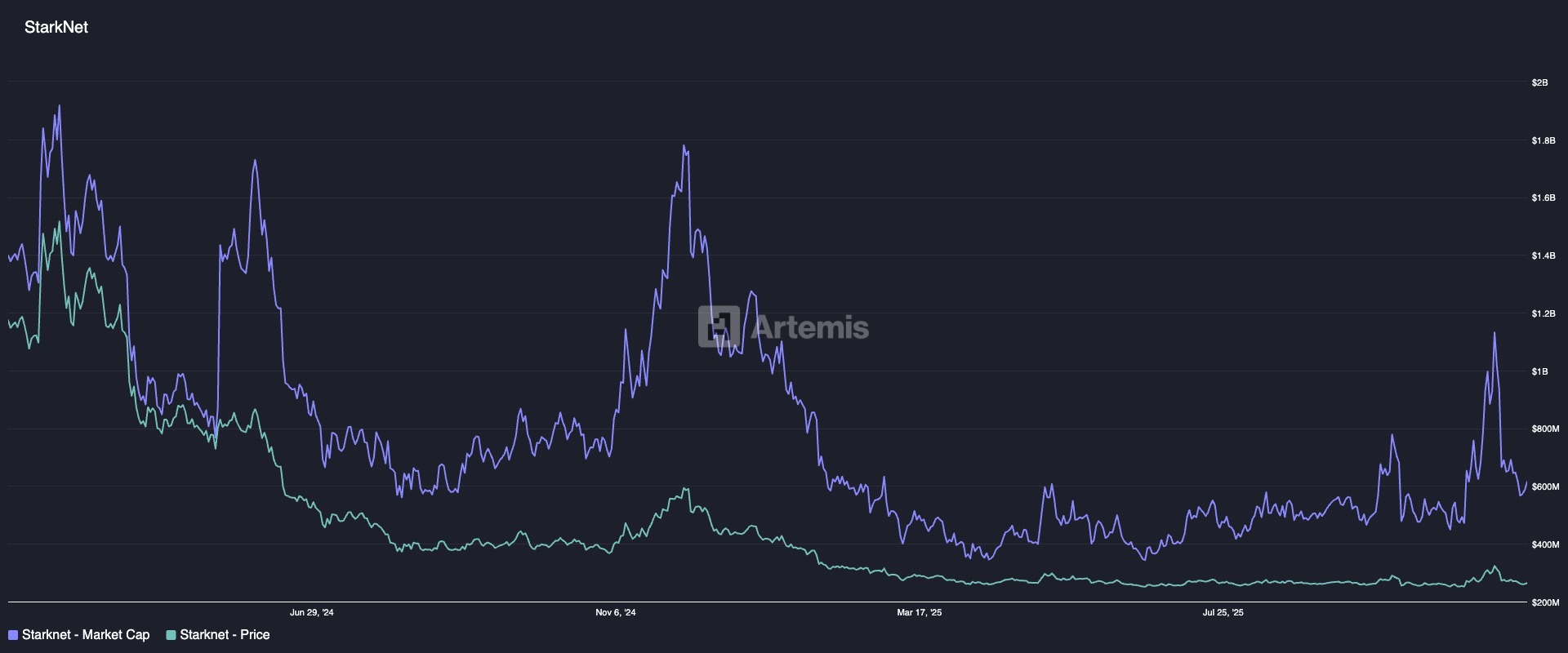
Chart showing STRK’s market cap (in blue) and its price (in green)
On December 15, 127.6 million STRK tokens will be released, representing over $16 million, or 2.66% of its market capitalization. Over the past 30 days, the price of the STRK cryptocurrency has risen by 18%.
Aster h2>
- Quantity: 78.41 million ASTER tokens;
- Value: $79.43 million;
- Unlock date: December 17;
- Amount unlocked relative to circulating supply: 3.89%.
Aster is a decentralized exchange (DEX) specializing in the trading of perpetual contracts (perps), but it also offers spot trading and tokenized stocks.
Publicly backed by Binance founder Changpeng Zhao (CZ), Aster has quickly established itself as a credible alternative to the industry leader, Hyperliquid.
Driven by a wave of speculation surrounding its airdrop, Aster quickly captured significant market share from Hyperliquid. Since the hype has died down, Aster accounts for between 20% and 25% of total volume across all DEX perps.
By comparison, Hyperliquid now holds similar market shares.
On December 17, Aster will unlock 78.41 million tokens, representing $79.43 million, or 3.89% of its market capitalization. Over the past 14 days, the price of the ASTER cryptocurrency has fallen by 20%.
Honorable Mentions
Among other major unlocks to watch in December, we can also mention:
The Layer 1 blockchain Sei, which will release 95.15 million of its eponymous tokens on December 15, representing nearly $13.3 million, or 1.49% of its market capitalization.
The Layer 2 blockchain Arbitrum, which will release 92.