
The accelerated development of data centers designed to run AI is driving unprecedented competition in the market for computer memory chips computing. And needless to say, the decision by industry giant Micron to exit the public market won’t help matters.
Computing memory crisis: a “full-blown heist unfolding”
The rapid development of artificial intelligence (AI) is reshaping many industries, far beyond the simple fact that it is gradually and successfully performing increasingly complex tasks that until now involved intellectual and creative professions reserved for humans.
In fact, another battle is being waged from a more technical perspective, in the market for memory chips used in computing, particularly the well-known DRAMs. At the heart of the issue: data centers in constant need of RAM and computing power, to the obvious detriment of the consumer computing market.
This observation has been made by numerous IT specialists, to the point where the X account known by the pseudonym Deus Ex Silicium has described a “ full-blown heist currently unfolding” in the sector, with prices for DDR4, DDR5, and NAND Flash RAM having risen sharply since September, and “peaks of over 500% expected by next summer.”
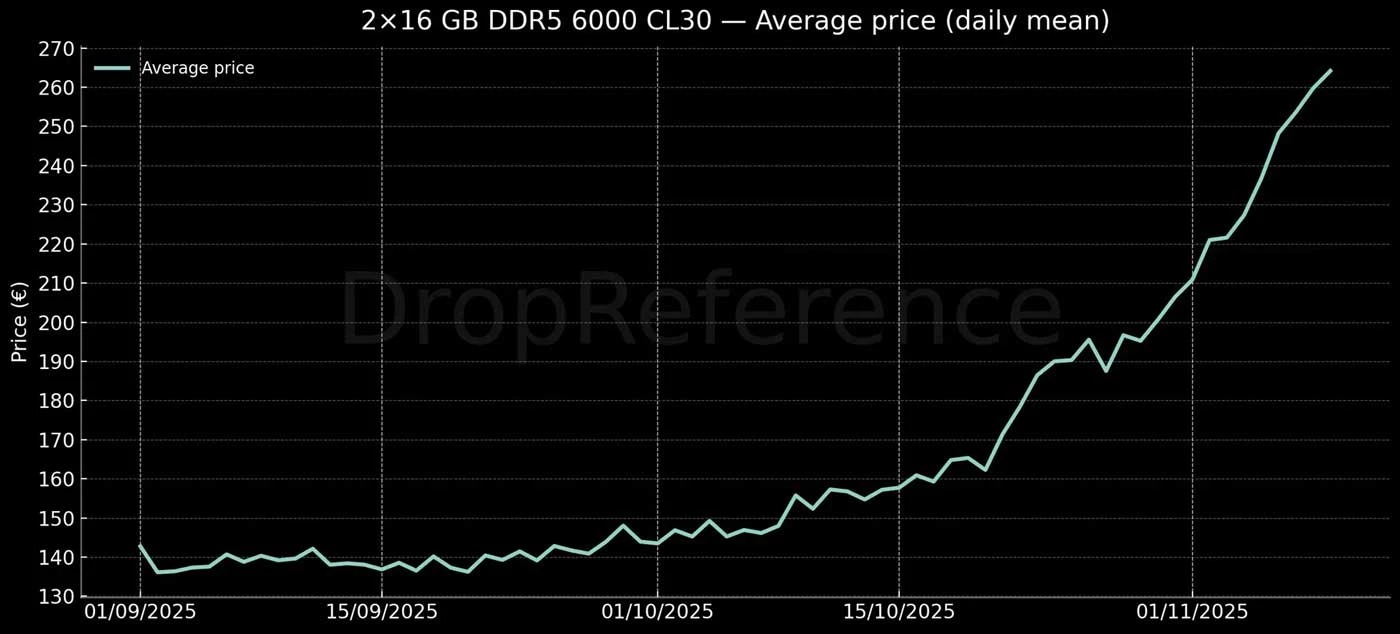
Memory chip prices have risen sharply since September
A memory shortage in which the giant Nvidia —which does not directly manufacture this type of chip—appears to be an aggravating factor, given its dominant position in the AI accelerator market. But it has reportedly finally been caught up in this crisis. Indeed, some sources indicate that it is now shipping its GPUs without the video memory chips (VRAM) that were previously included, leaving its partners to handle the complexities of sourcing them. >
Micron Exits the Consumer Market to Focus on AI
A complicated situation that could well become even more so, if the recent announcement by industry giant Micron is to be believed—namely, the planned discontinuation by June 2026 of its consumer memory chips, sold under the Crucial brand.
The goal of this decision? To allow Micron to exit the consumer market—where it has been offering its products for 30 years—in order to focus exclusively on its most profitable business: selling memory directly to AI computing farms operated by companies such as OpenAI, Google, and others.
This shift toward AI also affects Bitcoin blockchain miners, particularly to increase the profitability of their power supply as BTC mining becomes less and less profitable.
From a more technical perspective, the current memory chip crisis does not directly affect the production of the ASICs needed for their operations, but rather reflects a broader reorganization of the global semiconductor supply chain. In any case, an inevitable increase in operating costs appears likely.
ers comp
Top Crypto Performers for November
With November marked by a drop of more than 13% in the price of Bitcoin, few cryptocurrencies managed to perform well. However, a few resilient altcoins stood out: find out which ones and the reasons behind their outperformance, bucking the trend of the overall market
A Difficult November for the Crypto Market
While Bitcoin’s price posted a negative return of -13% over the past 30 days, Ether, for its part, experienced a steeper decline of approximately -17%.
Few altcoins managed to perform well under such conditions . And yet, some cryptos have managed to post respectable returns.
Among the top 5 best-performing cryptos in November were KAS, XMR, QNT, WLFI, and RAIN:

The 5 best-performing cryptocurrencies in November
5 – Kaspa (KAS): +17.3%
Launched in November 2021, the Kaspa project draws heavily on Bitcoin, whether in terms of principles, methodology, or its proof-of-work (PoW) environment.
In fact, Kaspa is based on the GhostDAG protocol, which extends the Nakamoto consensus to a Directed Acyclic Graph (DAG) system, with the goal of making it more scalable than its first implementation, Bitcoin.
Over the past 30 days, the price of the KAS cryptocurrency has risen by more than 17%. Among the potential reasons for this performance is the launch of Kaspa’s first decentralized bridge, which greatly improves its interoperability with EVM blockchains.
Following this major milestone, Dymension has integrated KAS as a base asset. In other words, Dymension’s rollapps can now choose to use KAS to pay gas fees.
In summary, Kaspa has made a significant technological advancement, combined with new demand for KAS.
4 – Monero (XMR): +18.2%
Monero is a blockchain focused on anonymity, where transactions are made untraceable through the use of various cryptographic techniques. Monero’s native cryptocurrency shares the same name as the blockchain and is known by the ticker XMR.
Over the past 30 days, the price of XMR has surged by more than 18%.
Although the reasons behind this price surge remain unclear, it is likely that Monero benefited from a rotation of capital. Indeed, the privacy coin narrative was in full swing during the month of October, particularly with Zcash, which posted exceptional performance over that period.
Thus, it is possible that capital that had shifted away from Zcash has now flowed back into Monero. In fact, XMR remains to this day the highest-capitalized cryptocurrency to the privacy coin sector. It therefore remains a “safe bet” in the minds of investors, regardless of whether there is hype surrounding a particular narrative or not.
3 – Quant (QNT): +23.5%
Quant is a project focused on a very specific segment: institutional interoperability. Unlike most blockchains, which seek to attract users or developers, Quant directly targets banks, companies, and financial infrastructures that want to connect their existing systems to different blockchains without having to rebuild their entire architecture.
Its flagship product, Overledger, is not a blockchain but a multi-chain operating system that allows interaction with multiple public and private blockchains as if they were part of a single environment.
Over the past 30 days, the price of the QNT cryptocurrency has risen by 23.5%.
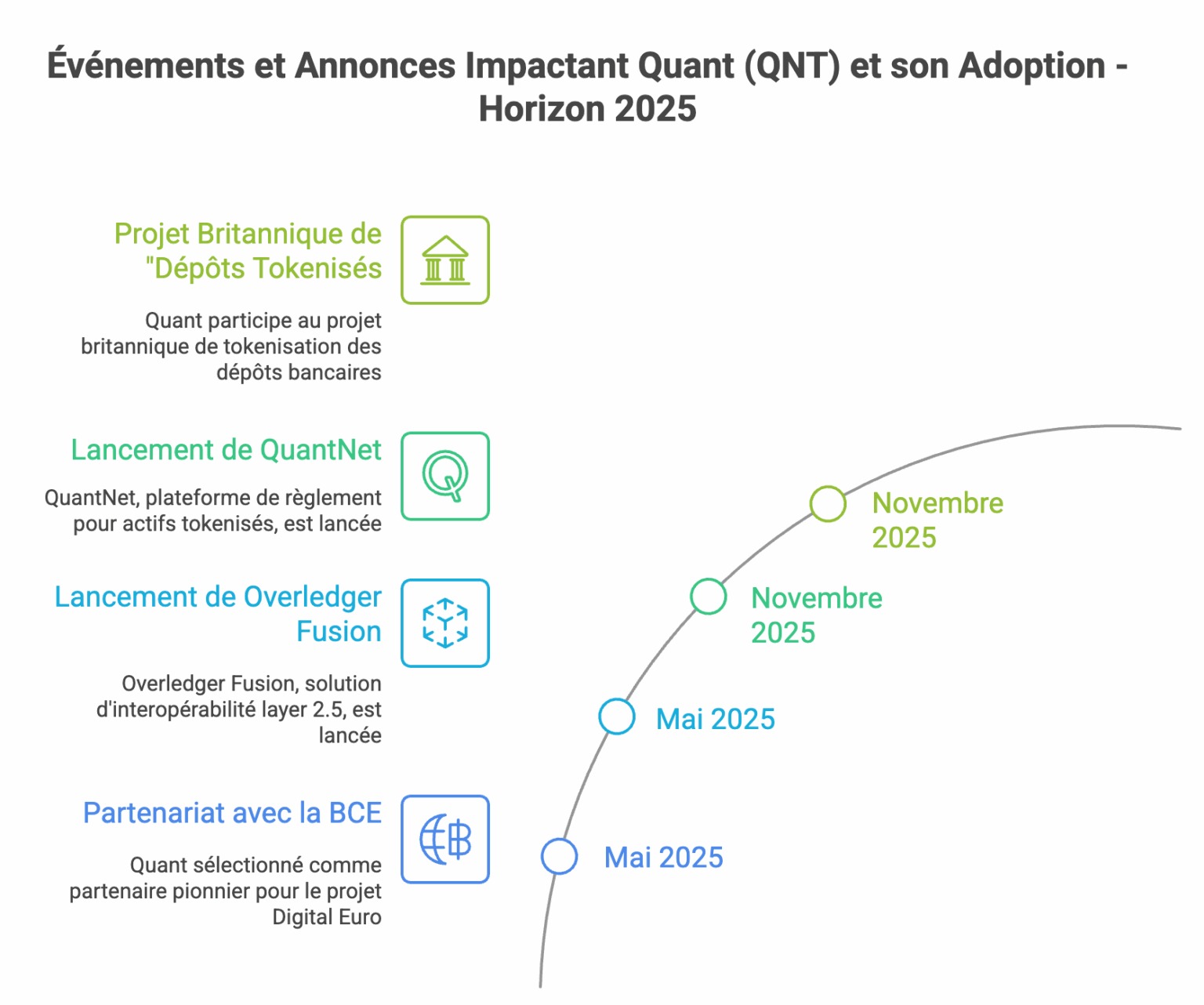
Chart showing the key milestones of the Quant project in 2025
Among the potential reasons for QNT’s performance, we can notably cite Quant’s collaboration with various institutions, such as the European Central Bank (ECB) on the digital euro (CBDC) project. More recently, Quant announced its participation in a British tokenized deposits project, launched by a banking consortium in the United Kingdom.
Caution is advised, however: beyond the hype, it is difficult to analyze the actual growth or demand for this type of project.
2 – World Liberty Financial (WLFI): +26.7%
World Liberty Financial is a decentralized finance (DeFi) protocol launched in 2024, closely linked to U.S. President Donald Trump and his family. Presented as an attempt to “improve the dollar,” the project consists of two pillars: a stablecoin, the USD1, backed by the U.S. dollar, and a governance token, the WLFI.
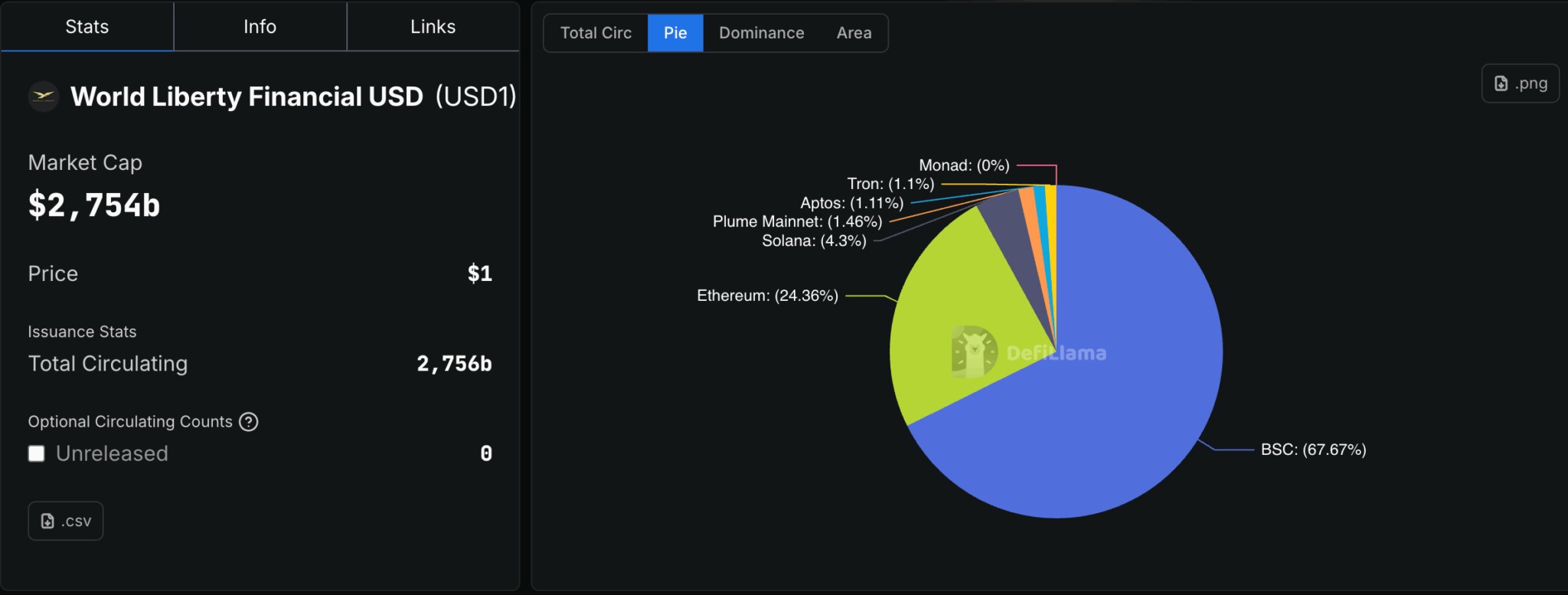
Chart showing the market capitalization of the USD1 stablecoin
According to data from the DeFiLlama analytics platform, the USD1 stablecoin is now the 7th-largest stablecoin by market capitalization, at $2.75 billion.
Beyond this key metric, the project recently announced a buyback & burn program for its WLFI token. This type of mechanism is generally very popular with investors, who may view it as a form of value redistribution.
Over the past 30 days, the price of the WLFI cryptocurrency has risen by 26.7%.
1 – Rain: +136.2% h2>
Rain Protocol is a decentralized prediction market built on the Arbitrum blockchain and interoperable with the Base, BNB Chain, and Ethereum. It aims to be the “Uniswap of prediction markets”: anyone can create markets (public or private) on a wide range of events, without prior authorization.
The RAIN token is the protocol’s native cryptocurrency: it is used to participate in the ecosystem, pay for and participate in markets, and engage in governance. Currently in beta, Rain touts a permissionless model that combines resolutions via oracles and artificial intelligence (AI) systems.
Over the past 30 days, the price of the RAIN token has skyrocketed, rising 136% during that period.
Among the potential reasons for this surge is the fact that a Nasdaq-listed company has chosen to invest $212 million in the RAIN token. Indeed, prediction markets are on the rise, as evidenced by recent funding rounds at the two industry leaders, Polymarket and Kalshi.
However, we recommend exercising caution regarding the RAIN token. In fact, companies that adopt the crypto treasury system often have a failing business model, and these strategic shifts are frequently “last-ditch” attempts to stay afloat.
Furthermore, if the company decides to abandon its crypto treasury project, the RAIN token could be significantly impacted. p>
Honorable Mentions
Among the cryptocurrencies not included in the previous ranking—due to their market capitalization falling outside the Top 100—we can mention:
The TEL token from the Telcoin project, which has risen 100% over the past 30 days.
The MYX token from the MYX Finance decentralized exchange (DEX) for perpetual contracts (perps), with a 66.4% return over the past 30 days.
The BAT token from Basic Attention, the native token of the Brave browser, used to reward users for their attention and to fund a decentralized advertising model, with a 46% return over the past 30 days.
Token Unlocks That Could Shake Up the Crypto Market in December 2025
Every month, regardless of market conditions, the same pattern repeats. Millions of new tokens are released onto the market, potentially putting selling pressure on the price of the relevant cryptocurrency. Find out which tokens are set to to watch in December to stay one step ahead.
The 5 crypto token unlocks to watch in December
While most altcoins have underperformed over the past 30 days, a well-oiled mechanism could further accentuate this trend: the infamous token unlocks.
Indeed, as is customary, millions of tokens will be released in December.
Although a token unlock doesn’t necessarily mean a drop in the price of the asset in question, this event does, at the very least, contribute to an increase in supply relative to demand, which can result in selling pressure.
This month, there are significant unlocks to be aware of and monitor, particularly for the ENA, APT, PUMP, STRK, and ASTER:
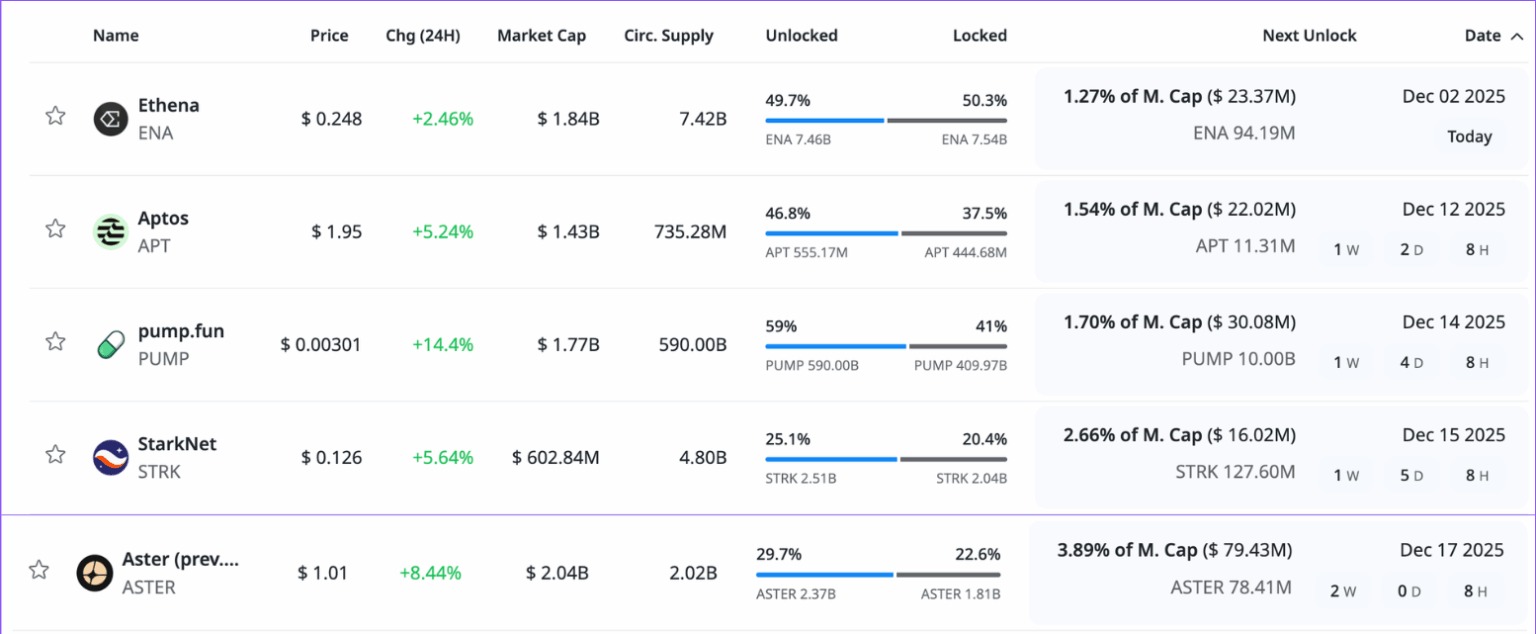
Token unlocks to watch in December
Ethena (ENA)
- Amount: 94.19 million ENA tokens;
- Value: $23.37 million;
- Unlock date: December 2;
- Amount unlocked as a percentage of the circulating supply: 1.27%.
Ethena is a decentralized finance (DeFi) protocol that offers an alternative to traditional stablecoins through a product called USDe, a “synthetic” stablecoin pegged to the dollar.
Unlike reserve-backed stablecoins (such as USDT or USDC), USDe is kept stable through a hedging strategy based on crypto derivatives.
The ENA token is the governance token of the Ethena protocol. It allows holders to participate in decisions regarding the protocol’s development and to earn staking rewards.
Over the past 30 days, the price of the ENA token has fallen by approximately 30%