
To make the world of Bitcoin more accessible, Bitcoin is nearing its limit: Only 5% remains to be mined
With less than 5% of BTC left to mine, Bitcoin confirms its programmed scarcity. Unlike other blockchains with changing monetary rules, Bitcoin remains faithful to its original protocol. This stability reinforces its unique position: a digital asset that cannot be manipulated, designed to counter inflation and censorship.
95% of BTC has already been mined—as expected, it is becoming scarcer
It is important to remember that Bitcoin is unique among digital and even physical assets: its monetary policy is immutable and transparent, and its transactions are inherently censorship-resistant.
Whereas many blockchains regularly adjust their economic rules (changing token issuance, operation, and usage), Bitcoin is based on code that is virtually set in stone and has been audited. No single entity can impose a change without the explicit consent of the entire network.
It is precisely this robustness that has allowed Bitcoin to guarantee, since its inception, a maximum supply of 21 million units—a certainty that few other cryptocurrencies can offer.
Today, the 95% threshold of the maximum supply of bitcoins has been reached, amounting to nearly 19.96 million BTC. Only about 1.04 million BTC remain to be mined—a scarcity that will continue to increase over time, until the final issuance, expected between 2130 and 2140.
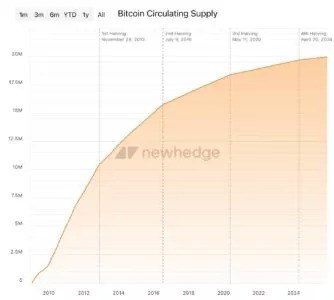
Bitcoin Issuance Over Time
But the scarcity perceived by the market is actually even greater; it is estimated that 3 to 4 million BTC are permanently lost due to lost or destroyed private keys.
Added to this are the famous BTC held by Satoshi Nakamoto, Bitcoin’s mysterious creator: approximately 1.125 million BTC, mined in the network’s early months and never moved since.
The majority of the community considers these BTC to be out of circulation forever. Taking these losses into account, the actual available supply could thus fall to around 16 million BTC, or even less.
What if someone were to steal Satoshi’s BTC?
Although the 1.125 million BTC attributed to Satoshi Nakamoto are considered permanently lost, some Bitcoiners believe there remains a tiny chance that they might one day be recovered.
Two scenarios are frequently discussed:
The first is based on a lack of entropy during the generation of private keys in Bitcoin’s early days. If the private key generation algorithm used by Satoshi lacked sufficient randomness, then well-equipped attackers could, in theory, recover some of these keys using a brute-force attack.
The second scenario involves quantum cryptography. A sufficiently powerful quantum computer could break classical cryptographic algorithms, such as ECDSA, which Bitcoin uses to secure private keys. This type of threat is still very theoretical, but it raises an existential question for all systems based on current cryptography; Bitcoin would not be the first victim of such computers.
New FUD on Tether — Could Diversification into Gold and Bitcoin Be Its Downfall?
Despite its undeniable successes and the clout of its USDT stablecoin, Tether remains the perennial crypto giant that everyone loves to bash. The latest example: a doomsday scenario imagined by Arthur Hayes regarding its diversification into gold and Bitcoin.
Tether: Could Diversification into Gold and BTC Make USDT Insolvent?
The growth of the cryptocurrency sector has already given rise to several giants, including the undisputed leader of the stablecoin market, Tether, and its USDT, currently valued at $185 billion—representing more than 60% of the market share.
A position it has secured despite frequent criticism regarding its high level of centralization, as well as the management of its reserves, which is considered too opaque. As a result, the company continues to rack up successes and profits while simultaneously being excluded from major regulatory jurisdictions such as the European Union and the United States.
A paradox that has fueled widespread speculation about its true strength or its ability to guarantee the solvency of its USDT stablecoin. This question has recently been brought back into the spotlight by investor Arthur Hayes, who sees this as “the beginning of the first rounds of a massive interest rate trade.”
Indeed, the co-founder and former CEO of the cryptocurrency exchange BitMEX believes that Tether’s latest quarterly report highlights a corporate strategy designed to counteract a potential cut in Fed rates, “which would crush the interest income” from its reserves, which are heavily exposed to U.S. Treasury bills.
In response, they are buying gold and BTC, which should theoretically skyrocket in value as the price of silver falls. But a drop of about 30% in these positions would wipe out their capital, and then USDT would theoretically become insolvent.
Arthur Hayes
New FUD Against Tether, According to CEO Paolo Ardoino
With this post, Arthur Hayes appears to be predicting the imminent insolvency of USDT, linked to the current decline in Bitcoin and the correction in the price of gold since its last peak—all due to Tether’s diversification policy, which is supposed to ensure greater stability.
A new attempt at FUD against Tether, according to its CEO Paolo Ardoino, orchestrated by “certain influencers who are either bad at math or incentivized to promote [its] competitors.” And for good reason: its latest quarterly report also notes that “Tether will continue to maintain a buffer of excess reserves amounting to several billion dollars and the Group’s total equity approaching $30 billion.”
This doomsday scenario has also been called into question by Joseph Ayoub, former head of crypto research at Citi, after “hundreds of hours spent writing research on Tether.” Indeed, he explains how the reported assets differ from the company’s actual assets and how Tether stands out as “one of the most efficient cash-generating companies in the world” with only 150 employees.
All of this allows us to estimate the value of their equity somewhere between $50 billion and $100 billion. Even though they’ve indicated they’re looking to raise $20 billion at a 3% stake, which would value them at around $500 billion. That probably won’t happen, and it’s undoubtedly overvalued, but it’s still very valuable equity.
Joseph Ayoub
Just an attempt to manipulate the market?
All these denials cast doubt on Arthur Hayes’ claims, which are considered alarmist, to say the least. This is especially true given his recurring attempts to sway the market in his favor, coupled with a clear desire to see “the mainstream media go wild over this.”
Could this instead be a strategy designed to trigger a more significant pullback in the crypto market, with the aim of finding a good entry point? This is a possibility very clearly considered by Ki Young Ju, founder and CEO of the analytics firm CryptoQuant:
Translation: I’m currently in a bad position, and I want crypto prices to fall so I can buy at lower levels.
Ki Young Ju
This is a serious question.
Strategy’s CEO is considering selling Bitcoin to pay dividends
The current decline in Bitcoin is not good news for Digital Asset Treasuries (DATs) that specialize in accumulating the most iconic cryptocurrency. This reality is even prompting the CEO of industry leader Strategy to consider selling a portion of its BTC to pay dividends to its shareholders.
Strategy has nothing to do with a “hyper-dilutive Ponzi scheme”
The current downturn in the cryptocurrency market is putting the Digital Asset Treasuries (DAT) sector through a full-scale stress test, a sector that has seen unprecedented growth since the beginning of the year.
In fact, these publicly traded companies—which have become specialists in crypto accumulation, often with (very) shaky financial structures—find themselves in a very precarious position as shareholders seek higher returns based on supposedly attractive per-share holding ratios (mNAV).
However, Phong Le, CEO of the industry leader Strategy, sought to reassure listeners about this reality during a recent appearance on the “What did Bitcoin” podcast. He explained how his company—and its current holdings of 648,870 BTC—have nothing to do with the “hyper-dilutive Ponzi scheme” conjured up by the “mental gymnastics” of certain observers.
Just as we introduced people to Bitcoin-backed debt, we’re now introducing them to Bitcoin-backed credit, and we’re just getting started. I think that, for the foreseeable future, we’re still talking about 40% to 50% annualized returns over a period of 4 or 5 years.
Phong Le
Could this be a way to reassure investors, given the sharp decline in its MSTR stock—down nearly 60% from its peak last July? The question arises, especially in light of the prospect of its possible exclusion from the Nasdaq 100 and MSCI USA indices early next year.
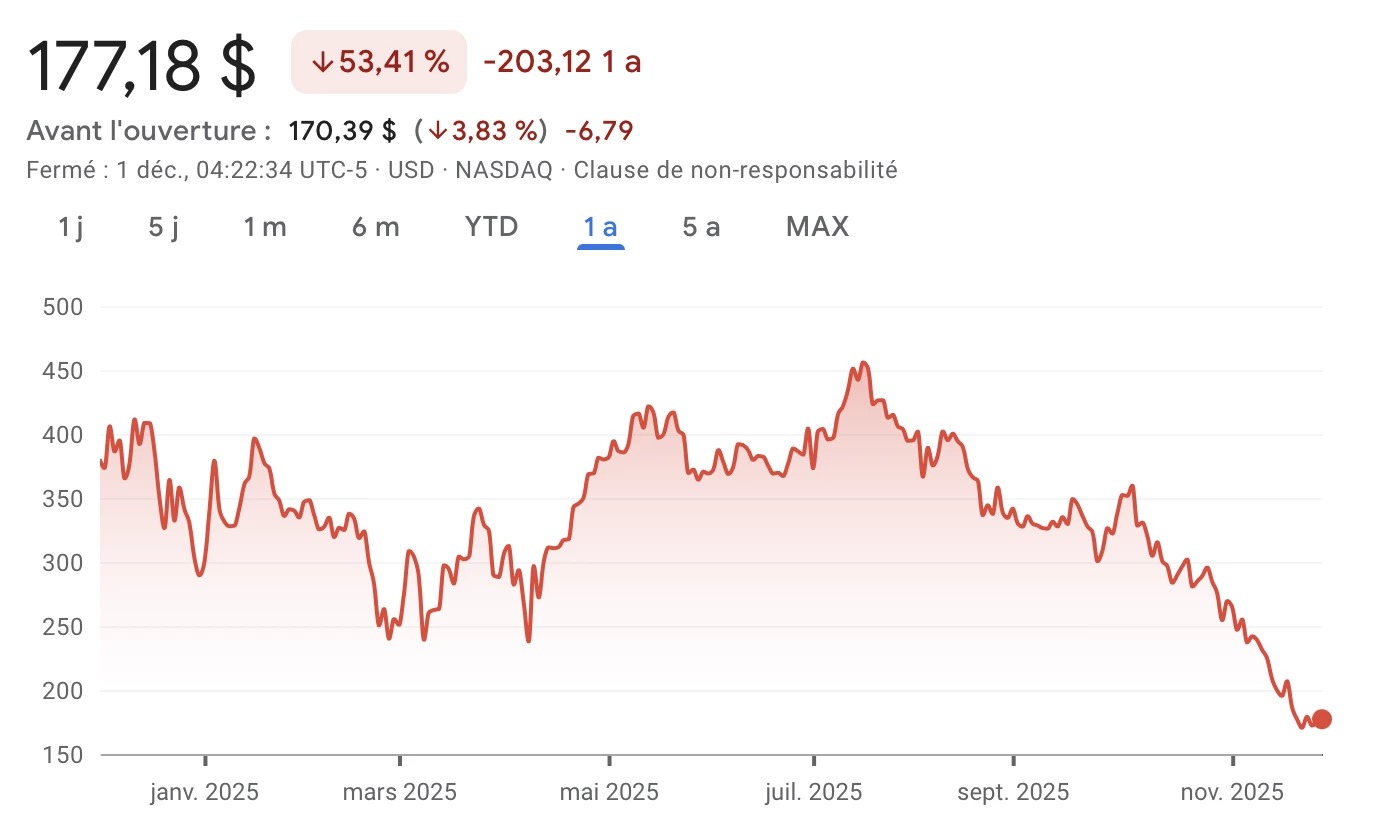
Strategy’s MSTR stock has seen a significant decline in recent months
Selling Bitcoin to Pay Dividends
A delicate situation greatly exacerbated by the current decline in the price of BTC, which has fallen back below $90,000 at the start of this week. This raises the question once again of whether Strategy might start selling Bitcoin, despite Michael Saylor’s recent denial.
A scenario that now appears very clearly as a possibility, according to Phong Le, but only as a last resort.
We can sell Bitcoin, and we would do so if we had to finance dividends when the mNAV falls below 1x. It would be a last resort: mathematically sound, but narratively tricky.
Phong Le
The problem? This mNAV figure has already been below the 1x level since November 12, according to data from Strategy Tracker. That is, almost exactly when suspicions of BTC sales began circulating online, following a series of transfers made by Strategy.
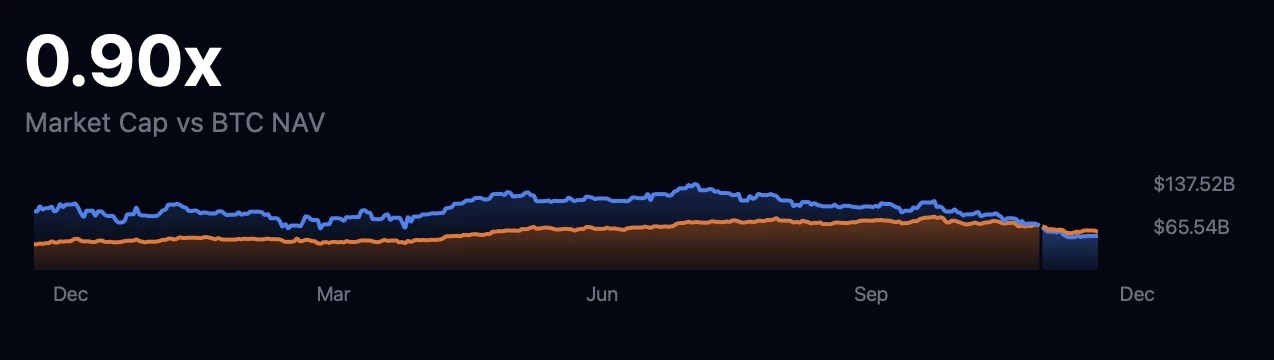
Strategy’s mNAV is trading below the 1x level
As Phong Le is quick to point out, an official announcement of a Bitcoin sale could have a significant psychological impact on the market. He seeks to reassure, however, by explaining that “if Bitcoin outperforms the S&P 500, Strategy wins .”
Another issue: BTC is down 10% over the past year, compared to a 13% gain for the S&P 500.
Why Is Bitcoin (BTC) Falling Again to $86,000?
Overnight, the price of Bitcoin (BTC) fell again, dragging the rest of the cryptocurrency market down with it. What can we say about this new bearish trend?
Bitcoin (BTC) and cryptocurrencies stumble again
Last week, the price of Bitcoin (BTC) managed to reclaim the $90,000 level, but that attempt now appears to have failed, as the asset suffered a sharp drop overnight, briefly dipping below $86,000:
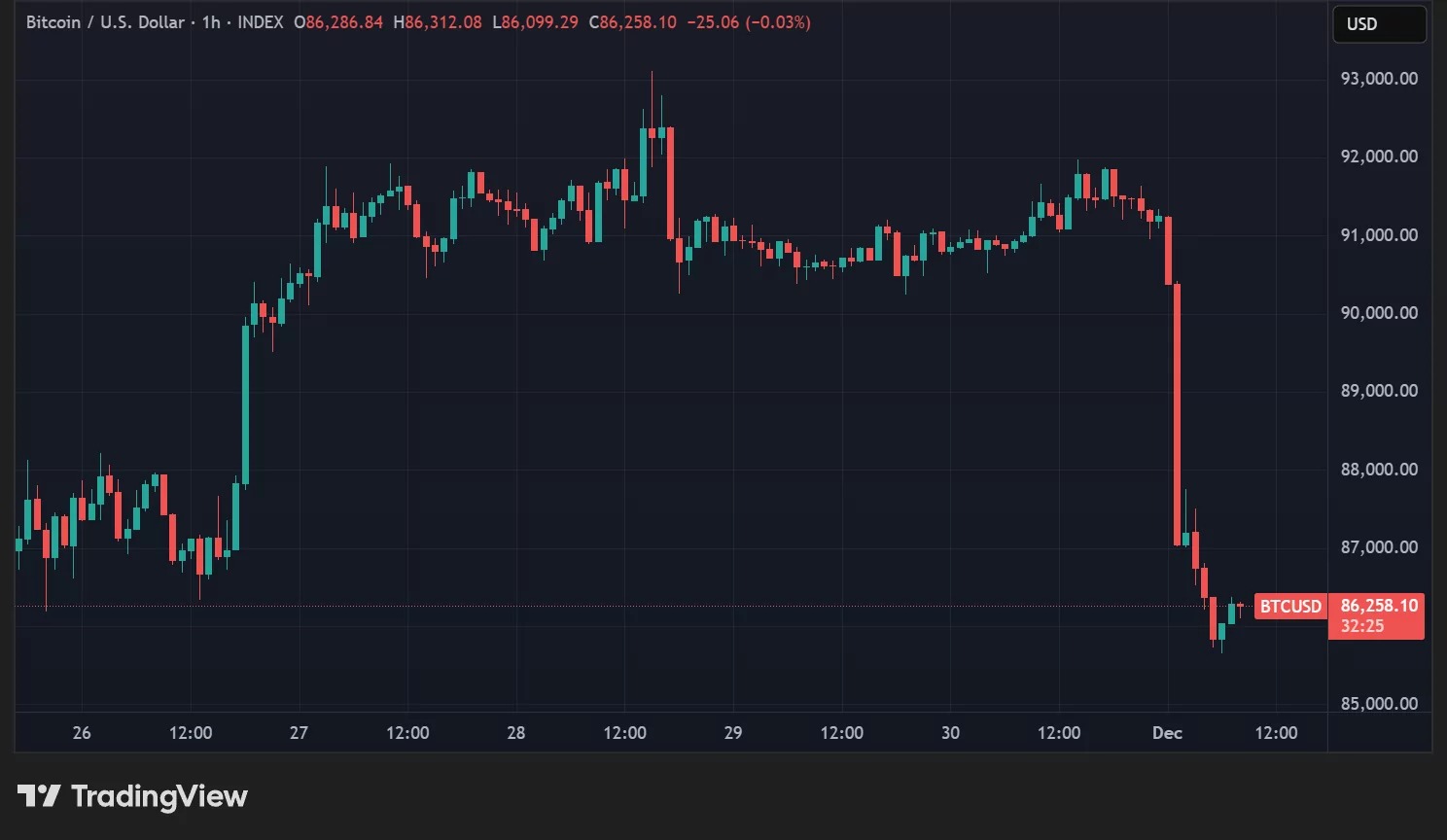
BTC price (hourly data)
At the time of this writing, one bitcoin is trading at $86,300, down 5.2% over the past 24 hours. More broadly, the rest of the cryptocurrency market is also feeling the impact, with total market capitalization down 4.9% and some of the top 10 cryptocurrencies losing more than 8%, such as ADA and DOGE:
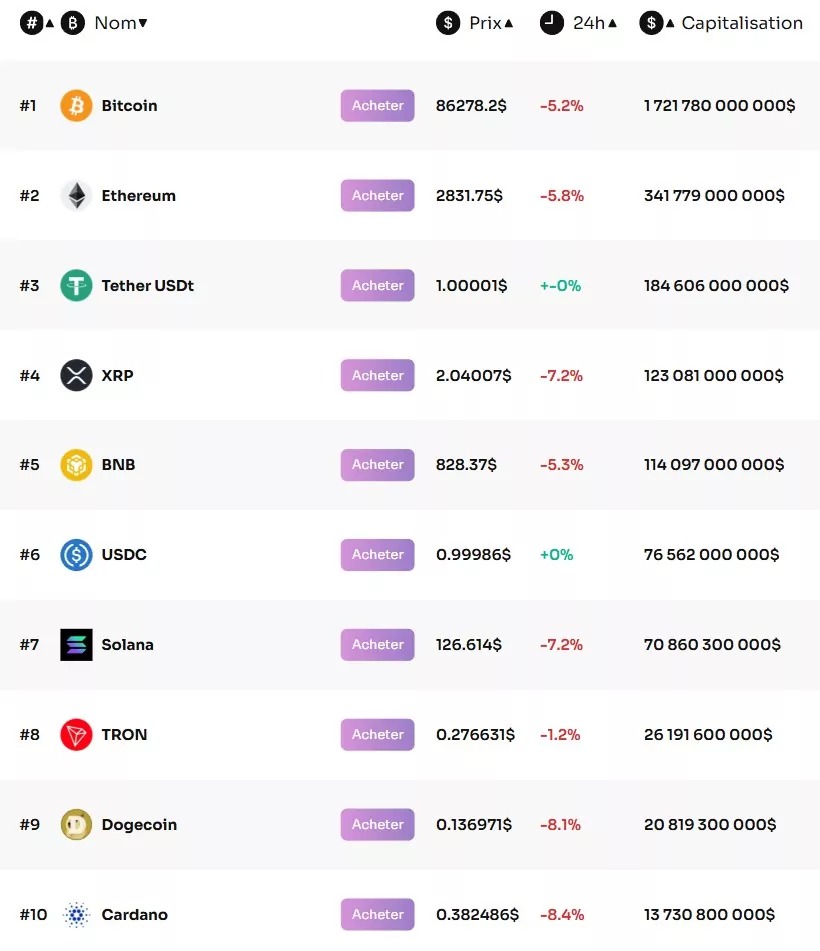
Overview of the top 10 cryptocurrencies