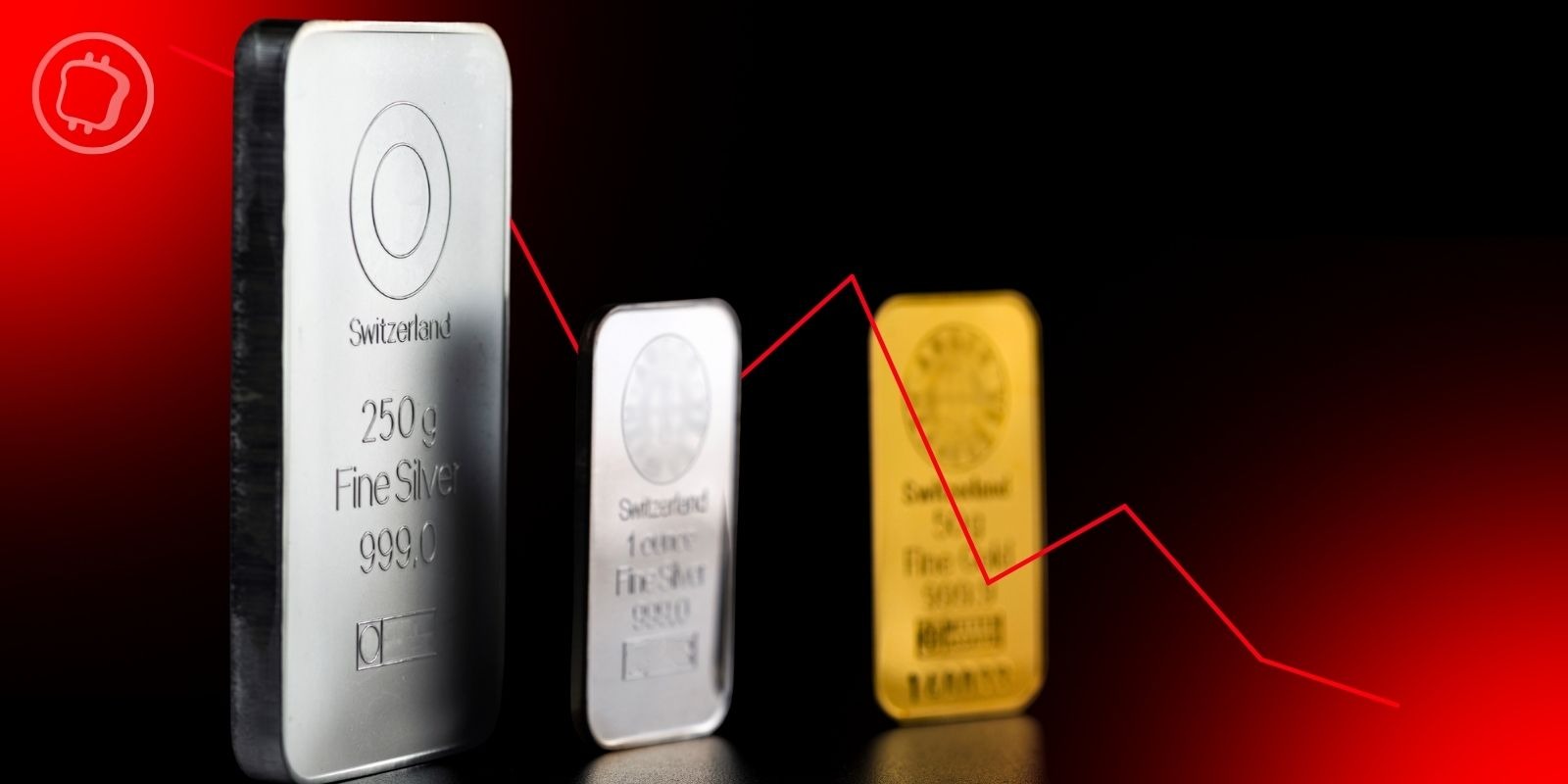
After a sharp rise in volatility in recent days, gold and silver have suffered a steep correction in what could be the biggest crash in history. Let’s take stock of the situation.
Gold and silver see sharp corrections
After weeks of gains, precious metals experienced what is likely the biggest crash in financial market history on Friday. Spot prices show a 9.6% drop for gold, 26.29% for silver, 5% for copper, and 15% for palladium.
In total, $7 trillion in market capitalization is estimated to have evaporated within 36 hours. Having fallen to $85 per ounce, silver reportedly suffered its worst day since 1921, while the chart for gold futures contracts shows a decline of nearly 13% from its all-time high (ATH):
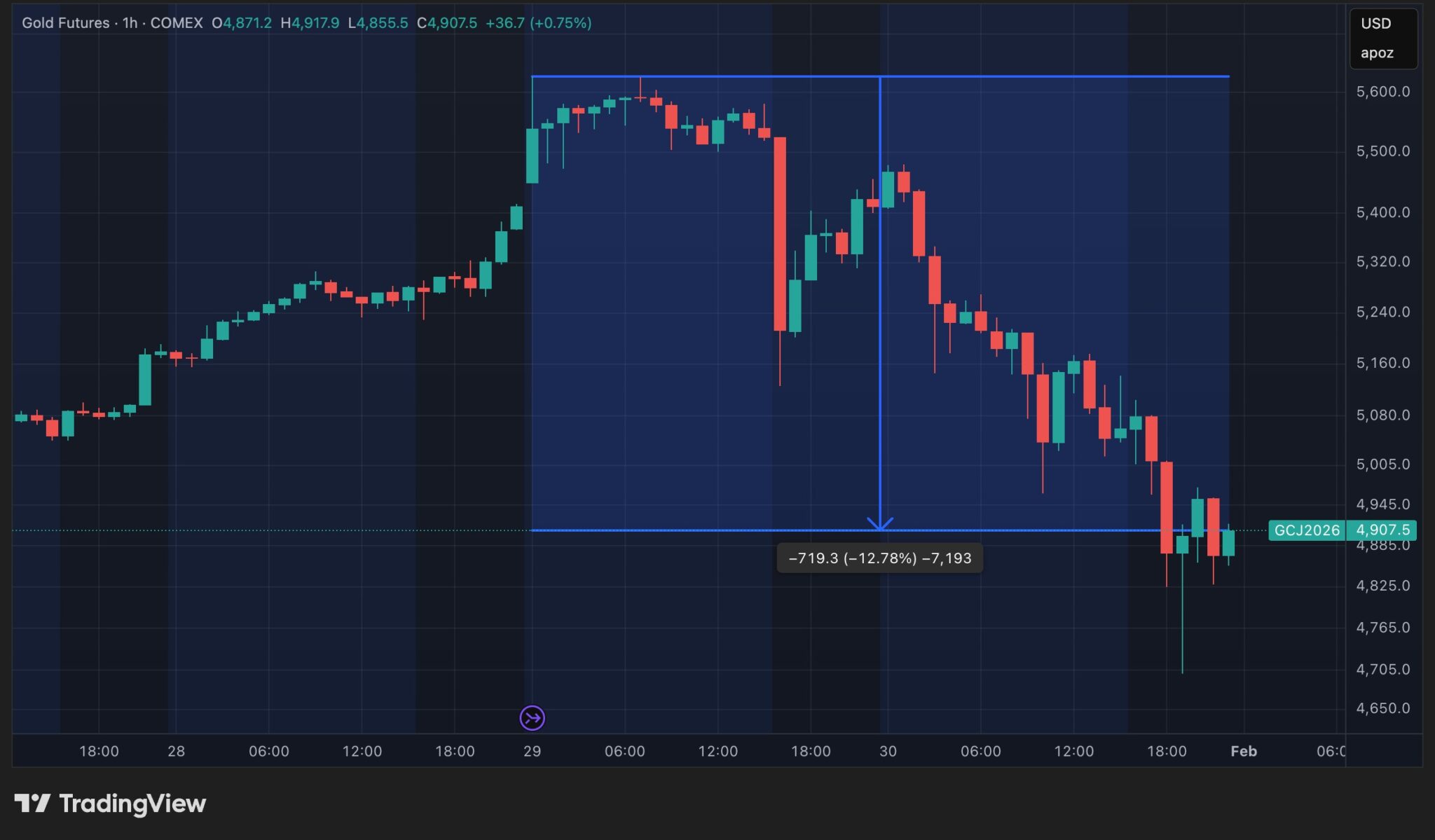
Gold futures prices (hourly data)
Having fallen from 5,600 to 4,700 in less than two days, the price of an ounce of gold now stands at $4,908 on financial markets, thereby erasing a week of gains.
On X, the StockMarket.News account shares an interesting theory suggesting that the announcement of the next chair of the U.S. Federal Reserve (Fed) may have played a role. Indeed, on Friday, Donald Trump nominated Kevin Warsh to succeed Jerome Powell as chair of the Federal Reserve Board of Governors.
Given his past experience, Kevin Warsh is viewed by many observers as a staunch opponent of inflation—or at least of policy tools that expand the Fed’s balance sheet, such as quantitative easing. According to StockMarket.News, this is what reportedly surprised the financial markets, which had been betting on a candidate whose stance would be more accommodating to Donald Trump’s pressures and a weaker dollar.
Nevertheless, Kevin Warsh is also said to have recently expressed support for rate cuts, and if his nomination is confirmed by the Senate, we should quickly gauge the direction of the policy he intends to implement at the Fed.
Furthermore, it is worth noting that Donald Trump’s announcement came several hours before the peak of the crash in precious metals. Moreover, increased volatility in this asset class had already been evident for several days.
In any case, the fact remains that the chain reaction inherent in this type of market movement unfolded on an unprecedented scale—namely, leveraged positions being liquidated, with forced sales triggering further forced liquidations, which in turn amplified the chain reaction.
In recent days, we have warned you about the FOMO syndrome, which it is easy to succumb to during such phases of euphoria. While there is nothing to prevent the market from rebounding after such a sell-off, we reiterate our call for caution in light of the risks that such volatility poses to an unprepared investor.