The decentralized platform Uniswap continues to grow in a regulatory environment that is now much more favorable. This has given its founder, Hayden Adams, the opportunity to approve the “fee switch” that UNI token holders have been eagerly awaiting.
Uniswap Proposes Activating a “Fee Switch”
Since its launch in 2018 on the Ethereum blockchain, the decentralized exchange (DEX) Uniswap has established itself as a key player in the cryptocurrency ecosystem. This position was further strengthened in 2020 following its airdrop of UNI tokens to its users.
A cryptocurrency based on a decentralized finance (DeFi) protocol, the role of which had, until now, been limited to providing governance power—specifically through participation in community votes. As a result, its holders had been calling for the introduction of a “fee switch” for some time.
In practice, this involves changing how the protocol’s revenue is managed to benefit token holders while also attracting a broader community. Uniswap Labs has just confirmed this decision, simultaneously initiating a merger with the Uniswap Foundation.
This significant shift in direction was announced by Uniswap founder Hayden Adams following the lifting of restrictions previously imposed by “a hostile regulatory environment, which cost thousands of hours and tens of millions of dollars in legal fees.”
UNI was launched in 2020, but for the past five years, Uniswap Labs has been unable to participate meaningfully in the protocol’s governance and has been severely limited in its ability to create value for the community. That ends today!
Hayden Adams
“UNIfication”: An Aggressive Burn Strategy
This proposal bears the highly symbolic name “UNIfication.” The goal: “to lay the foundation for the protocol’s next decade of growth” through a burn policy that will begin with “the destruction of 100 million UNI tokens from the treasury, representing the fees that could have been burned had the ‘fee switch’ been activated at launch.”
In parallel with this reduction in the UNI token supply, the UNIfication plan also proposes using the fees generated by the Uniswap DEX and the Unichain sequencer to burn even more tokens. In addition, the returns for its liquidity providers will also receive a boost through a method called Protocol Fee Discount Auctions, specifically designed to “internalize the Maximal Extractable Value (MEV) for the benefit of the protocol.”
Finally, Uniswap V4 will integrate “aggregator hooks” capable of “collecting protocol fees from external liquidity sources.” At the same time, Uniswap Labs announced that it will stop collecting fees on its interface, wallet, and API to further stimulate this program.
The UNI token is skyrocketing
This announcement has clearly convinced UNI token holders, with a 50% surge over the past few hours that propelled its price above $10, before settling back to around $8.70 at the time of writing.
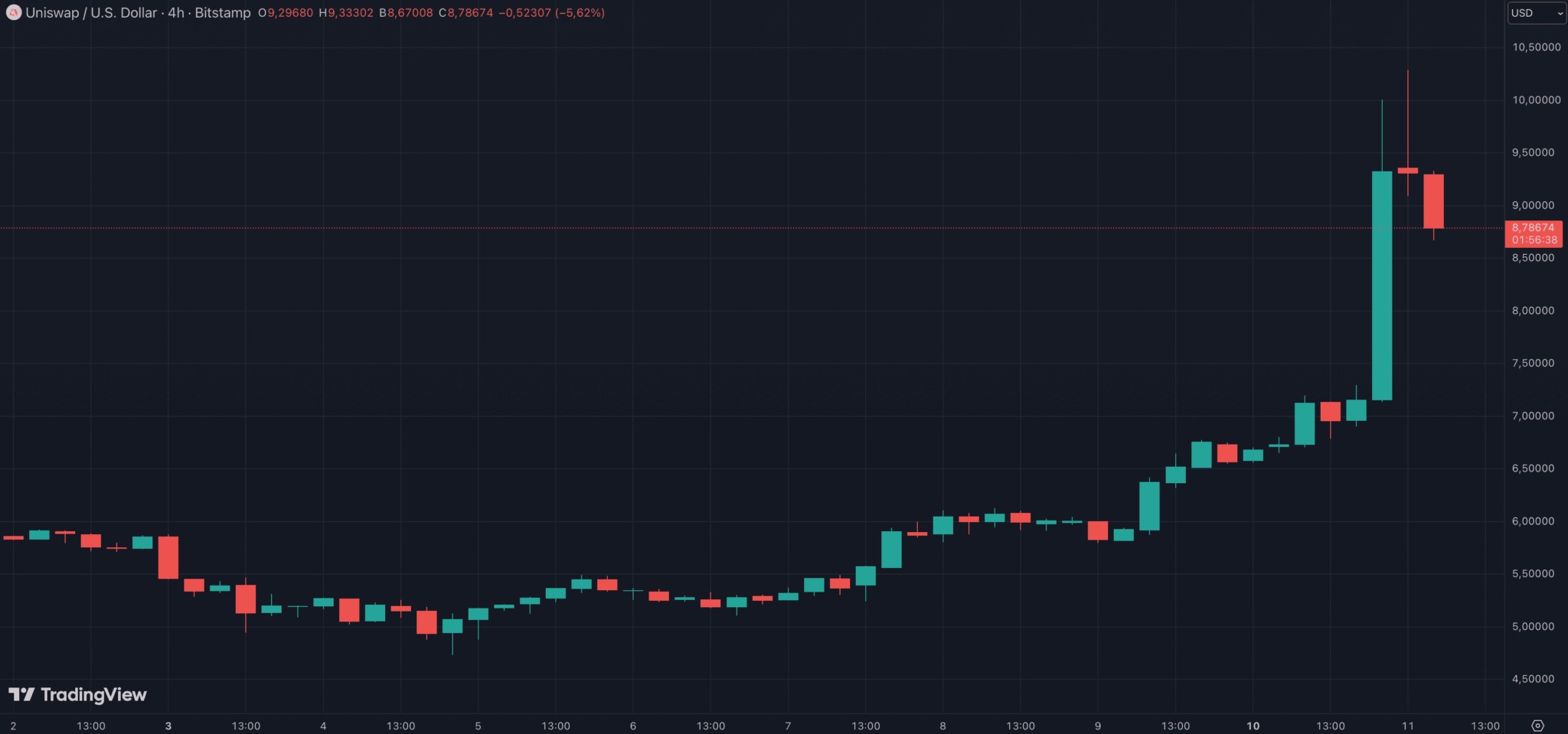
The UNI token has seen a significant surge in the last few hours
At this time, no details are available regarding the actual proportion of fees allocated to the burn. In any case, the Uniswap protocol has been among the top performers in DeFi over the past few months, with the potential to generate over $2 billion in annualized revenue.