An unexpected surge. Amid a bearish market for cryptocurrencies, zkSync’s ZK has just surged significantly, bucking the trend. How can this be explained?
The price of zkSync’s ZK has surged in recent days
While Bitcoin is struggling, having fallen 19% from its all-time high a month ago, the same cannot be said for the cryptocurrency associated with zkSync: ZK.
Over the past 7 days, the cryptocurrency has actually gained 100%, with two consecutive rallies that pushed ZK to around $0.070–$0.075:
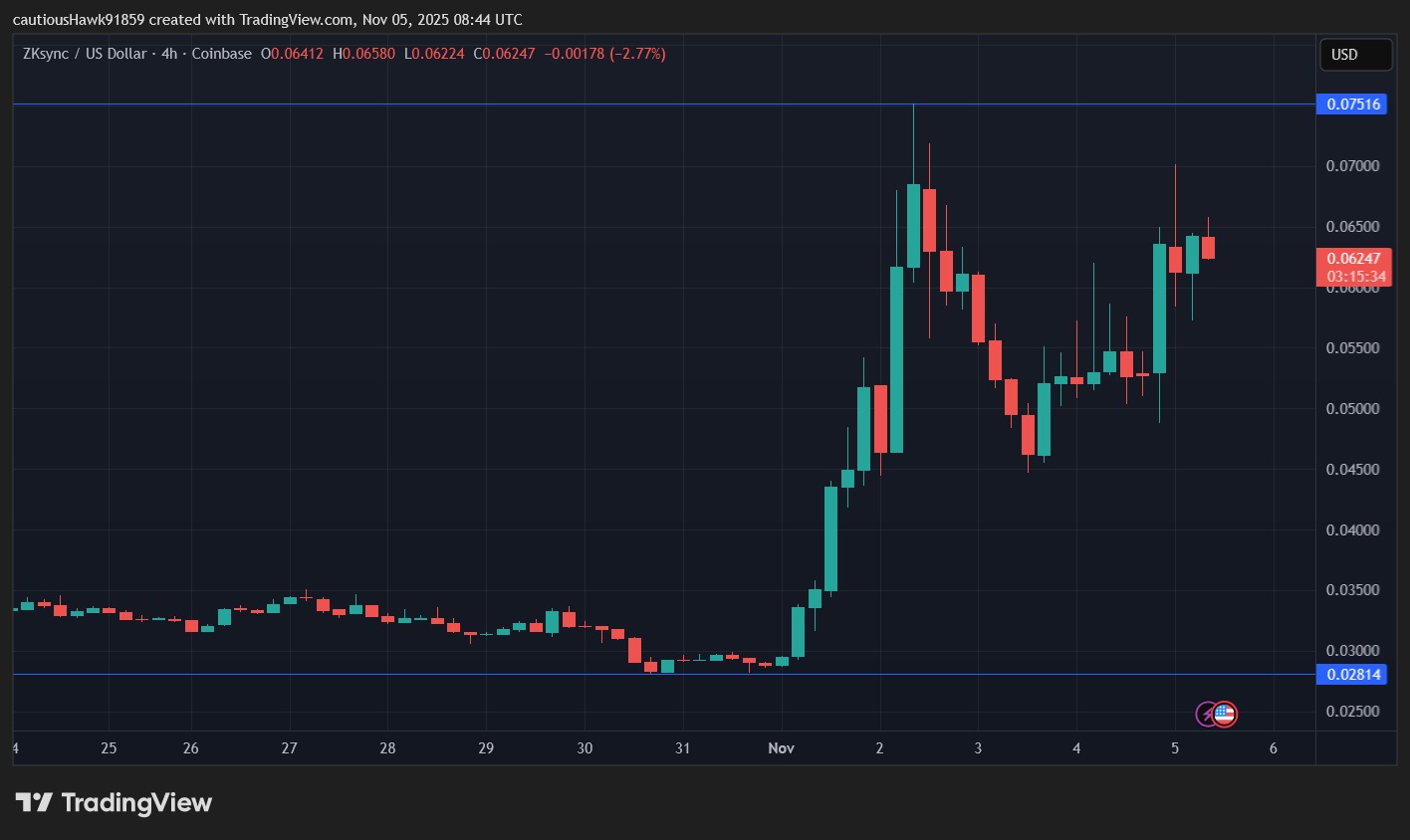
zkSync’s ZK has been surging since the start of the month
Launched in 2024, the ZK cryptocurrency had enjoyed a sustained rally in the weeks that followed, reaching $0.27 last December. But since then, the cryptocurrency associated with zkSync had fallen steadily, hitting a low of around $0.020 in October.
But the trend decisively reversed over the course of October. While ZK is still trading at a level 80% below its all-time high, there’s no denying the enthusiasm surrounding it. Why?
The Atlas Upgrade as the Catalyst for the Rally
The main reason appears to be the release of the Atlas upgrade in early November. This highly anticipated update gives zkSync a major boost. It now theoretically allows the network to process up to 15,000 transactions per second, with near-instant transaction confirmation (in about 1 second).
Furthermore, the update has drastically reduced network usage fees and transfer costs.
The other breakthrough is the concept of liquidity unification. In short, this means that L2 chains based on zkSync can now directly access Layer 1 liquidity (Ethereum, in this case), without relying on separate liquidity pools.
With much higher efficiency and capital less fragmented across pools, zkSync has experienced a growth spurt that has attracted investors, leading to this surge in the price of ZK.
New Tokenomics for ZK?
Furthermore, zkSync’s creator, Alex Gluchowski, has confirmed that he has no intention of stopping there. Yesterday, on his X account, he proposed new “tokenomics”—that is, economic mechanisms—for ZK.
Alex Gluchowski proposes implementing cross-chain fees, as well as revenue from licenses offered to businesses. According to him, this would give the token real utility. The value generated would be directed toward governance to fund buybacks, token “burns,” and staking, among other things. This is intended to support the price of ZK.
These prospects have appealed to investors, who have rushed to buy ZK this week. However, beware of a passing fad: the token’s sharp decline since its launch calls for some caution, even though zkSync appears well-positioned to lay a solid foundation.