Founded in 2017 by Kyle Samani and Tushar Jain, Multicoin Capital has established itself as one of the most influential crypto funds on the market. Its legend is built around a single bet: the Solana blockchain. But behind the success story lies a tale of obsession with performance, a resounding false start, and a rare ability to double down when everyone else is panicking. Discover the story of Multicoin Capital.
Two young graduates far from the norms of Silicon Valley
Kyle Samani and Tushar Jain met at New York University, where they studied finance between 2008 and 2012. Their arrival in the world of finance coincided with a time when Wall Street suddenly ceased to be a stable horizon: Lehman Brothers filed for bankruptcy on September 15, 2008, triggering a systemic shockwave.
Very quickly, their curiosity drew them as much to tech as to Wall Street: they followed the rise of the first major mobile apps, then moved to Austin, Texas, and each launched a startup: Pristine (Google Glass in healthcare) for Samani, and ePatientFinder (connecting patients with clinical trials) for Jain.
Samari and Jain later recount raising millions for these startups: a crucial step in their journey, both in terms of learning how to attract investors and surviving the reality of products that were too far ahead of their market.
But the bridge to Multicoin Capital and investment was not built in a snap. Their experience in entrepreneurship gave them one conviction above all: capital rewards not only ideas, but also distribution and, above all, execution. It is precisely this perspective that they would apply to blockchains a few years later.

Creating a fund by first building credibility
Multicoin Capital did not start out as one of the most prolific crypto funds. The duo describes their journey as initially opportunistic, then increasingly structured: first Bitcoin purchases in 2013, more serious immersion in Ethereum in 2016, then profit-taking and arbitrage in 2017. In other words, before becoming “VCs,” they learned about crypto as a market, with its cycles, narratives, and biases. That’s when the transition from entrepreneurship to pure investment made sense to them: after experiencing fundraising on the founders’ side, they wanted to apply the opposite approach, but with a twist specific to crypto. Multicoin Capital takes a hybrid approach: seeking returns on protocols whose tokens can become liquid faster than unlisted stocks: “venture capital economics with public market liquidity,” according to the formula found in public communications related to the fund.
The fund announced its first closing on August 1, 2017, and since they have neither pedigree nor historical network in the original crypto circles, they compensate with what they do control: the thesis.
Their credibility is built through lengthy and highly technical analyses (tokenomics, consensus design, arbitrage between architectures), intended both to convince the community and to signal to the market that they are not just playing on momentum.
First blow: EOS and the mirage of “Ethereum killers”
Multicoin’s defining obsession at the time can be summed up in one word: execution. Their intuition is simple: if a blockchain wants to support mass use, it must be fast, scalable, and “usable.”
In April 2018, Multicoin published a very favorable report on EOS, praising its high scalability and excellent user experience. The context was heated: EOS raised $4 billion through its ICO, and the idea that a serious competitor to Ethereum had been born emerged within the crypto community.
Except that the story of EOS quickly became a lesson: contested governance, perceived centralization, broken promises… The kind of disillusionment that permanently damages a young fund like Multicoin Capital, still seeking its legitimacy.
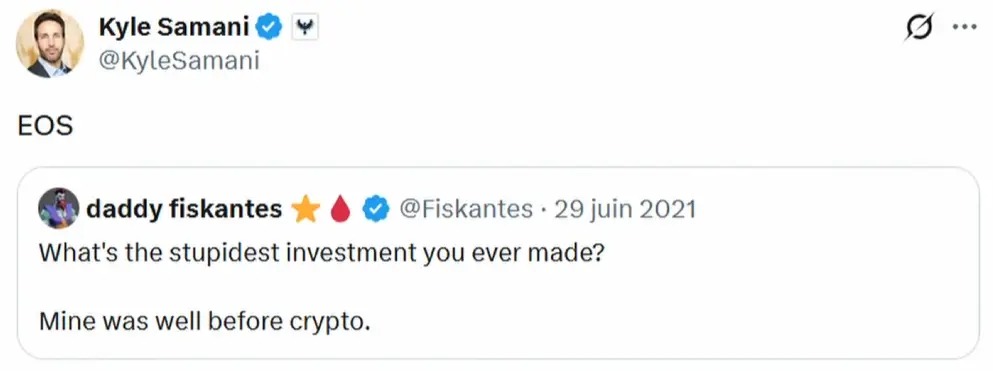
And yet, it is precisely after this failure that their trajectory becomes interesting: they do not give up on the thesis of a high-performance blockchain and continue to seek a truly credible execution.
Solana: when the thesis is finally verified
Multicoin Capital claims to have invested in the Solana blockchain since the seed round (May 2018), well before the launch of the mainnet (March 2020). This detail is important: they did not discover Solana when blockchain was in vogue, but exposed themselves very early on to a network that was still largely theoretical.
In July 2019, Solana announced that it had closed a $20 million Series A round led by Multicoin Capital. At this stage, the project put forward a simple but ambitious promise: to aim for Layer 2 performance directly on the main layer, notably via Proof of History.
This is where the narrative shifts, because participation in the seed round is not an end for Multicoin Capital: it is the starting point. Today, Solana has become one of the leading blockchains on the market (DeFi, NFTs, payments, memecoins, etc.).
Multicoin Capital’s thesis bet, namely a very fast blockchain capable of supporting large-scale use cases, is no longer a hypothesis: it has found industrial materialization with Solana.
What about the profit made by Multicoin Capital on this investment?
The exact amount of Multicoin Capital’s gains on Solana is not public, for one simple reason: a fund may have entered at several prices (seed, Series A, secondary purchases), undergone vesting/lockup periods, and, above all, sold in tranches. However, we can estimate the order of magnitude of the theoretical multiple achieved by the fund.
Legal proceedings brought by a former Solana investor and reported by Blockworks mention that during the seed sale, future rights to SOL were valued at $0.04 per unit.
From such an entry point, even without knowing the exact exit price (and even if part of it was sold well before the peak at $293), it is understandable why Solana has become the textbook case associated with Multicoin Capital: the gap between a price of a few cents and an asset that, at certain times in the market, was trading at several hundred dollars, can be measured in thousands of times (on paper).
Historical price data available on market aggregators allows us to observe these extremes, without revealing the fund’s actual performance.
The fall of FTX: loss of credibility followed by a rebound
However, the 2021–2022 era serves as a stark reminder of one brutal rule: in the crypto ecosystem, even the best theories can be distorted by market structure. When the FTX platform collapsed, the shockwave hit Solana hard, and Multicoin Capital along with it.
According to a letter to investors relayed by CoinDesk, Multicoin Capital indicated that approximately 10% of its total assets were locked on FTX. That same year, due to heavy exposure to FTT, SRM, and SOL, the fund recorded a loss of 91.4%, according to market sources based on its communications.
The interesting point is what happened next: instead of withdrawing from the market for good, Multicoin Capital maintained a “post-crisis” view that the Solana ecosystem could survive the disappearance of its main industrial supporter.
And the crypto market, buoyed by the 2023 rebound, proves them right. Indeed, The Block reports that the fund posted an exceptional performance of +537% over the year and a cumulative gain of +9,281% since 2017.
2025: the “Solana Treasury Company,” or the institutionalization of the bet
In September 2025, Multicoin Capital announced that it had co-led with Jump Crypto and Galaxy a $1.65 billion capital increase in Forward Industries to initiate a cash strategy focused on the SOL cryptocurrency.
The idea is to use Solana’s SOL to transpose a model popularized by Strategy with Bitcoin, playing on the boundary between traditional markets (access to capital) and on-chain returns (staking/network participation).
However, this type of investment vehicle remains intrinsically linked to market cycles: it can amplify both ups and downs, and exposes investors to leverage, refinancing, and volatility of the underlying asset.
What Multicoin (really) says about crypto venture capital
The story of Multicoin Capital is not just one of a good call on the Solana blockchain. It is a reminder that crypto amplifies everything. Beliefs become roller coasters, mistakes are paid for not in reputation points but in years of drawdown, and the line between fundamental thesis and market structure can collapse in a week. Multicoin built its brand on a simple idea: if crypto is to support mass use cases, then execution performance is not a luxury. Solana embodied this thesis. FTX nearly destroyed it. And the 2023–2025 sequence shows that Samani and Jain are not content with having survived: they are now trying to industrialize their bet, with investment vehicles that borrow from Wall Street.
Thus, Multicoin Capital has earned a special place in crypto history by accepting a level of volatility that most funds cannot tolerate. Time will tell whether the Solana Treasury Company is the ultimate act of rationalization or yet another risk in a market that punishes excessive certainty.