
To make the world of Why is Bitcoin (BTC) falling back to $86,000?
Overnight, the price of Bitcoin (BTC) fell again, dragging the rest of the cryptocurrency market down with it. What can we say about this new bearish trend?
Bitcoin (BTC) and cryptocurrencies stumble again
Last week, the price of Bitcoin (BTC) managed to reclaim the $90,000 level, but that attempt now appears to have failed, as the asset suffered a sharp drop overnight, briefly dipping below $86,000:
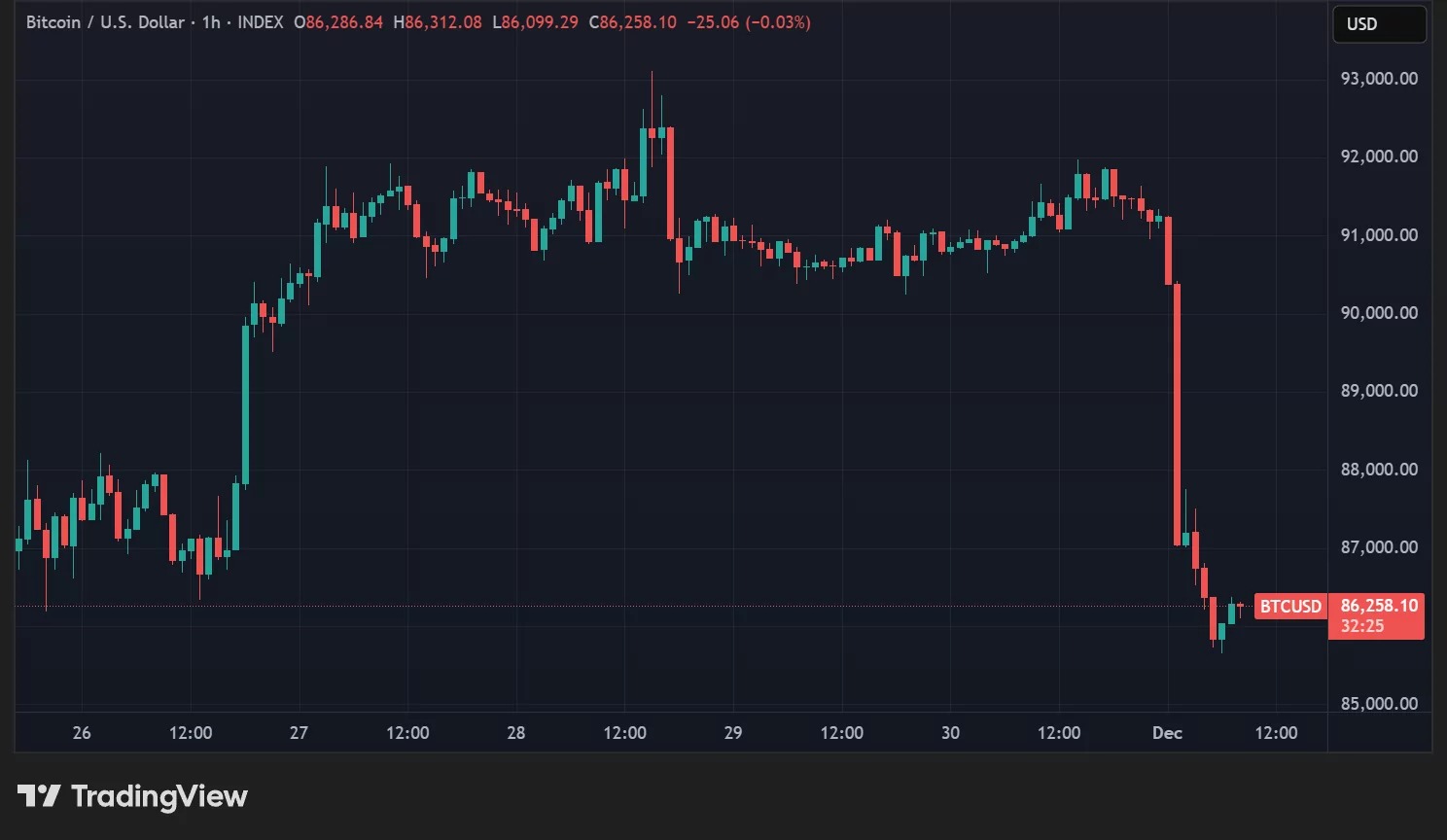
BTC price (hourly data)
At the time of this writing, one bitcoin is trading at $86,300, down 5.2% over the past 24 hours. More broadly, the rest of the cryptocurrency market is also feeling the impact, with total market capitalization down 4.9% and some of the top 10 cryptocurrencies losing more than 8%, such as ADA and DOGE:
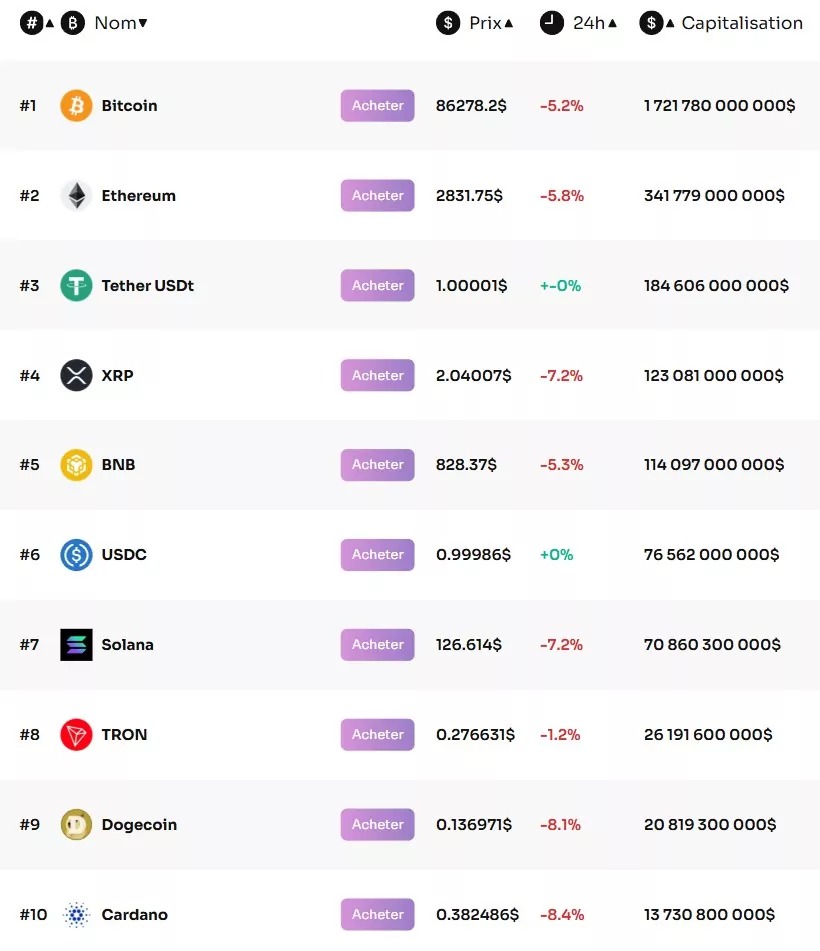
Overview of the top 10 cryptocurrencies
During every bearish (or bullish) trend, it’s common to look for reasons to explain the movement, and a few possibilities can therefore be explored.
Probable reasons for this decline
In terms of liquidations on perpetual markets, we can note $641.5 million in positions that were forcibly closed, and of this total, $567 million came from long positions. Admittedly, the amounts involved are substantial, but they are far from significant compared to what we see during waves of panic.
Last Thursday, we revisited S&P Global’s warnings regarding Tether, which further exacerbated the prevailing gloomy sentiment. Since then, Paolo Ardoino, Tether’s CEO, has pointed out that Tether still has excess liquidity relative to its liabilities—specifically, a $30 billion surplus at the end of the last quarter. At the same time, the Treasury bonds held by the company are reportedly generating $500 million in monthly profits.
On another front, Phong Le, CEO of Strategy, stated Saturday on the “What Bitcoin Did” podcast that the company could potentially sell bitcoins if its market value were to fall below its net book value and it encountered difficulties raising new capital. Nevertheless, he also clarified: “I wouldn’t want our company to sell Bitcoin.”
In addition, the People’s Bank of China reiterated its position on cryptocurrencies on Saturday, echoing that of the country’s government:
Commercial activities related to cryptocurrencies constitute illegal financial activities. Stablecoins, a form of virtual currency, currently do not effectively meet customer identification and anti-money laundering requirements, which exposes them to the risk of being used for money laundering, financing fraud, and illegal cross-border fund transfers.
However, these last three factors—though negative and potentially weighing on the overall sentiment of the ecosystem—do not seem to align with the timing of the decline, which accelerated starting at midnight Paris time.
Another explanation may lie with the Bank of Japan, as its governor, Kazuo Ueda, has hinted that rates could rise this month. In fact, the yield on 2-year Japanese bonds has now reached its highest level since 2008.
For years, the yen has depreciated against currencies such as the euro and the dollar, which has encouraged borrowing in yen to invest in foreign markets. If interest rates rise, this practice could become less profitable and lead to a repatriation of capital to Japan, which may explain the market’s fears.
However, despite Kazuo Ueda’s remarks, it’s worth noting that this possibility has been known for quite some time. Thus, if the cryptocurrency market becomes this volatile, the current downtrend could be more than just a simple correction.
DeFi Saver, a more accessible and user-friendly take on decentralized finance (DeFi), is emerging as an essential aggregation solution, offering simplified and efficient management of cryptocurrencies held within this ecosystem. This all-in-one, non-custodial, and trustless application is an indispensable tool for interacting with major DeFi protocols from a single interface. A Closer Look at DeFi Saver’s Unique Features.
What Is DeFi Saver?
Navigating the world of decentralized finance (DeFi) can be complex to understand and get started with, especially for beginners. With a multitude of concepts such as staking, liquid staking, lending, and yield farming, it’s very easy to get lost among the various protocols and tools available.
To simplify the user experience, numerous DeFi service aggregation solutions have emerged. DeFi Saver stands out as a platform that enables simple and comprehensive management of your liquidity.
This all-in-one, non-custodial, and trustless app makes it easy to manage assets and positions across decentralized finance protocols.
DeFi Saver caters to a variety of user profiles, whether they are familiar with cryptocurrencies or not. It offers access to several lending and borrowing protocols, such as Aave, decentralized exchanges (DEXs) like Uniswap, cross-chain bridges, and a variety of yield strategies.
Optimize Your Strategies with DeFi Saver
How to Improve Your Trading Experience?
If trading cryptocurrencies via DEXs is part of your daily routine, DeFi Saver’s swap aggregator could prove invaluable.
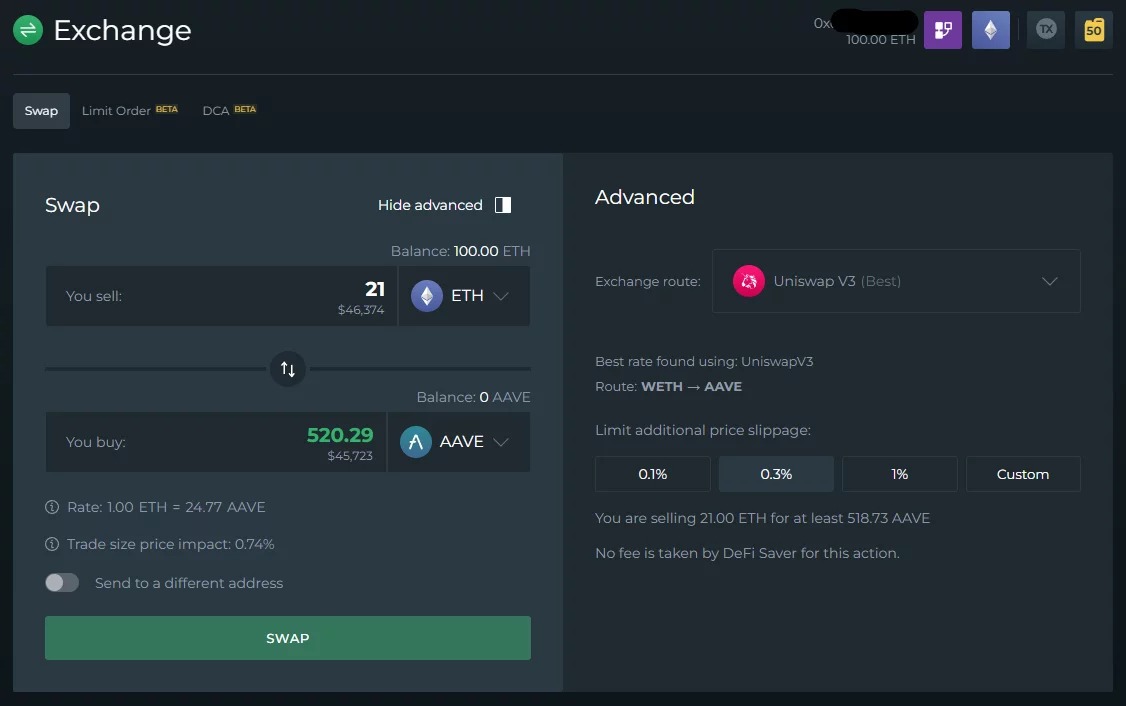
In addition to letting you swap tokens at the best rates by providing an overview of exchange rates offered by various DEXs such as Uniswap and Balancer, DeFi Saver’s Smart Exchange also lets you:
- Perform multiple swaps between various sets of tokens;
- Set limit orders to specify a price that triggers a buy or sell;
- Create a recurring investment plan, known as Dollar Cost Averaging (DCA).
How can you simplify the use of lending and borrowing protocols?
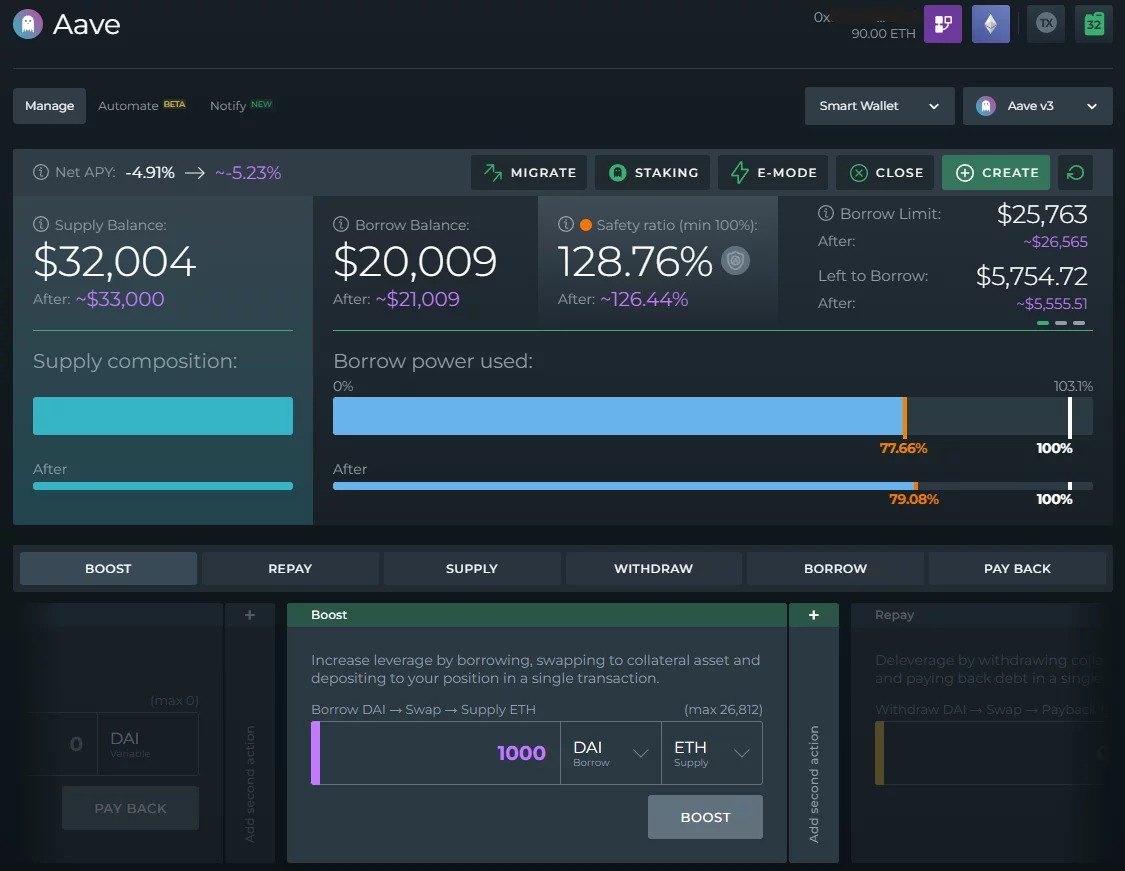
Having all these applications in one place speeds up transactions and enables automated management of your liquidity invested in DeFi.
How can you improve your asset management with the automation feature?
DeFi Saver’s automation feature is a system designed to protect and manage your collateral assets deposited on DeFi protocols. In short, it consists of a series of transactions executed simultaneously when certain conditions are met.
This feature allows you to schedule actions such as selling, buying, or transferring cryptocurrencies, triggered when an asset reaches a certain price. These automated actions, specifically designed to prevent liquidations, are DeFi Saver’s flagship feature, sought after by all DeFi enthusiasts.
DeFi Saver’s most widely used automation feature is the one dedicated to collateral management. It automatically manages your loan-to-value ratio on DeFi protocols by adjusting your position if the value of your collateral approaches your liquidation threshold. Conversely, if the value of your collateral becomes too high relative to your loan, this feature can automatically take out a new loan without any action on your part.
A major development in this automation is the introduction of the Automated Collateral Switch for Aave v3, deployed on November 27, 2025. This feature allows users to set price triggers to instantly swap their initial collateral asset for another.
For example, it is possible to schedule the swap of some or all of your ETH for USDC as soon as the price of ETH reaches a certain threshold, or vice versa. This offers significantly better risk management and position optimization, all without manual oversight.
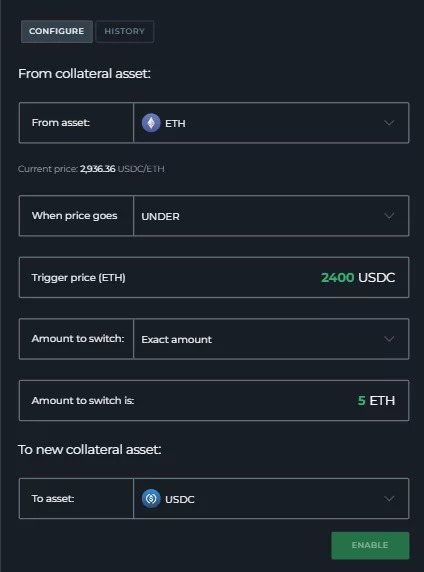
In addition, the stop-loss and take-profit options allow you to set a target price for fully closing your position. This not only serves as a safeguard against liquidations but also helps minimize losses.
The trailing stop option is designed to trigger a specific action when the price of an asset moves by a defined percentage.
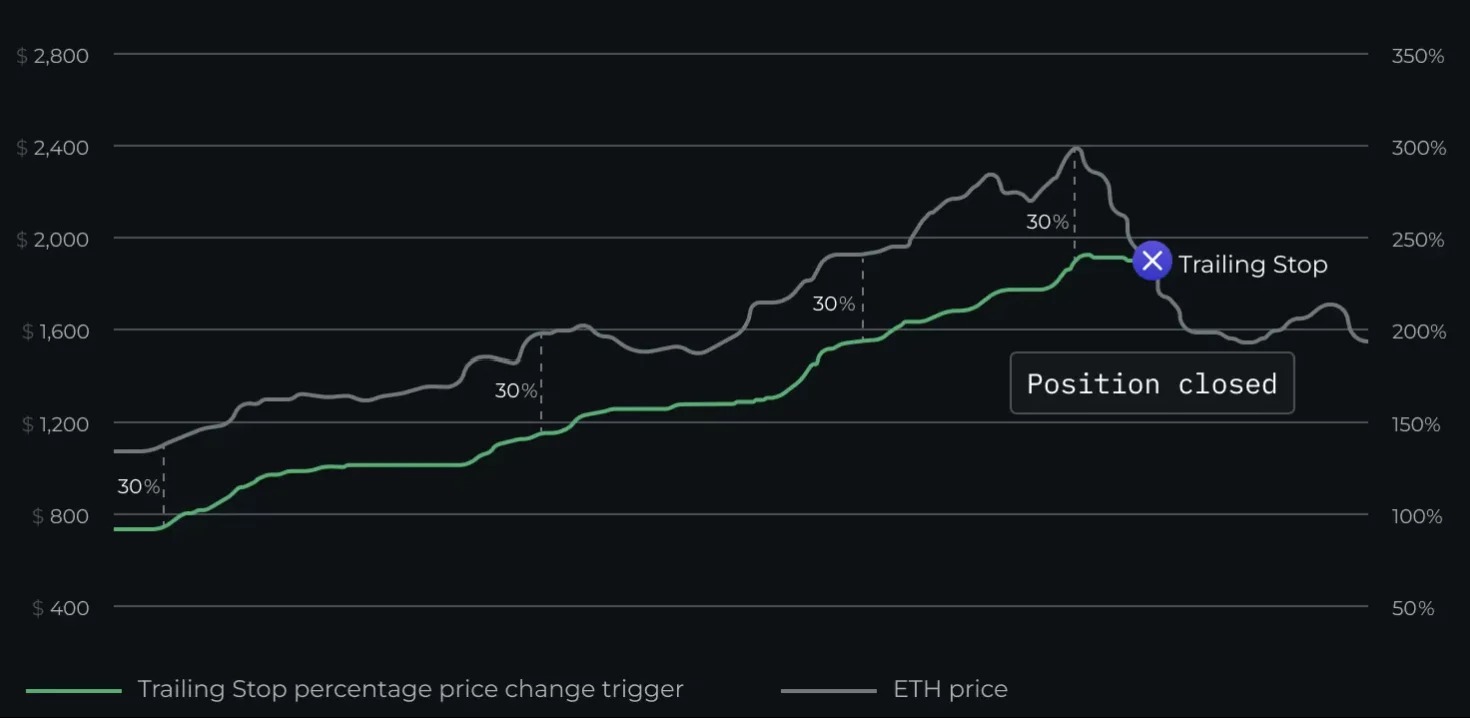
To optimize DeFi returns while protecting against liquidations, DeFi Saver’s Savings Liquidation Protection feature is ideal. It allows you to withdraw your interest-bearing assets to repay your debts if the value of your collateral drops too sharply.
Finally, the automation offered by DeFi Saver is particularly well-suited for managing DAI collateral on MakerDAO and managing obligations on Liquity.
How to Use Leverage Like a Pro?
For experienced users, DeFi Saver greatly simplifies the creation of long and short leveraged positions across lending and borrowing protocols. Additionally, the Boost option allows you to amplify these positions, while the Repay option lets you reduce them, enabling you to adjust the size of your loans and borrowings with a single click.
The Boost and Repay options are currently available for the following protocols: Maker DAO, Compound, Aave, Spark, Curve, and Liquity.
How to switch between different protocols with a single click?
If you want to quickly optimize your yields, DeFi Saver’s Loan Shifter feature lets you transfer your collateral and loans from one protocol to another with a single click.
Without this feature, each transaction to close and reopen a position would have to be done manually, which would not only be time-consuming but also more expensive in terms of transaction fees.
How can you perform multiple complex actions with a single click?
DeFi Saver’s “Recipe Creator” allows you to design sets of transactions tailored specifically to your needs. This feature incorporates a variety of transaction types, such as wrapping, buying, selling, withdrawing, depositing, repaying, borrowing, and even staking cryptocurrencies.
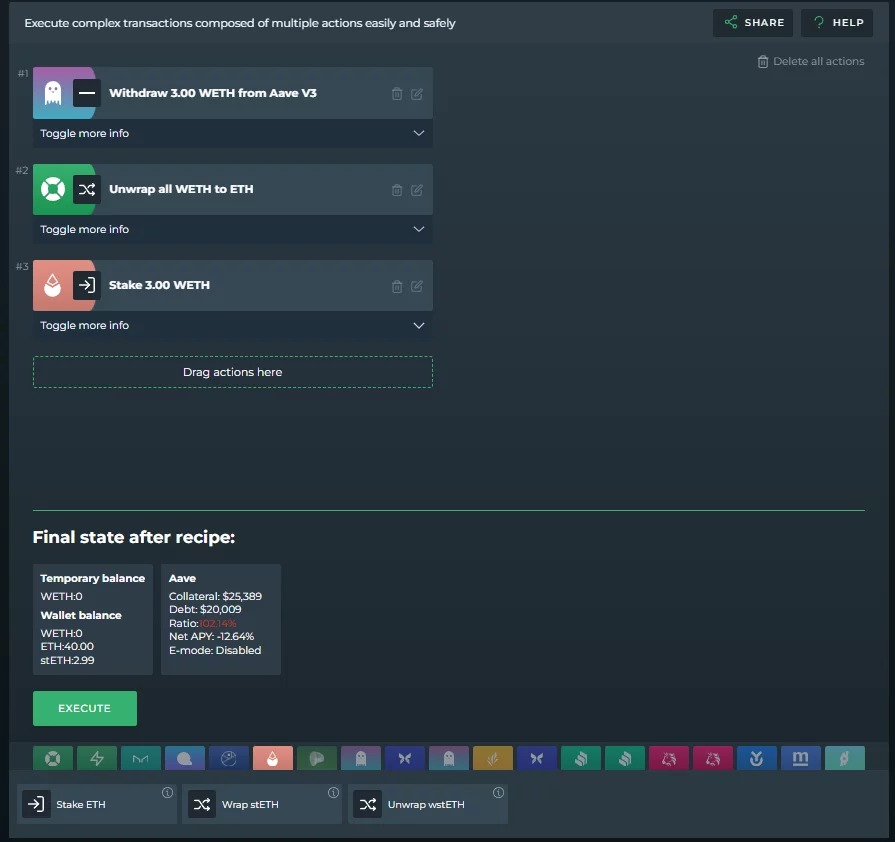
The Recipe Creator transforms DeFi into a modular building block system, much like Lego bricks, where you can create a recipe that allows you to withdraw, unwrap, and then stake Ether (ETH) with a single click.
How can you test your DeFi strategies risk-free?
All the features mentioned above can be tested and explored in DeFi Saver’s Simulation mode, a fictional environment that lets you simulate the application before performing complex transactions with real cryptocurrencies.
This mode functions as a sandbox, allowing you to experiment with all decentralized finance protocols and all the features DeFi Saver offers, without needing to connect to a real wallet.
This simulation mode provides an in-depth understanding of the app and lets you explore all its features before using it to its full potential.